

Design and Commissioning of a Precise Aeration System for a Multi-stage AAO Wastewater Treatment Plant
Overview
Wastewater treatment is a vital component of urban construction. In recent years, China's wastewater treatment industry has developed rapidly. The deep participation of wastewater treatment plants in collaborative emission reduction serves as an important support for building a low-carbon society, developing a low-carbon economy, and achieving sustainable urban development. Under the "Dual Carbon" goals, the concept of low-carbon wastewater treatment plants has attracted industry attention. To align with the development strategy of low-carbon wastewater treatment plants, it is necessary to analyze and study the key factors influencing energy conservation and emission reduction.
Most domestic wastewater treatment employs activated sludge processes. A key factor in this treatment is supplying an appropriate amount of oxygen for oxidation reactions by microorganisms in the biological tanks, making the control of aeration volume crucial. Traditional aeration control, achieved through manual switches, primarily relies on the experience of on-site operators, leading to significant uncertainty and waste. To achieve automatic control of precise aeration systems and reduce manual intervention, researchers have extensively studied aeration control methods, including fuzzy control, neural networks, fuzzy neural networks, genetic algorithms, and support vector machines. This paper focuses on the multi-stage AAO process of a wastewater treatment plant in Shenzhen, analyzing and summarizing the design and commissioning process of its precise aeration system to provide reference for similar projects.
1 System Overview
1.1 Principle of the Precise Aeration System
Biological treatment is the most important stage in the wastewater treatment process, typically aiming to remove or reduce target substances in wastewater to meet discharge standards by maintaining sustained and effective microbial growth and promoting biochemical processes. Traditional control strategies cannot timely and accurately respond to changes in operational parameters of modern wastewater treatment plants. During the initial trial operation, adjustments are often made only to blowers or to the terminal aeration pipes, failing to perform real-time, on-demand regulation of aeration volume in reaction tanks based on actual operational condition changes while achieving energy savings.
Dissolved Oxygen (DO) is a primary factor affecting the biological treatment process. The quality of DO control directly impacts wastewater treatment efficiency. The precise aeration system introduces a multi-parameter control method combining "feedforward + feedback + model," effectively addressing characteristics like large time delays and non-linearity in wastewater treatment plants. It comprehensively considers blowers, regulating valves on aeration pipelines, as well as DO and water load, to implement precise control over the biological reaction process, achieving on-demand aeration, thereby enhancing system operational stability and saving energy.
In wastewater treatment plants, feedforward signals mainly include influent flow and quality signals; feedback signals mainly include DO, mixed liquor suspended solids (MLSS), and biological tank level signals.
The DO control strategy of precise aeration systems typically has two approaches: setting the control target as a constant value or as a dynamic value.
Usually, under the strategy where the DO control target is set as a constant value, the precise aeration system calculates the required air volume for each biological tank zone and the total required air volume based on signals such as influent quality, influent flow, DO setpoint, and biological tank MLSS. It then adjusts the blower main control system and electric valves on the aeration pipes to match the air supply with the demand, thereby achieving control of the DO target value.
By adopting a precise aeration system, wastewater treatment plants can better achieve the following objectives:
(1) Reduce energy consumption per unit of wastewater treated, lowering costs.
(2) Improve the overall stability and reliability of wastewater treatment operations.
(3) Automatically adjust aeration based on treated water load and pollution load, truly achieving on-demand aeration and automatic control.
(4) Improve effluent quality and increase the compliance rate of effluent quality.
1.2 Overall Design of the Precise Aeration System
The designed treatment capacity of this wastewater treatment plant is 50,000 m³/d. It adopts a multi-stage AAO process, equipped with 2 biological tanks. The main effluent quality indicators meet Surface Water Class IV standards. The wastewater treatment process flow is shown in Figure 1.

The project has 2 biological tanks. Each biological tank is divided into 6 DO control zones, resulting in a total of 12 DO control zones for the plant's biological tanks. The design diagram of its precise aeration system is shown in Figure 2.

To achieve precise aeration, a complete control network for the precise aeration system is required. The automation communication topology of the precise aeration system is shown in Figure 3.
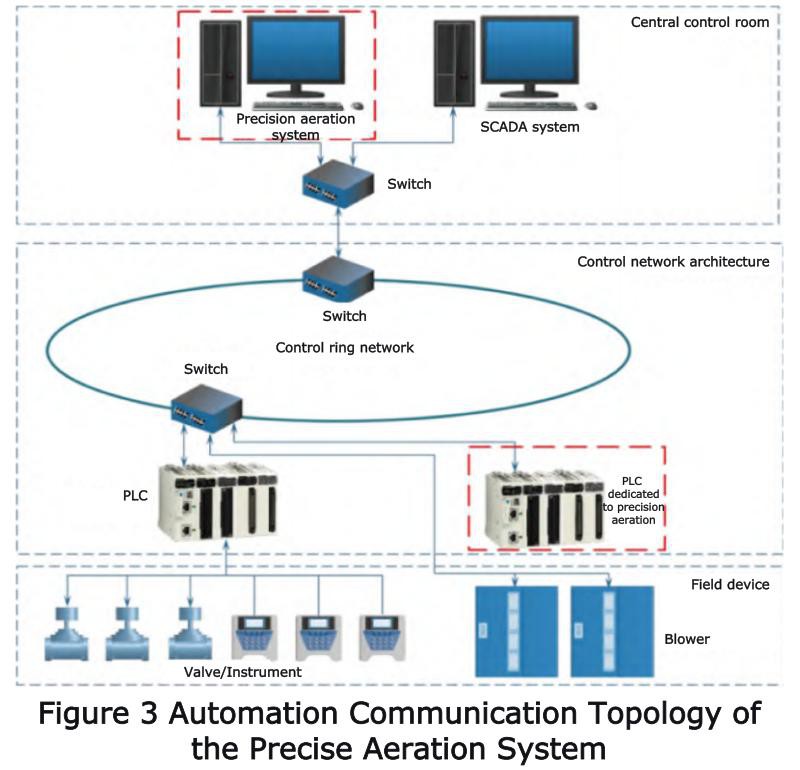
The precise aeration system master station directly obtains relevant parameters from the aeration blowers via communication, collects signals from on-site monitoring instruments, and sends control adjustment commands to equipment valves and the blower system, thereby achieving full automatic control of the aeration process and coordinated regulation of flow control valves and blowers.
1.3 Hardware Components of the Precise Aeration System
One online DO analyzer is configured for each DO control zone. One thermal gas flow meter and one electric control valve are configured on the aeration branch pipe corresponding to each DO control zone. One thermal gas flow meter and one pressure transmitter are installed on the main outlet pipe in the blower room.
The equipment and instrument configuration table for the precise aeration system is shown in Table 1.

1.4 Software Components of the Precise Aeration System
The precise aeration system software is installed and runs on the precise aeration system workstation, serving as the core processing unit of the system. Based on collected field signals, this unit calculates the biological air demand of the biological tanks through a model and simultaneously issues adjustment commands to field control devices. Functionally, it includes core modules such as the aeration volume calculation module, air distribution module, and blower optimization setting module.
The precise aeration system software is primarily designed based on the following two aspects:
(1) The precise aeration system divides the aerobic section into several independent DO control zones, capable of adapting to the requirements of the process control flow, automatically adjusting aeration flow to meet the DO distribution process conditions required by the treatment units.
(2) The precise aeration system allows users to independently set target DO levels and supports dynamic DO setpoints. Considering convenience and operability, relevant data can be viewed and configured in the central control room.
The control mechanism for precise aeration prioritizes the field, followed by the central control upper computer, mainly including valve control and blower control.
Valve control has two modes: local control mode and remote control mode. On the central control upper computer, there are two choices: manual mode and precise aeration mode.
Blower pressure control includes:
(1) When the main control cabinet enters local mode, the pressure setpoint can be manually set locally.
(2) When the main control cabinet enters remote automatic mode, pressure setting is divided into two modes: manual and precise aeration, and control switches to the central control room.
Since it possesses three control modes - full automatic control, partial automatic control, and manual forced control - and allows mode switching either on-site or in the main control room, the precise aeration system can adequately handle various situations encountered during wastewater treatment plant operation.
1.5 Functions of the Precise Aeration System
1.5.1 Air Demand Calculation
The precise aeration system can dynamically calculate the actual air demand based on changes in various factors within the biological tanks, enabling the aeration system to supply air on demand. The air demand calculation model for the precise aeration system is shown in Figure 4.

In practical applications of precise aeration control in wastewater treatment plants, the precise aeration system can calculate the actual air demand in real-time as influent flow and quality loads change, ensuring reasonable aeration that meets biochemical requirements while saving unnecessary aeration energy consumption.
1.5.2 Aeration Volume Distribution
The precise aeration system involves multiple aeration control units. The system incorporates a multi-valve decoupling control strategy to suppress interference from single-valve adjustments on other valves. It also possesses a multi-valve optimal opening control strategy, enabling rapid and optimal valve opening adjustments to achieve fast and accurate transmission and distribution of aeration volume among different aeration control units.
1.5.3 Blower Optimization Control
Energy saving in the aeration process is achieved by optimizing blower operation. The core of the aeration system is regulating blower operation based on operational parameters. On one hand, blower adjustments need to consider actual operational parameters; on the other hand, blower adjustments must also consider equipment protection. The general principle is to operate blowers under the most economical conditions while preventing abnormal blower conditions (such as surging).
The precise aeration system calculates the required air volume based on current process operational parameters and then sends the signal to the blower control cabinet. Operations like starting/stopping blowers and adjusting openings are performed based on the total air volume setpoint to meet the biological system's aeration demand, while surging protection pressure is used to protect blowers from surging. Blowers are core process equipment in wastewater treatment plants. The precise aeration system should regulate blower operation to meet the aeration demand of biological tanks while preventing blower surging.
2 Commissioning of the Precise Aeration System
To ensure the normal operation of the precise aeration system, individual devices within the system must first be commissioned one by one. Subsequently, coordinated commissioning of biological tank aeration valves and blowers is necessary, setting blower air volume and regulating pipeline pressure monitoring. During commissioning, all operations and adjustments must ensure no impact on production. Specifically, precautions for emergency blower operation should be emphasized:
(1) During short-term significant fluctuations in blower opening. This system uses magnetic bearing centrifugal blowers, which can receive setpoints sent by the precise aeration system in real-time. The blower adjusts its opening and action time based on the difference. The precise aeration system has a safety protection mechanism for blower fluctuations to prevent surging caused by fluctuations. Possible reasons for short-term significant fluctuations in blower opening include sudden changes in influent quality, mismatched system adjustment parameters, sudden changes in pipeline pressure, and biological tank instrument failures. For equipment safety, to prevent large pipeline pressure fluctuations and blower surging risks, the precise aeration system can be manually overridden and switched to manual mode.
(2) During blower surging. During initial commissioning, blower surging is sometimes inevitable. Possible reasons include insufficient coordination between valves and blowers, leading to increased pipeline pressure and surging; or unreasonable blower parameters themselves, with opening adjustments too fast, causing the blower itself to surge. When this fault occurs, the precise aeration system can be manually overridden and switched to manual mode for operation.
3 DO Control Effectiveness and Energy Saving Results of the Precise Aeration System
3.1 DO Control Effectiveness of the Precise Aeration System
The effectiveness verification of the precise aeration system for this project was primarily conducted by comparing scenarios with and without the system's intervention. Traditional control methods cannot timely and accurately respond to the impact of various disturbances. When the online controlled DO value shows large fluctuations, the variation of Dissolved Oxygen (DO) over time at a certain location in a biological tank without precise aeration is shown in Figure 5.

Compared to traditional biological tank control methods, the precise aeration control method can more accurately control the DO within the biological tank, demonstrating stronger adaptability, thereby enabling better aeration and energy saving. The trend of Dissolved Oxygen (DO) at a certain location in a biological tank with precise aeration is shown in Figure 6.

According to the trial operation results of the precise control system in this project, the probability of DO values distributed within ±0.5 mg/L of the target setpoint is 90%; the probability within ±0.3 mg/L is 30%; and the probability within ±0.2 mg/L is 20%, meeting design requirements and actual operational needs.
3.2 Energy Saving Results of DO Control with the Precise Aeration System
In the multi-stage AAO wastewater treatment plant, the precise aeration system calculates the required total air volume in real-time based on current influent flow and load during blower control. It then transmits the total air demand setpoint to the blower main control cabinet, which regulates the associated blowers according to the set target. This ensures the aeration volume meets actual demands under both high and low load conditions while reducing unnecessary aeration energy consumption. Under traditional control, blowers typically operate continuously at a relatively high power. Through the precise aeration system's control of blowers, real-time adjustment of operating power is achieved, accomplishing the goal of saving energy.
After adopting the precise aeration system, the multi-stage AAO wastewater treatment plant benefits from the normal operation of treatment equipment, accurate instrument data, stable influent flow and quality (not exceeding ±20% of design values), sufficient blower operating pressure, continuously adjustable air volume, and automatic constant pressure operation of the main control cabinet.
4 Conclusion
The application of the precise aeration system in the multi-stage AAO wastewater treatment plant aims to provide a refined operational solution for the aeration stage of the wastewater treatment process. The precise aeration system solution fully matches the plant's operating conditions, achieving precise aeration control. On this basis, the microbial biochemical environment remains stable, thereby assisting the wastewater treatment plant in achieving refined, energy-saving, and automated operation of the aeration system, consequently improving the stability of effluent quality.