


Mandarin fish (Siniperca chuatsi) is widely regarded as one of the most difficult freshwater species to farm intensively. Aggressive cannibalism, an extreme sensitivity to ammonia and nitrite, and a long-held dependence on live bait fish have kept it out of mainstream high-density aquaculture. Now a 240-day commercial-scale trial from the Chongqing Academy of Agricultural Sciences shows that a properly designed recirculating aquaculture system (RAS) - built around high-performance MBBR biofiltration - can break through those barriers. The results speak for themselves: 98.2% survival, a feed conversion ratio of 1.10, 1,911.56% weight gain, and a final stocking density of 25.6 kg/m³, all achieved on formulated feed alone.
Why Mandarin Fish Demands Better Biofiltration
A Species Pushed To Its Biological Limits
Mandarin fish are obligate carnivores with a reputation for cannibalism, and they are exceptionally vulnerable to nitrogenous waste. In a closed-loop system, every gram of feed becomes a gram of metabolic waste: uneaten protein is broken down into ammonia, then oxidized to nitrite, then nitrate. Both ammonia and nitrite are toxic to fish even at low concentrations, so the speed and reliability of the biological filter determine how many fish a tank can safely hold.
Traditional pond culture keeps stocking density low - around 1.05 kg/m³ - precisely to dilute these wastes. But low density means low productivity per hectare and limited profitability. RAS changes the equation: if the biofilter can keep nitrogen compounds near zero at high density, the entire production model shifts. This trial was run at commercial scale to prove exactly that. The system consisted of three circular tanks (4 m diameter × 1.6 m depth, 50 m³ total), designed for a maximum stocking density of 50 kg/m³.
System Design And Water Treatment Train
A Three-Stage Treatment Train Built Around MBBR
The water treatment train follows a deliberate sequence - solids first, then dissolved nitrogen, then pathogens: micro-screen filtration → MBBR biofilter → UV disinfection. Each stage protects the next, and together they keep the water fit for fish at 25.6 kg/m³.
| Component | Specification | Role In The Train |
| Micro-screen filter | Rotary drum, 200-mesh, 50 m³/h | Removes suspended solids before they reach the biofilm, protecting carrier surface area |
| MBBR biofilter | Cylindrical PP tank (1.6 m × 2.0 m), carriers at 1,200 m²/m³ | Ammonia and nitrite oxidation - the core of the system |
| UV sterilization | In-line flow-through, 240–280 nm, 50 m³/h | Inactivates pathogens as the final barrier before water returns to the tanks |
| Oxygenation | Micro-nano ceramic disc diffusers (0.5–0.8 µm), liquid oxygen supply | Maintains DO above 8 mg/L at high density and high temperature |
| Temperature control | Air-source heat pump, 21 kW heating / 11 kW cooling | Keeps the tank in the 20–28 °C band mandarin fish prefer |

The MBBR biofilter is the workhorse of the system. The carriers provide a massive protected surface area for nitrifying bacteria - at 1,200 m²/m³, roughly 50% more than the 800 m²/m³ carriers typical of wastewater MBBR installations. For an intensive aquaculture load, that extra area is not a luxury; it is the difference between ammonia accumulating and ammonia being oxidized as fast as the fish produce it.
Water Quality Performance
Ammonia Held Near Zero At 25.6 kg/m³
Table 1 summarizes water quality across the entire 240-day culture period. The most striking number is ammonia: it averaged just 0.13 mg/L - a fraction of the 0.5 mg/L danger threshold - even with 25.6 kg/m³ of fish in the tank.
| Parameter | Range | Average | Target |
| NH₃-N (mg/L) | 0.02–0.27 | 0.13 | < 0.5 |
| NO₂-N (mg/L) | 0.014–0.120 | 0.030 | < 0.1 |
| Temperature (°C) | 19.09–27.70 | 22.56 | 20–28 |
| DO (mg/L) | 8.3–10.3 | 9.13 | > 5 |
| pH | 6.52–7.60 | 7.06 | 6.5–8.5 |
That consistently low ammonia is the direct result of the high-surface-area carriers supporting dense populations of ammonia-oxidizing bacteria (AOB). Because the biofilm grows in layers, AOB at the outer surface are continuously supplied with oxygen and substrate, so ammonia oxidation keeps pace with the loading rate rather than lagging behind it.
Nitrite tells a more subtle story. The 0.030 mg/L average hides an early-phase pattern: nitrite accumulated during the first weeks as nitrite-oxidizing bacteria (NOB) established their population, then stabilized below 0.05 mg/L by day 60–90. This is why biofilm acclimation before full stocking matters - the filter must be biologically matured before the fish load arrives, or the system risks a classic "new tank syndrome" nitrite spike.
Growth Performance
From 21.6 g To 434.5 g In 240 Days
The production data in Table 2 confirm that water quality translated directly into fish performance. Over 240 days, fish grew from an average initial weight of 21.6 g to a final weight of 434.50 g - a 1,911.56% weight gain.
| Parameter | Value |
| Initial weight (g) | 21.6 ± 0.4 |
| Final weight (g) | 434.50 ± 27.74 |
| Weight gain rate (%) | 1,911.56 ± 128.47 |
| Survival rate (%) | 98.2 |
| Feed conversion ratio (FCR) | 1.10 |
| Final stocking density (kg/m³) | 25.6 |
| Condition factor (g/cm³) | 0.029 ± 0.002 |
| Viscerosomatic index (%) | 24.24 ± 4.05 |
| Hepatosomatic index (%) | 1.47 ± 0.42 |
These results decisively outperform traditional pond culture, which typically delivers 1.05 kg/m³ density, 72.26% survival, and 1.20 FCR - and they also beat earlier closed-loop RAS trials for this species. A FCR of 1.10 means the fish converted nearly every gram of formulated feed into body mass, a dramatic departure from the species' historical reliance on live bait fish. The condition factor and organ indices (viscerosomatic index 24.24%, hepatosomatic index 1.47%) confirm the fish are in good physiological shape, not merely surviving under stress.
Fish Health Assessment
Histology Confirms A Low-Stress Environment
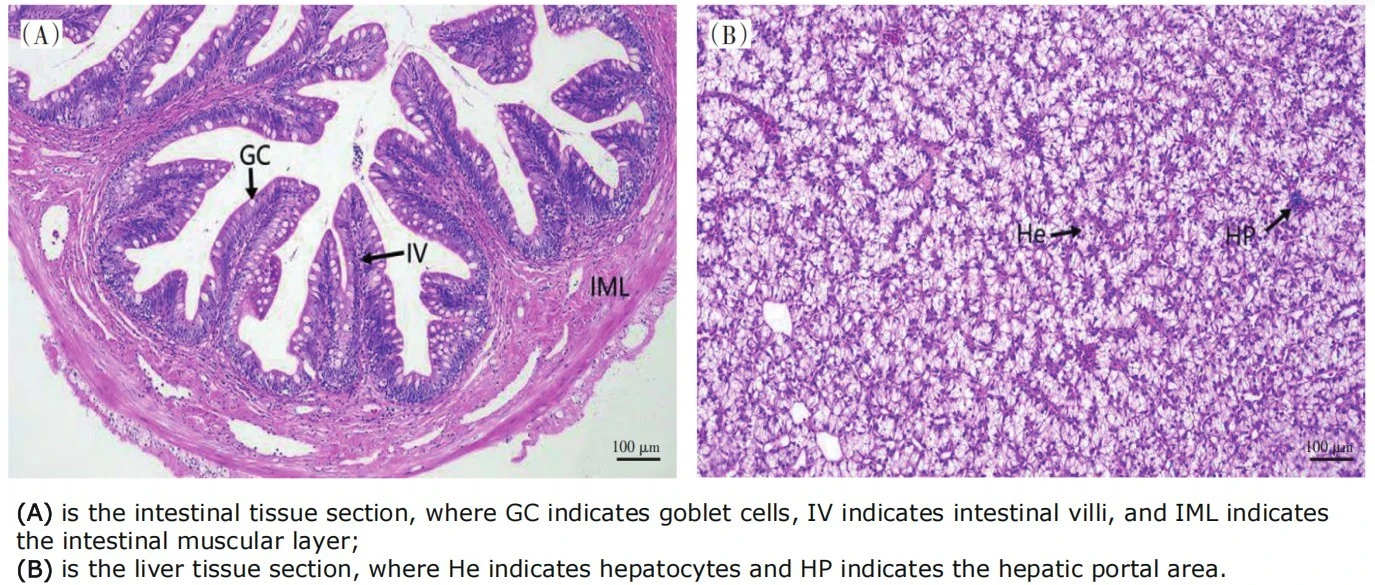
Histological examination of intestinal and liver tissue showed no pathological damage - a strong indicator that the MBBR-maintained water quality, combined with UV sterilization, created a genuinely low-stress environment. The intestinal mucosa was intact, with a villus height of 634.76 µm and villus width of 161.58 µm, indicating a healthy, well-developed gut lining for nutrient absorption.
The liver showed normal hepatic lobule structure with orderly hepatocytes and no vacuolization. This matters because chronically stressed fish typically display shortened gut villi and fat vacuolation in liver cells. The absence of both pathologies - at 25.6 kg/m³ density - is direct biological evidence that the treatment train kept the water in the fish's comfort zone for the entire 240 days.
Key MBBR Takeaways For RAS
Higher surface area carriers win at high load. Carriers at 1,200 m²/m³ provide roughly 50% more biofilm area than the typical 800 m²/m³ carriers used in municipal MBBR. For intensive aquaculture ammonia loads, that extra surface is the critical safety margin.
Biofilm acclimation time is critical. Allow 4–6 weeks for the filter to mature before full fish stocking, otherwise nitrite accumulates while NOB populations establish. The early nitrite spike in this trial was managed precisely because the operator understood this.
MBBR + UV + microscreen completes the treatment train. Solids removal, ammonia and nitrite oxidation, and pathogen inactivation are three distinct jobs. Trying to make one unit do all three is how systems fail; the cascade design here handled each task reliably.
Survival and FCR translate directly to economics. 98.2% survival and 1.10 FCR at 25.6 kg/m³ mean more marketable fish per cubic meter and significantly less feed waste - the two levers that drive RAS profitability.
RAS is a high-growth market for MBBR technology. As global aquaculture expands under tightening environmental constraints, land-based recirculating systems become the default route for growth - and every one of them needs a reliable biological filter.
Conclusion
This 240-day mandarin fish RAS trial demonstrates that, with proper design - particularly a high-performance MBBR biofilter using 1,200 m²/m³ carriers - results previously unattainable for this species are achievable: 98.2% survival, 1.10 FCR, and 25.6 kg/m³ density, all on formulated feed alone.
For MBBR suppliers, this case provides powerful, data-backed evidence that biofilm carriers - adapted for aquaculture loading rates - can be a key enabler of the rapidly growing land-based aquaculture industry. If you are evaluating MBBR media for a RAS project, reach out to discuss carrier selection, acclimation strategy, and system configuration suited to your target species and density.
98.2% Survival for Mandarin Fish in RAS
A 240-day commercial trial hit 98.2% survival and 1.10 FCR at 25.6 kg/m3 density using high-performance MBBR carriers. Ask how Juntai MBBR media can power your RAS.