

Design Requirements for Biofilters in RAS
An ideal biofilter for high-density RAS must satisfy multiple critical criteria to ensure efficient and stable operation. The system should fully utilize the media's surface area to achieve complete ammonia removal while minimizing nitrite accumulation. Optimal oxygen transfer rates must be maintained within a compact footprint, using cost-effective media that creates minimal head loss. The design should require little maintenance and avoid solid retention to prevent clogging issues.

One of the most challenging aspects of biofilter design involves accurately calculating oxygen demand to meet both the cultured species' requirements and the biofilter's operational needs. While stoichiometric calculations suggest a theoretical minimum of 0.37 kg dissolved oxygen per kg feed (with 0.25 g supporting fish metabolism and 0.12 g for nitrification), practical design considerations recommend provisioning 1.0 kg O₂ per kg feed to ensure system reliability. Field data from commercial-scale operations indicate the most efficient oxygen utilization typically occurs at approximately 0.5 kg O₂ per kg feed, representing an optimal balance between biological performance and energy efficiency.
This oxygen supply strategy must account for several factors including:

MBBR Technology and Its Advantages
The Moving Bed Biofilm Reactor (MBBR) system offers significant advantages over traditional biofiltration technologies such as trickling filters and rotating biological contactors, particularly in terms of operational and maintenance requirements. Currently, MBBR technology has been widely implemented in European wastewater treatment plants and commercial aquaculture systems of various scales.
MBBR represents an attached-growth biological treatment process that operates continuously as a low-headloss, non-clogging biofilm reactor. This system features high specific surface area for biofilm growth without requiring backwashing. In MBBR systems, bacterial cultures develop on specialized carrier media that move freely within the reactor volume. The reactor configuration can maintain either aerobic conditions for nitrification through diffused aeration or anoxic conditions for denitrification using submerged mechanical mixers.
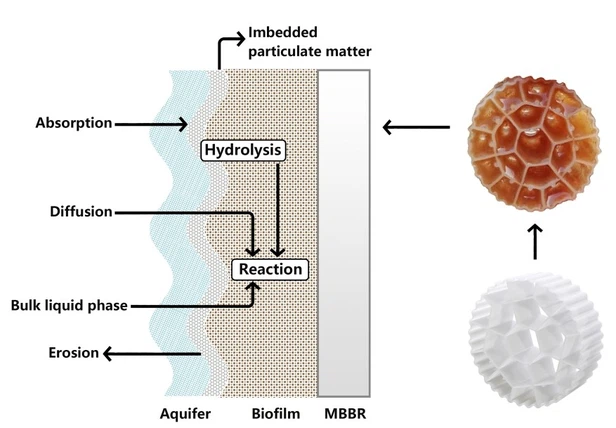
The carrier media typically occupies 50-70% of the reactor volume, as higher filling ratios may impede proper mixing. Retention screens - including vertical bar racks, rectangular mesh screens, or cylindrical sieve arrangements - prevent media loss while allowing water flow. The most commonly used carrier media (MBBR04/K1 type) consist of high-density polyethylene (density 0.95 g/cm³) formed into small cylinders with internal cross structures and external fin-like protrusions. While various media designs exist, all share the essential characteristic of providing protected surface areas for biofilm development. Continuous media movement within the reactor creates a self-cleaning effect that prevents clogging and promotes controlled biofilm sloughing. As an attached-growth process, MBBR treatment capacity directly correlates with the total available media surface area.
Key Operational Characteristics:
Typical media filling ratio: 50-70% of reactor volume
Standard media density: 0.95 g/cm³ (HDPE construction)
Hydraulic retention time: 1-4 hours depending on load
Surface area loading rate: 5-15 g NH₄⁺-N/m²·day
Oxygen requirement: 4.3 kg O₂/kg NH₄⁺-N oxidized
Case Study Design and Calculations
System Overview
This design example illustrates the MBBR biofilter sizing for a 500-ton annual production RAS. Key production parameters for each culture stage are provided in Tables 1-1 and 1-2.
| Table 1-1 Initial and final body weight/length of cultured fish at three growth stages | ||||
| Initial weight & size |
Final weight & size |
Final tank biomass per unit |
Daily final feeding ration |
|
| Fry production | 50 g | 165 g | 2195 KG | 61.7 KG |
| 13.4 cm | 19.9 cm | |||
| Fingerling | 165 g | 386 g | 5134 KG | 109 KG |
| 19.9 cm | 26.4 cm | |||
| Market-size fish | 386 g | 750 g | 9827 KG | 170 KG |
| 26.4 cm | 32.9 cm | |||
| Table 1-2 Final stocking density and tank specifications for three culture stages | ||||
| Fish density (kg/m³) |
Tank volume (m³) |
Tank depth (m) |
Tank diameter (m) |
|
| Fry production | 82.9 | 26.5 | 1 | 5.8 |
| Fingerling | 110 | 46.6 | 1.2 | 7 |
| Market-size fish | 137 | 72.8 | 1.5 | 7.9 |
Design Methodology
The MBBR design follows a simplified approach when the TAN (Total Ammonia Nitrogen) removal efficiency is known, based on:
- Fixed reactor volume
- Media type characteristics
- Hydraulic loading
- TAN removal rate
- Operating temperature
The required total biofilm surface area (Amedia, m²) is calculated from:
- MBBR TAN loading rate (PTAN kg/day)
- Estimated nitrification rate (rTAN, g/(m²·day))
The bioreactor volume (Vmedia, m³) is then determined by:
Vmedia = Amedia/ SSA
where SSA = specific surface area of media (m²/m³)
Reactor geometry is optimized based on height-to-diameter (H/D) ratios.
Design Procedure
Step 1: Calculate Oxygen Demand (RDO)

Where:
- aDO = 0.25 kg O₂/kg feed
- rfeed = 0.0173 kg feed/kg fish/day
- ρ = stocking density (137 kg/m³)
- Vtank = tank volume (72.8 m³)
Step 2: Determine Water Flowrate (Qtank)
Assuming:
DOinlet = 14.2 mg/L (50% O₂ saturation)
DOtank = 5 mg/L (28°C)

Where
- Qtank = 3,250 L/min
Verify whether the hourly tank exchange rate meets effective solids removal requirements:

If necessary, it can be reduced (e.g., to 2 exchanges/hour), depending on tank hydraulics and solids removal efficiency.
Step 3: Calculate TAN Production (PTAN)

Where
- Rfeed = 170 kg feed/day
- aTAN = 0.032 kg TAN/kg feed
- PTAN = 5.44 kg TAN/day
Step 4: Determine Media Volume
Using volumetric TAN removal rate (VTR):

- Warm water (25-30°C): 605 g/m³/day
- Cold water (12-15°C): 468 g/m³/day (at 1-2 mg/L TAN)
Step 5: Size Bioreactor
Key parameters:
- H/D ratio: 1.0-1.2 (optimized for mixing/aeration)
- Max diameter: ≤2 m
- Media fill ratio: 60-70%
For this case:

- Required volume: 5.0 m³ at 60% fill
- Dimensions:
- Height: 1.83 m
- Diameter: 1.83 m
- Total height: 2.1 m (including freeboard)

Get MBBR Design & Calculation for Your RAS