

Retrofit and Performance Study of Fine-Bubble Aeration System in a Municipal Wastewater Treatment Plant
Introduction
At present, the main wastewater treatment processes used in China include oxidation ditch, SBR, activated sludge, and others. The oxidation ditch process has the problem of high energy consumption, especially in the biological section, which accounts for 65%–80% of total energy consumption. Common aeration equipment used in oxidation ditch processes includes aeration brushes, aeration discs, vertical shaft aerators, and fine-bubble aerators. For example, after a municipal wastewater treatment plant in a certain city changed from traditional surface mechanical aeration to bottom fine-bubble aeration, energy consumption decreased by 20.11%, while treatment water quality became more stable. In addition, fine-bubble aeration has the characteristic of zoned oxygen supply, which can provide precise oxygen supply according to the oxygen demand in different areas of the oxidation ditch, further improving nitrogen and phosphorus removal efficiency.
The surface aeration system at a certain municipal wastewater treatment plant had been in operation for over ten years, with serious equipment aging and operational difficulties. It was difficult to meet the latest discharge standards, making technical renovation urgent. This project upgraded the system to a fine-bubble aeration system, which can significantly reduce energy consumption, optimize operation, extend equipment life, and reduce maintenance costs, aligning with national energy conservation and emission reduction policies. This renovation project implemented green construction practices during equipment dismantling and installation: classified recycling of old equipment, adoption of prefabricated installation, and use of low-noise, low-emission machinery, achieving "process-construction" dual-dimensional energy savings and supporting the sustainable development of the wastewater treatment plant.
1 Project Overview
1.1 Current Situation
A municipal wastewater treatment plant in a certain city has a total capacity of 50,000 tons/day, constructed in three phases. Phase I adopted the oxidation ditch process, Phase II and the advanced treatment project also adopted the oxidation ditch process, with subsequent advanced treatment using coagulation sedimentation + cloth media filtration + ultraviolet disinfection process. Phase III adopted the modified A²O process. Currently, the effluent meets the DB32/1072-2018 standard.
1.2 Existing Problems
1.2.1 External Pipe Network Impact
The wastewater within the collection scope of this plant's pipe network includes contributions from many industrial enterprises. During daily operation, there can be impacts from abnormal wastewater from industrial enterprises, causing the DO value in the biological tank to become very low, even reaching 0 mg/L, failing to meet production requirements. Meanwhile, due to changes in external conditions, as more industrial enterprises within the service area discharge wastewater into the pipe network, this plant will face more severe influent water quality in the future. Once influent fluctuates, dissolved oxygen in the biological tank will decrease significantly, and the adjustment range of aeration volume from the rotating discs is limited. In some periods, the DO in the aerobic tank reaches 0 mg/L, forcing the plant to reduce treatment capacity in response, significantly impacting the aerobic environment of the biological tank and treatment capacity.
1.2.2 Low DO in Aeration Tank
Due to rotating disc malfunctions causing low oxygenation efficiency of aerators, during actual production operation, historical operating data shows that the average DO values from instruments in the middle and outlet of the aeration tank do not exceed 1 mg/L, with the lowest reaching 0 mg/L, severely affecting biochemical reaction effectiveness.
1.2.3 High Energy Consumption
The Phase I and II biological tanks of this plant are in oxidation ditch form. Phase I oxidation ditch uses 8 rotating disc aerators with power of 18.5 kW, with total surface aerator power of 148 kW. Phase II oxidation ditch is a four-channel Carrousel ditch type, using 13 Hitachi self-priming aerators, including 2 sets of 11 kW, 2 sets of 18.5 kW, and 9 sets of 15 kW, with total surface aerator power of 194 kW. Under normal operation, to ensure sufficient water volume, due to the low oxygenation efficiency of the existing oxygen supply equipment, all aerators must be fully turned on.
The power consumption per ton of water for Phase I and II aerators is: (18.5 kW*7+194)*24*0.75/25,000 = 0.2392 RMB/ton. Based on a survey of biological system power consumption at several surrounding municipal domestic wastewater treatment plants, the energy consumption for a 25,000 tons/day municipal domestic wastewater plant using a bottom fine-bubble aeration system is generally 0.09–0.1 RMB/ton. The energy consumption of the rotating disc aerator is 2.4–2.7 times that of the bottom fine-bubble aeration system, indicating relatively high energy consumption.
1.2.4 High Equipment Failure Rate
As rotating disc aerators age, equipment failure rates gradually increase. After 11 years of operation at this plant, the rotating disc aeration system developed disc deformation, causing high equipment load and significant vibration. Long-term use led to bottom loosening, resulting in misalignment at both ends and other problems, causing increased bearing wear and high failure rates. Main shafts, impellers, couplings, and base gears have undergone multiple repairs or replacements, essentially reaching the point of replacement. The bearings and aerator head blades of the self-priming aerators were severely worn. Recent statistics show that the plant experienced nearly 30 repairs annually for rotating disc aerators and self-priming aerators.
2 Design of Retrofit Technical Solution
The overall retrofit approach is: remove the original rotating disc aerators and replace them with bottom fine-bubble aeration, with corresponding addition of blowers; raise the effluent weir of the biological tank to increase the effective water depth of the biological tank; add mixers in the aerobic section using the original channel structure to prevent localized sludge accumulation.
2.1 Aerator Selection and Layout
2.1.1 Aerator Disc Parameters
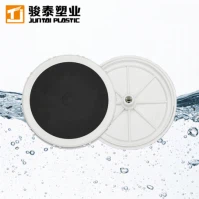
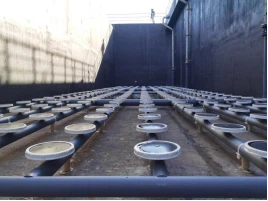
EPDM membrane aerator disc model DD330 was selected, as shown in Figure 1, with specific parameters shown in Table 1.
| Table 1 – Diffuser Parameters | |||||
| Size (mm) | Service Area (m²) |
Air Flow Rate (m³/h) |
Bubble Diameter (mm) |
SOTE (%) | Resistance Loss (kPa) |
| Φ330 | 0.4–1.7 | 2.5–10.0 | 0.8–2.0 | 34–39.5 | 2.0–4.3 |
2.1.2 Aerator Disc Layout
Number of aerator discs: Phase I tank bottom net area 864 m², Phase II tank bottom net area 1,412 m², average service area 0.8 m²/disc, with a safety factor of 1.05–1.10. The final total number of aerator discs determined: Phase I 1,150 discs, Phase II 1,900 discs.
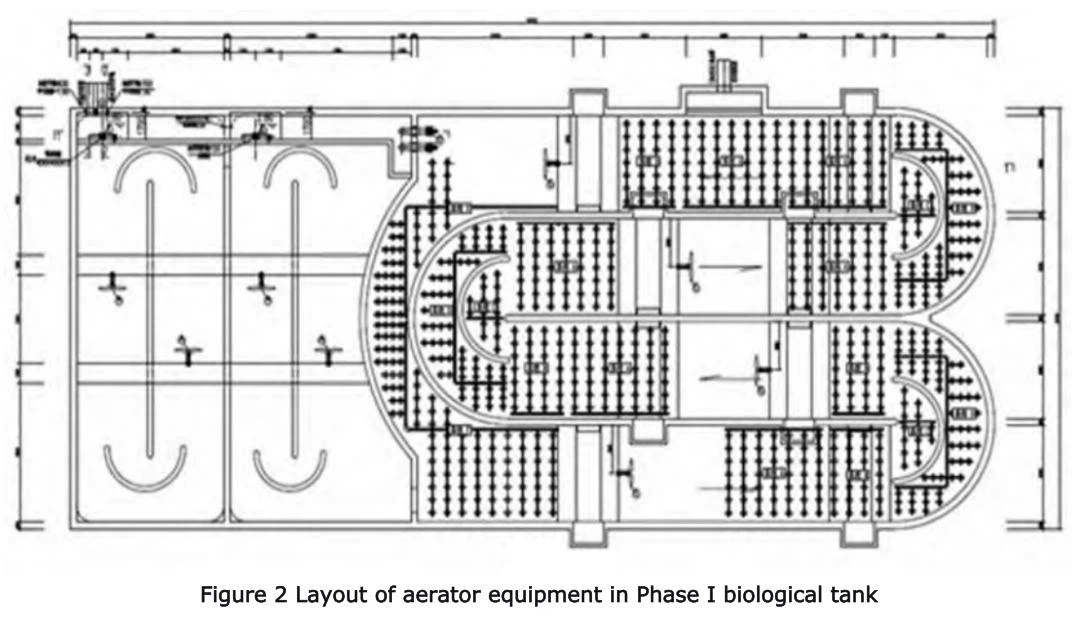
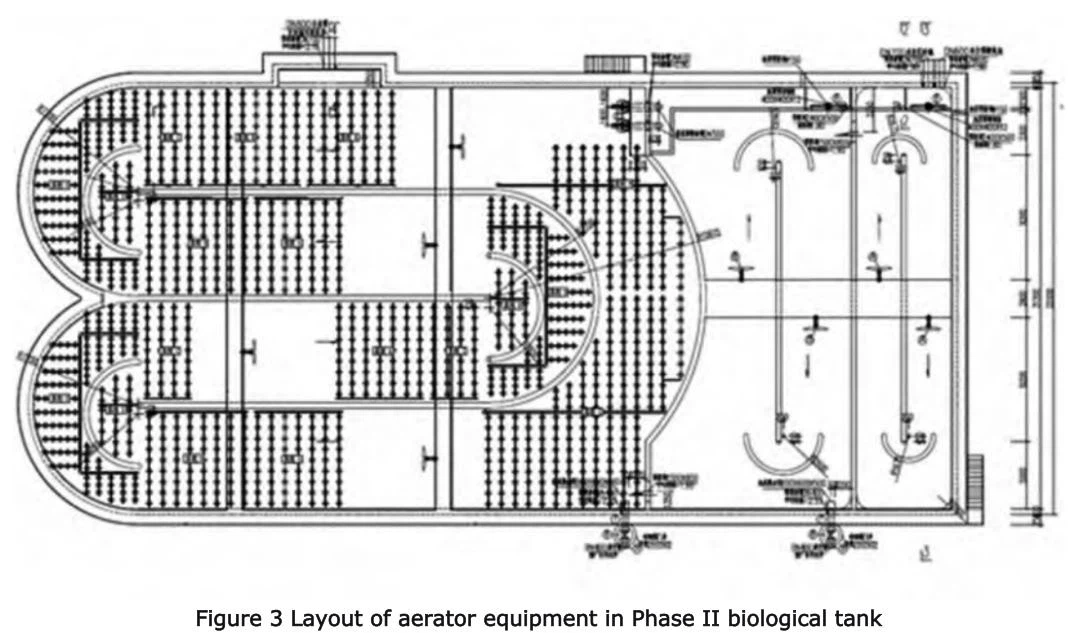
Layout principle: Evenly distributed in a regular triangular grid pattern. Clearance from tank wall ≥0.3 m to avoid dead zones; clearance from channel partition wall ≥0.4 m to facilitate maintenance. Partition along the water flow direction, with one electric air control valve per zone to achieve DO zonal control. Avoid sludge pump suction ports, sampling troughs, and cable trays, locally adjusting spacing to 1.5 m while maintaining service area per disc ≤0.8 m².
Installation height and pipe grading: The top surface of the membrane disc is 0.25 m from the tank bottom, ensuring submersion ≥5.0 m at minimum water level to prevent fan surge. Branch pipes use ABS DN50 with perforated air distribution; main pipes are arranged in a loop, with air velocity controlled at 10–12 m·s⁻¹, material SS304. A pair of flange quick-connect fittings is provided for every 10 discs, allowing overall lifting for maintenance without draining the tank.
2.2 Blower System Optimization
2.2.1 Adding Blowers
Imported air suspension blowers were purchased as the main units, and a new blower room was constructed with stainless steel air ducts added.
2.2.2 Blower Selection
Based on the actual operating conditions of the plant and considering future water quality changes, the influent COD concentration in the retrofit plan is not significantly different from the design value, with an average concentration of about 320 mg/L. BOD concentration was calculated based on the Phase III design value of 150 mg/L, and other influent indicators were calculated based on Phase III design influent concentrations. The required operating air volume for Phase I and II of the plant is 103.7 m³/min (6,225.1 m³/h, two duty units and one standby, single unit air volume 50 m³/min).
Comprehensively considering various factors, two imported air suspension blowers NX75-C060 were purchased as the main units for Phase I and II. A new blower room needed to be constructed, tentatively located on the south side of the original sludge dewatering workshop, with stainless steel air ducts added to the oxidation ditch. Blower parameters: air pressure 0.049 MPa, air volume 50 m³/min, with maximum output power of 64.3 kW under these operating conditions.
2.2.3 Aeration System Retrofit
The aeration method was changed to bottom aeration. Phase I and II biological tanks use corresponding numbers of disc aerators and UPVC aeration pipes. Specific retrofit approach: Phase I biological tank is expected to use 780 sets of DD330 disc aerators and UPVC aeration pipes, Phase II biological tank is expected to use 1,276 sets of DD330 disc aerators and UPVC aeration pipes, with single aerator operating air volume of 3.45 m³/h. The aerator head layout is shown in Figures 2 and 3.
2.3 Process Parameter Optimization
2.3.1 Oxidation Ditch Zoning and DO Control Strategy
Along the water flow direction of the oxidation ditch, the aeration section is divided into four zones. Zone 1: DO 0.3–0.5 mg/L, Zone 2: DO 0.2–0.3 mg/L, Zone 3: DO 1.5–2.0 mg/L, Zone 4: DO 1.0–1.5 mg/L. An ammonia nitrogen process instrument is installed at the point of highest nitrification reaction rate between Zone 2 and Zone 3, ultimately controlling effluent NH₃-N ≤1.5 mg/L.
2.3.2 Aeration Period Optimization
An "intermittent aeration" module was added to the existing SCADA system, forming a DO online instrument + time dual closed loop to ensure DO in the middle of the aerobic section remains at 0.2 mg/L. If DO <0.2 mg/L at the end of the air-off period, an additional 5 minutes of micro-aeration is automatically added (to protect mixers). After the cycle count reaches 12 times (6×24/120=12), the blower is forced to rest for 30 minutes (to prevent overheating from frequent start-stop cycles).
3 Retrofit Effect Analysis
The impact of this engineering retrofit on overall process operation was examined by comparing changes in effluent pollutants before and after the retrofit.
3.1 Comparison of Effluent Water Quality Before and After Retrofit
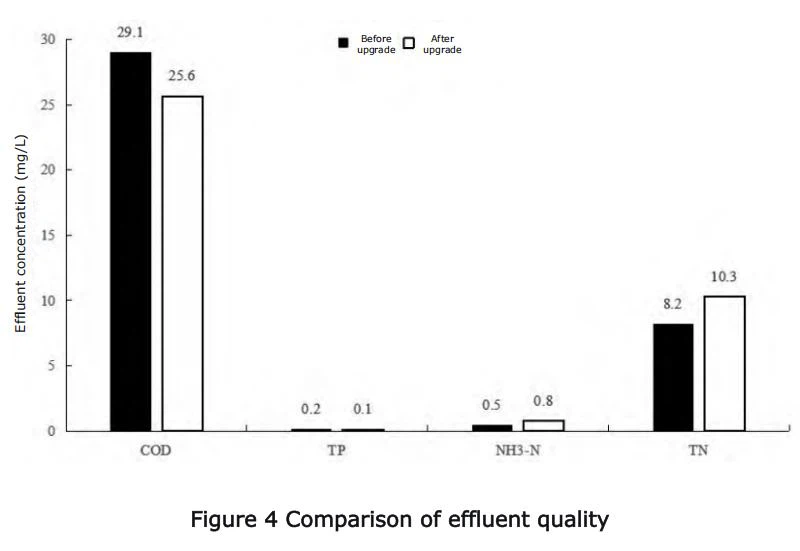
Effluent water quality before and after retrofit tended to be stable, as shown in Figure 4. Before and after retrofit, average effluent COD remained below 30 mg/L, TP basically remained ≤0.3 mg/L, NH₃-N ≤1.5 mg/L, while TN fluctuated around 10 mg/L. Overall water quality reached quasi-Class IV surface water standards, far exceeding the discharge standards required for the plant.
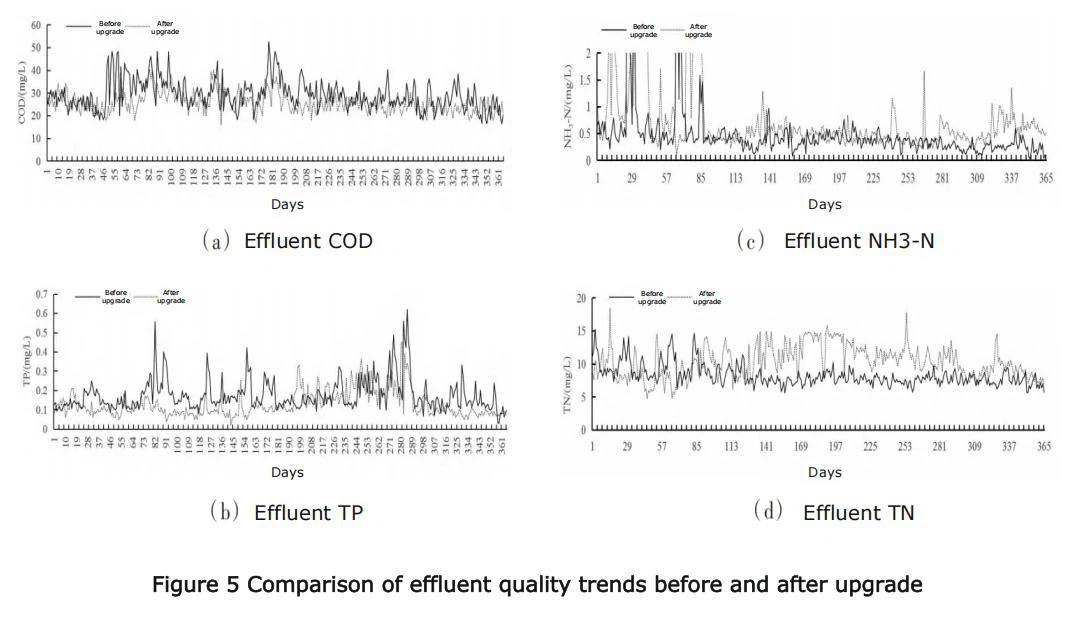
To more intuitively analyze the possible impact of the retrofit on water quality, the one-year effluent water quality trends before and after retrofit were compared, yielding Figure 5. It can be seen from the figure that, without considering the impact of influent concentration changes, the fluctuations in COD and TP effluent concentrations after retrofit were more stable than before retrofit. Although the average values of nitrogen indicators increased compared to before retrofit, the overall trend was relatively stable, resulting in lower overall plant energy consumption and chemical savings.
3.2 Comparison of Pollutant Removal Before and After Retrofit
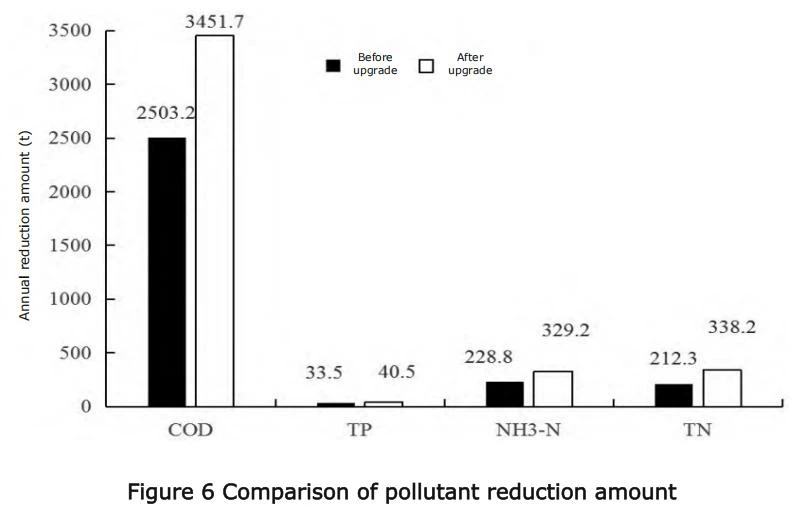
Due to the improvement in the aeration system, overall plant electricity consumption decreased by 1.7% compared to before, while treatment capacity increased by 8.33%, and corresponding pollutant reduction also increased, as shown in Figure 6. After calculation, COD reduction increased by 948.5 tons, TP increased by 7.0 tons, NH₃-N increased by 100.4 tons, and TN increased by 125.9 tons.
Actual pollutant removal also changed accordingly, as shown in Table 2. After retrofit, except for a decrease in NH₃-N removal rate, removal rates for all other indicators increased.
| Table 2 – Comparison of Pollutant Removal Efficiency | ||||
| Parameter | COD | TP | NH₃-N | TN |
| Removal rate before upgrade (%) |
83.89 | 92.10 | 96.77 | 61.04 |
| Removal rate after upgrade (%) |
88.25 | 94.56 | 95.98 | 64.69 |
| Increase rate (%) | 4.36 | 2.46 | –0.80 | 3.65 |
3.3 Energy Consumption Comparison Before and After Retrofit
The energy consumption of this retrofit project is shown in Table 3. After retrofit, the power consumption per ton of water for the Phase I biological tank aeration system decreased by 67.3%, and for Phase II decreased by 80.9%. The overall plant average power consumption per ton of water decreased by 55.3%, demonstrating significant energy-saving effects. The overall plant power consumption per ton of water decreased to 0.21 kW·h/m³, within the range of energy consumption values for similar oxidation ditch processes nationwide (0.292±0.192) kW·h/m³. The power consumption per unit weight of pollutant before and after retrofit for the overall plant is shown in Table 4. After retrofit of the overall plant aeration system, power consumption per 1 kg of COD treated decreased by 26.2%, per 1 kg of TP treated decreased by 15.7%, per 1 kg of NH₃-N treated decreased by 29.3%, and per 1 kg of TN treated decreased by 36.1%, showing good energy-saving effects.
| Table 3 – Comparison of Energy Consumption Before and After Upgrade | |||
| Item | Phase I Biological Tank | Phase II Biological Tank | Whole Plant |
| Energy consumption before upgrade (kWh/m3) | 0.26 | 0.33 | 0.42 |
| Energy consumption after upgrade (kWh/m3) | 0.09 | 0.06 | 0.21 |
| Reduction rate (%) | 67.30 | 80.90 | 55.30 |
| Table – Energy Consumption per Unit Mass of Pollutant Removed | ||||
| Parameter | COD | TP | NH₃-N | TN |
| Energy consumption before upgrade (kWh/kg) |
1.79 | 133.52 | 19.58 | 21.10 |
| Energy consumption after upgrade (kWh/kg) |
1.32 | 112.55 | 13.85 | 13.48 |
| Reduction rate (%) | 4.36 | 15.70 | 29.30 | 36.10 |
3.4 Chemical Comparison Before and After Retrofit
Before retrofit, due to frequent aeration system failures, DO in the biological system was difficult to control, and meeting nitrogen indicator standards required external carbon source addition to ensure removal effectiveness. After retrofit, external carbon source addition was basically no longer needed. After retrofit, biological phosphorus removal and denitrification efficiency significantly improved, and accompanying phosphorus removal chemical PAC and sludge dewatering chemical PAM were correspondingly reduced. Annual chemical costs decreased by about 167,000 RMB compared to before. Specific changes are shown in Table 5.
| Table 5 – Comparison of Chemical Consumption Before and After Upgrade | ||||||
| Item | PAC Consumption (g/t) |
Phosphorus Removal Agent Cost (CNY) |
Carbon Source Consumption (g/t) |
Carbon Source Cost (CNY) |
PAM Consumption (g/t) |
PAM Cost (CNY) |
| Before upgrade | 7.79 | 630,256 | 2.32 | 39,200 | 0.321 | 37,200 |
| After upgrade | 5.9 | 514,079 | 0 | 0 | 0.058 | 25,400 |
| Saved | 1.89 | 116,177 | 2.32 | 39,200 | 0.263 | 11,780 |
3.5 Investment Comparison Before and After Retrofit
Before retrofit, the annual cost for surface aerators was 1.6281 million RMB, with annual equipment repair costs of no less than 250,000 RMB. After retrofit, the annual cost for blowers and mixers was 714,600 RMB. Based on this calculation, annual electricity cost savings were 913,500 RMB, plus annual repair cost savings of 250,000 RMB, totaling annual savings of 1.1635 million RMB. Based on a total investment of 3.704 million RMB, the payback period is 3.18 years.
3.6 Process Stability
Before retrofit, during periods of malfunction, dissolved oxygen in the biological tank was mostly maintained below 1.0 mg/L. After retrofit, dissolved oxygen in the biological tank averaged 1.5–2.0 mg/L. Depending on influent concentration and process requirements, the dissolved oxygen adjustment range can be 1.0–2.5 mg/L. When influent concentration is high, normal dissolved oxygen levels in the biological tank can also be maintained by adjusting blower output. Therefore, after retrofit, stable effluent compliance conditions are satisfied.
4 Conclusion
Before technical renovation, this plant faced common problems with the oxidation ditch process: aging rotating discs → attenuation of oxygenation efficiency → insufficient DO, along with skyrocketing energy consumption and failure rates. Replacing them with a bottom fine-bubble aeration-mixer-blower system can reversely amplify the oxygen mass transfer coefficient, increase HRT in section A, and improve zonal oxygen supply precision, simultaneously enhancing denitrification without adding carbon sources. For similar plants: any oxidation ditch that has been in operation for ≥10 years, with aeration power consumption per ton of water >0.23 kW·h, DO frequently <1 mg/L, and annual repair cost increases >15%, can replicate this technical renovation. Based on the 55.3% electricity savings, 3.18-year payback period, and marginal benefits of 3%–5% increase in pollutant reduction rates from this example, the renovation investment has a high safety margin and can immediately unlock carbon reduction potential, providing replicable and sufficient conditions for green and low-carbon upgrading of old oxidation ditches.