

Case Study – Wastewater Treatment Project for a Seafood Processing Plant – A Practical Application Example
Abstract
This case study details the design, implementation, and operational results of a dedicated wastewater treatment system for the No. 1 Seafood Processing Plant of a leading seafood group in Shandong Province, China. The plant specializes in producing frozen seafood products, generating wastewater primarily from raw material washing. This wastewater contains high concentrations of water-soluble compounds and fine suspended solids derived from fish tissue, primarily organic nitrogenous compounds. Untreated discharge would cause significant pollution to the surrounding water bodies. The project successfully implemented a combined physico-chemical and biological treatment process to achieve compliant discharge. This report provides a comprehensive overview of the influent characteristics, selected treatment technology, detailed unit design, performance data, and project economics.
1. Introduction: The Challenge of Seafood Processing Wastewater
The seafood processing industry generates effluents characterized by high organic loads from proteins, fats, and suspended solids. These contaminants stem from blood, viscera, fish scales, and wash water. The primary challenges include:
- High Organic Strength: Measured as Biochemical Oxygen Demand (BOD₅) and Chemical Oxygen Demand (COD), indicating significant oxygen depletion potential in receiving waters.
- Nutrient Content: High levels of nitrogenous compounds from proteins.
- Fats, Oils, and Grease (FOG): Can cause operational issues and form surface scum.
- Suspended Solids (SS): Includes fine organic particulates.Direct discharge of such wastewater violates environmental regulations, harms aquatic ecosystems through eutrophication and oxygen depletion, and poses public health risks. Therefore, effective on-site treatment is not only a regulatory mandate but also a corporate environmental responsibility.
2. Project Scope: Defining the Problem
2.1 Wastewater Quantity and Quality
- Flow Rate: 200 m³/day (25 m³/hour, single-shift production).
- Influent Characteristics:
- COD: 1,500 mg/L
- BOD₅: 800 mg/L (BOD₅/COD ≈ 0.53, indicating good biodegradability)
- Animal & Vegetable Oil: 50 mg/L
- SS: 400 mg/L
2.2 Discharge Standards
The treated effluent was required to meet the Grade II standards of China's Integrated Wastewater Discharge Standard (GB 8978-1996):
- COD ≤ 150 mg/L
- BOD₅ ≤ 30 mg/L
- Animal & Vegetable Oil ≤ 15 mg/L
- SS ≤ 150 mg/L
3. The Solution: Proposed Treatment Process
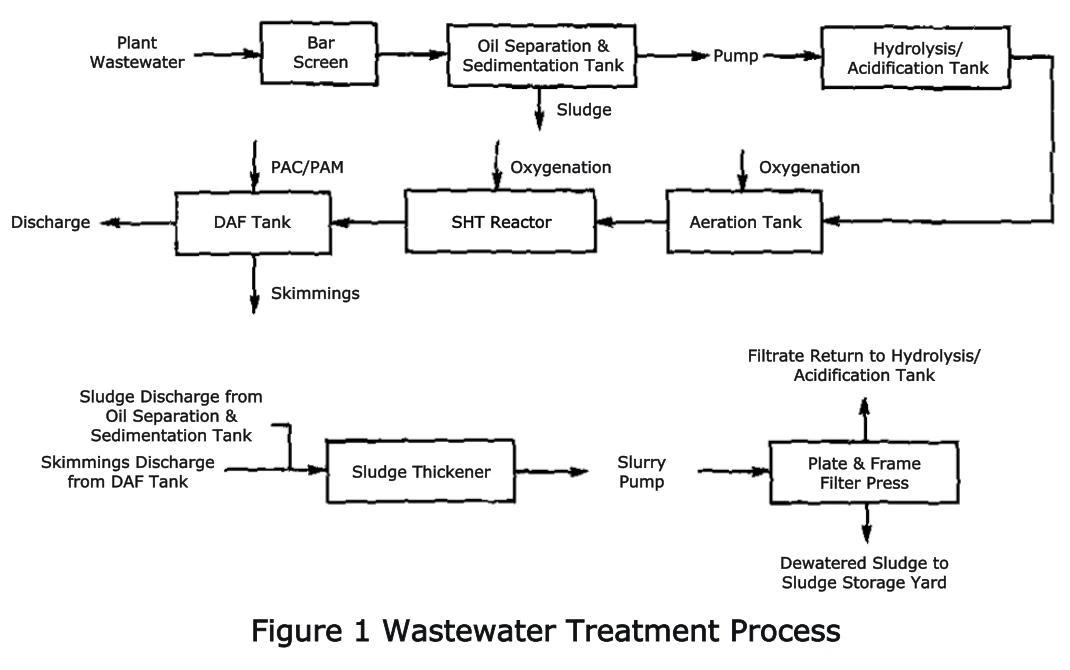
Given the wastewater's characteristics-good biodegradability but containing oils, solids, and high organic/nitrogen loads-a hybrid "Oil Separation/Sedimentation + Anaerobic (Hydrolysis/Acidification) + Aerobic (Aeration & Bio-contact Oxidation) + Flotation" process was selected. This multi-stage approach ensures robust treatment by addressing different pollutant types sequentially.
The process flow diagram is illustrated in Figure 1.
4. Detailed Process Description and Unit Design
4.1 Pre-treatment & Primary Treatment
- Bar Screen (2 units): Purpose: To intercept large suspended and floating solids (e.g., fish scales, debris).
- Dimensions: 700mm (L) x 500mm (W).
- Bar Spacing: 5 mm.
- Material: Steel.
- Oil Separation & Sedimentation Tank: Purpose: To remove floating oils/fats and settleable sands/heavy suspended solids.
- Effective Volume: 40 m³.
- Hydraulic Retention Time (HRT): 1.5 hours.
- Construction: Underground reinforced concrete (RC).
4.2 Biological Treatment (Core Process)
- Hydrolysis/Acidification Tank (Anaerobic): Purpose: To break down complex, refractory organic molecules (proteins, fats) into simpler, readily biodegradable compounds (volatile fatty acids), thereby enhancing overall biodegradability (BOD/COD ratio). This pre-treatment significantly improves the efficiency of subsequent aerobic stages.
- Volume: 60 m³.
- HRT: 2.4 hours.
- Construction: Semi-underground RC.
- Internal Feature: Filled with combined polyethylene biofilm media to support microbial growth.
- Aeration Tank (Conventional Activated Sludge): Purpose: Primary aerobic treatment for bulk removal of soluble BOD and COD.
- Volume: 75 m³.
- HRT: 3 hours.
- Construction: Semi-underground RC.
- Aeration: Fine-bubble diffused aeration using blowers.
- SHT Reactor (Bio-contact Oxidation): Purpose: A secondary, high-efficiency aerobic stage. It further degrades remaining organics and performs nitrification, converting toxic ammonia-nitrogen into nitrate-nitrogen. The fixed biofilm media provides a high concentration of attached biomass, making the system more stable and resistant to shock loads.
- Volume: 180 m³.
- HRT: 7 hours.
- Construction: Steel structure.
- Internal Feature: Packed with semi-soft biofilm media.
- Aeration: Fine-bubble diffused aeration.
- Aeration Equipment: Two Roots blowers (model SSR125) supply air to both the Aeration Tank and SHT Reactor.
- Configuration: One duty, one standby.
- Flow: 10.17 m³/min.
- Pressure: 49 kPa.
- Power: 11 kW each.
4.3 Tertiary/Polishing Treatment
- Dissolved Air Flotation (DAF) Unit: Purpose: To remove fine suspended solids, colloidal particles, and any residual oils/fats that escaped biological treatment. A coagulant (Polyaluminum Chloride - PAC) and a flocculant (Polyacrylamide - PAM) are dosed to agglomerate particles, which are then removed by adhering to micro-air bubbles.
- Model: JHF-30.
- Capacity: 30-35 m³/h.
- Construction: Anti-corrosive steel.
- Total Power: 8.12 kW (for pump, scraper, etc.).
4.4 Sludge Handling System
- Sludge Thickener: Purpose: To concentrate sludge from the primary settler and DAF unit, reducing volume for subsequent dewatering.
- Volume: 15 m³.
- Construction: Above-ground RC.
- Sludge Dewatering: A filter press is used for final dewatering, producing a solid cake for disposal.
- Equipment: Plate & Frame Filter Press (Model: BM103/1000).
- Power: 7.0 kW total.
- Feed Pump: Progressive Cavity Pump (Model: I-1B-2), 5.4 m³/h flow, 80m head, 3 kW power (one duty unit).
5. Treatment Performance and Results
The performance of each treatment unit, demonstrating the progressive removal of pollutants, is summarized in Table 1. The system consistently achieved the target discharge standards.

Key Achievements:
- Overall COD Removal: >90% (from 1,500 mg/L to <150 mg/L).
- Overall BOD₅ Removal: >96% (from 800 mg/L to <30 mg/L).
- Oil & Grease Removal: >70% (from 50 mg/L to <15 mg/L).
- SS Removal: >85% (from 400 mg/L to <150 mg/L).
- Effective Nitrification: The SHT reactor successfully oxidized ammonia, a critical step given the high nitrogen content of the wastewater.
6. Project Economics
The total project investment was 817,600 Chinese Yuan (RMB), broken down as follows:
- Equipment Supply & Installation
- Civil Works (Tanks, Structures)
- Process Design & Engineering
- Commissioning & Startup Services
This investment provided the client with a reliable, compliant, and operationally manageable wastewater treatment solution, mitigating environmental risks and ensuring regulatory compliance.
7. Conclusion and Lessons Learned
This seafood processing wastewater treatment project is a successful example of applying a tailored, multi-stage process to solve a specific industrial effluent problem. The key to success was the combination of technologies:
- Effective pre-treatment (screening, oil separation) protected downstream biological units.
- Anaerobic hydrolysis preconditioned the wastewater, enhancing aerobic treatability.
- Two-stage aerobic treatment (activated sludge + bio-contact oxidation) ensured robust and stable organic and nitrogen removal.
- Final polishing via chemical DAF guaranteed consistent compliance with strict SS and residual pollutant limits.
The system demonstrates robustness, operational simplicity, and cost-effectiveness for medium-scale food processing facilities. This case study serves as a valuable reference for engineers and plant managers designing or operating treatment systems for similar high-strength organic wastewaters from the food and beverage industry.