



A conventional sedimentation tank is sized around one assumption: every particle must fall the full depth of the basin before the water leaves. Raise the flow rate, or cap the available land, and that assumption collapses - retention time shrinks, short-circuiting appears, and suspended solids escape with the effluent. An inclined tube settler removes the assumption instead of the tank, dividing one deep settling zone into dozens of 60-degree inclined channels so a particle only travels a few centimetres to reach a settling surface.
Why Conventional Sedimentation Tanks Run Out Of Capacity
Efficient solid-liquid separation is a critical step in most water and wastewater treatment systems, and it is also the step that most often becomes the bottleneck. A conventional sedimentation tank is designed to hit a target settling performance at a specific design flow, and that design point is governed by the surface loading rate - the overflow rate the tank can carry equals flow divided by available settling area.
The consequence is uncomfortable. To capture finer, slower-settling particles, an operator must either lower the overflow rate or increase the settling area, and in a conventional basin more area means a bigger tank. When flow rates climb with production, population, or seasonality while the site is hemmed in by buildings, pipework, or permits, a larger tank is often not an option at all. The basin simply runs above its design loading. Tube settlers address this gap directly: instead of adding a new concrete structure, they raise the effective settling area inside the tank volume that already exists.
How Inclined Tubes Increase The Effective Settling Area
A tube settler consists of multiple inclined channels installed inside a sedimentation tank. The channels are commonly positioned at an angle of approximately 60 degrees, which allows suspended solids to settle onto the tube surfaces rather than travelling the full depth of the basin.

The mechanism is geometric rather than mechanical. As clarified water moves upward through the channels, heavier particles move downward along the inclined surfaces under gravity. Each particle now falls only a short distance before meeting a tube wall, where it aggregates with other solids and slides down the incline. The settled material collects at the bottom of the tank, where it can be removed through the existing sludge withdrawal system.
The main engineering principle is to increase the effective settling area without requiring a proportionally larger tank footprint. A single open basin offers one horizontal settling plane; the same basin filled with inclined tube packs offers the summed surface of every channel wall, packed into the same volume. That also explains the 60-degree figure. The incline must be steep enough that captured sludge keeps sliding down instead of blinding the channels, yet shallow enough to keep the projected settling area per cubic metre as high as possible.
What An Inclined Tube Configuration Actually Changes
Compared with a conventional open settling basin, an inclined tube configuration changes five properties of the settling zone at once, each with a direct operational consequence:
- Increased effective settling area - the same tank volume presents far more settling surface, lowering surface loading
- Shorter vertical settling distance - particles are captured in centimetres instead of metres
- More controlled hydraulic flow paths - channels constrain flow direction and suppress short-circuiting
- Better utilization of existing tank volume - depth and plan area already paid for are put to work
- Potential for more compact clarification systems - new installations can be designed smaller for the same duty
One point deserves emphasis before any procurement decision. Tube settlers do not replace proper coagulation, flocculation, or sludge removal. They are a settling aid, not a treatment process, and their performance depends heavily on upstream water chemistry, hydraulic loading, particle characteristics, and installation conditions.
The Design Factors That Decide Tube Settler Performance
Several parameters should be evaluated before selecting tube settler modules. They are not independent - inclination, length, profile, and material together determine both the hydraulics of the settling zone and the maintenance burden over the module's service life.
| Parameter | Typical Consideration | Engineering Importance |
| Inclination | Around 60° | Supports downward movement of settled solids and prevents channel blockage |
| Tube Length | Project-specific | Affects settling path and module dimensions |
| Material | PP, PVC, or application-specific plastic | Determines durability and chemical resistance |
| Tube Shape | Round, hexagonal, or other profiles | Influences hydraulic characteristics and structural rigidity |
| Installation | Modular inclined packs | Determines tank coverage and maintenance access |
| Water Flow | Project-specific | Affects hydraulic loading and clarification performance |
The required tube size and quantity should be calculated based on design flow, surface loading rate, suspended solids concentration, tank dimensions, and the characteristics of the particles being removed. Sizing is a hydraulic exercise, not a catalogue lookup.
Where Tube Settlers Fit In Water And Wastewater Treatment
Tube settlers are commonly used in clarification processes where suspended solids need to be separated from treated water. Typical applications include:
- Municipal wastewater treatment
- Industrial wastewater treatment
- Drinking water clarification
- Process water treatment
- Tertiary clarification
- Existing sedimentation tank upgrades
- Water recycling systems
One advantage of inclined tube modules is their suitability for retrofit projects. When an existing sedimentation tank has limited available space, adding settling media can increase the effective settling area without constructing an entirely new basin - the civil structure, inlet arrangement, and sludge collection system all stay as they are.
Material Choice: Why PP And PVC Dominate
Material selection matters when tube settlers are exposed to wastewater, chemicals, sunlight, or outdoor installation conditions, and it is one of the few decisions that cannot be revisited after installation. Polypropylene (PP) is commonly used because of its low density and resistance to many chemical environments. Low density is not a marketing point: module packs must be supported on frames inside the tank, and lighter media mean less structural load on both the support system and the basin itself.
For outdoor applications, UV stabilization may also be considered depending on exposure conditions, since prolonged sunlight degrades unstabilized polymer surfaces. For drinking-water applications, the material and manufacturing process should meet the relevant local requirements for potable-water contact. Project specifications and applicable certifications should always be verified before procurement rather than assumed from a generic material grade.
Retrofit Without New Concrete: The Fastest Capacity Upgrade
In a typical wastewater clarification project, inclined tube settler modules are installed inside an existing sedimentation basin to increase the available settling area. The project uses 60-degree inclined tube modules to create multiple parallel settling channels. Instead of expanding the concrete tank, the treatment team utilizes the existing basin volume more effectively by installing modular tube settler packs - prefabricated and lifted into place, with the civil structure untouched.
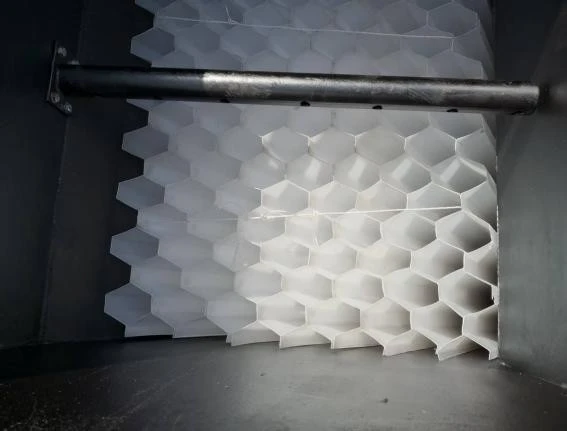
During operation, suspended solids entering the clarification zone move downward along the inclined tube surfaces, while clarified water travels upward through the channels. The configuration provides a more controlled settling environment and supports the required clarification process. The effect is visible at the surface: the module bank sits beneath the water line, and clarified overflow leaves the basin from above the packs.

This type of retrofit demonstrates an important application of tube settlers: improving the utilization of an existing clarification structure without necessarily increasing its physical footprint. It also exposes the limit of the approach. Actual performance will vary depending on influent solids, floc characteristics, hydraulic loading, tube geometry, and sludge removal conditions, so project-specific hydraulic calculations remain necessary - the retrofit raises the ceiling, it does not remove the need to design for it.
How To Specify And Install A Tube Settler
Selecting a tube settler should begin with the treatment conditions rather than the module dimensions alone. Engineering teams should provide the supplier with:
- Design and peak flow rate
- Tank length, width, and water depth
- Existing sedimentation tank configuration
- Influent and target TSS
- Coagulation and flocculation process
- Expected sludge loading
- Installation angle
- Required tube dimensions
- Indoor or outdoor installation conditions
Tube modules with different cross-sectional dimensions may be selected according to the required hydraulic loading and available installation space. Longer modules may provide a longer settling path, while the appropriate tube diameter and geometry depend on the specific application and flow conditions. Installation details are equally important: the tube packs need to be properly supported and aligned to maintain stable hydraulic conditions, and adequate access should be provided for inspection, cleaning, and future maintenance. In practice, the factors that shorten tube settler life are almost always operational rather than material - sludge allowed to harden at the channel outlets, uneven flow distribution across the bank, and neglected support corrosion are all preventable with periodic inspection.
Conclusion
Tube settlers can improve water clarification by increasing the effective settling area and creating multiple inclined settling channels within a sedimentation tank. They are applicable to municipal wastewater, industrial wastewater, drinking-water clarification, and retrofit projects where space or existing infrastructure is a consideration. For a new clarification system or an existing tank upgrade, providing flow rate, tank dimensions, TSS data, and process conditions allows the configuration to be evaluated according to actual hydraulic requirements - and a project-specific assessment determines the appropriate module size, material, quantity, and installation arrangement for reliable long-term operation.
Size Your Tube Settler Packs On Real Hydraulics
Send your design flow, tank dimensions and target TSS - Juntai will size PP, PVC or hexagonal inclined tube settler modules for your clarifier, new build or retrofit.