


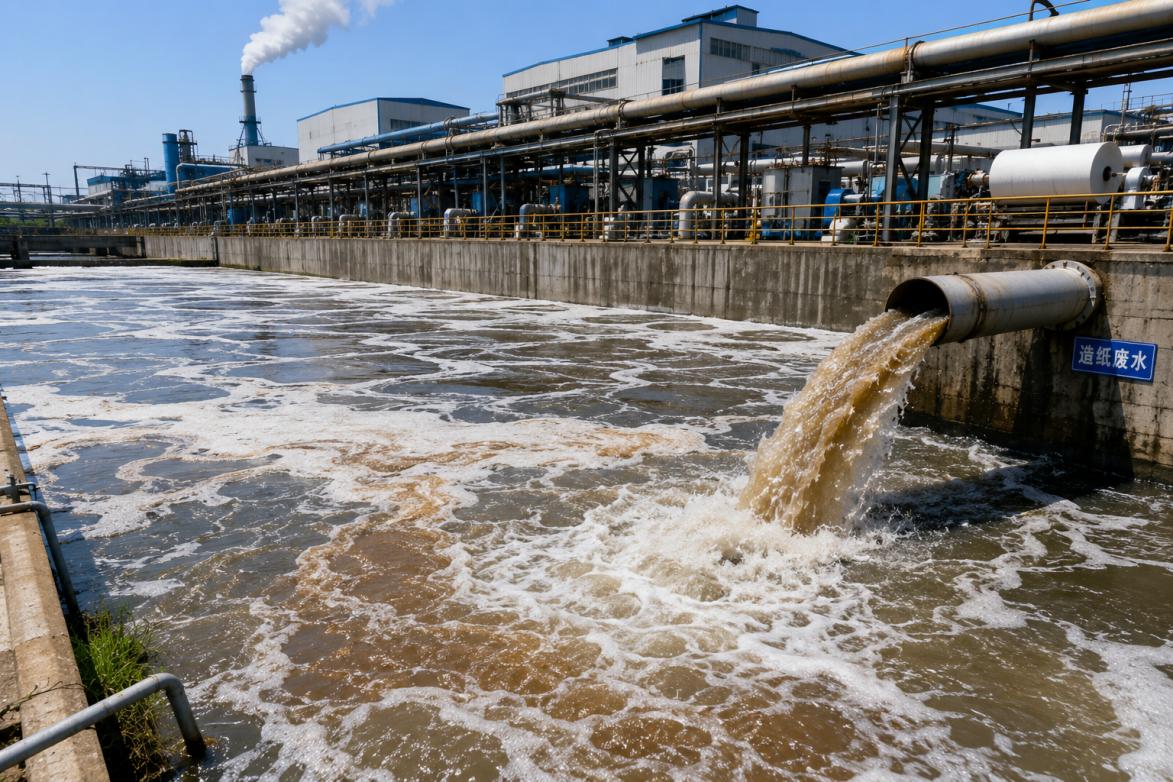
Take a domestic sewage stream - predictable, biodegradable, easy. Add papermaking wastewater - high in wood fibre, phenolic compounds, bleaching residues, and colour. Mix them in the same treatment plant, and you have created a wastewater that is harder to treat than either stream alone. The biodegradable fraction drops. The suspended solids change character. Membrane foulants multiply. This article reports experimental results from four treatment approaches applied to mixed domestic-papermaking wastewater: biological treatment, chemical precipitation, membrane separation, and an integrated combination. Only one approach achieved both high removal and manageable cost.
1. TWO WASTEWATER STREAMS, TWO ENTIRELY DIFFERENT PROBLEMS
1.1 Domestic sewage - high volume, low complexity
Domestic sewage carries organic matter, nitrogen, phosphorus, suspended solids, and pathogenic microorganisms - all at concentrations that vary with population density, lifestyle, and season. Most of the organic fraction is biodegradable. COD and BOD are the core treatment targets. Nitrogen appears as ammonia and nitrate; phosphorus drives eutrophication risk. Suspended solids come from food residues, dust, and detergents. Nothing in this stream is chemically exotic - the challenge is volume, not toxicity.
1.2 Papermaking wastewater - low volume, high complexity
Papermaking wastewater is a different animal. Wood pulp fibres - incompletely decomposed raw material - create high suspended solids of a fibrous, clogging character. Chemical residues from pulping and bleaching - chlorides, bleaching agents, surfactants - drive up COD and, more critically, inhibit the microorganisms that would otherwise degrade them. Colour, especially from chlorine bleaching, is intense and resists conventional biological treatment. Phenolic compounds add acute toxicity. The stream is harder to treat but smaller in volume - which makes mixed treatment economically attractive, if the process can handle it.
1.3 Why mixing makes it harder
Mixing the two streams creates three specific challenges that neither stream presents alone:
Biodegradability mismatch. Domestic sewage is readily biodegradable. Papermaking wastewater contains refractory organics - phenolics, certain chemical residues - that resist biological attack. In a mixed biological reactor, the easy fraction degrades quickly while the refractory fraction accumulates, reducing overall removal efficiency.
Solid–liquid separation conflict. Wood pulp fibres create a fibrous sludge that behaves differently from the flocculent sludge of domestic sewage. Sedimentation characteristics change. Dewatering becomes unpredictable. The mixed sludge is harder to handle than either source alone.
Water quality fluctuation amplified. Domestic sewage varies diurnally and seasonally. Papermaking wastewater is relatively stable when production is running - but changes abruptly with process batches, washdowns, and grade changes. When mixed, the combined stream can swing in pH, ammonia, and COD faster than any single treatment process can adapt.
2. FOUR PROCESSES TESTED - EXPERIMENTAL RESULTS
Each process was evaluated in a continuous-flow reactor using real samples of domestic sewage and papermaking wastewater. COD, BOD, nitrogen, phosphorus, and specific pollutants were monitored across varying reaction times, temperatures, and operating conditions.
2.1 Biological treatment - works for one, fails for the other
At 3–5 days retention time, biological treatment removed over 70% of COD and BOD from domestic sewage. For papermaking wastewater alone, COD removal reached only 40–50%. When the streams were mixed, BOD removal dropped to 40–60% - well below the 80% achieved when treating domestic sewage alone.
The mechanism is clear: phenolic substances and chemical residues in the papermaking fraction inhibited the microbial community. The microorganisms that readily consumed domestic organics were partially suppressed by the papermaking chemicals, reducing the overall biodegradation capacity. The experiment confirmed what theory predicts: biological treatment alone cannot handle the mixed stream.
2.2 Chemical precipitation - strong on phosphorus and metals, weak on surfactants
Using aluminium chloride and calcium hydroxide as precipitants, phosphorus removal in the mixed wastewater exceeded 85%. Lead and copper removal reached over 80% - the heavy metals from papermaking processes precipitated efficiently. However, certain surfactants in the papermaking fraction resisted precipitation and passed through largely unaffected.
Chemical precipitation is a targeted tool: it removes what it is designed to remove (phosphorus, metals) and leaves what it is not (dissolved organics, surfactants, colour). As a standalone process for mixed wastewater, it addresses only part of the pollutant load. But as a step in a treatment train, it handles the fraction that biology and membranes struggle with - a valuable niche.
2.3 Membrane separation - excellent removal, rapid fouling
Ultrafiltration removed over 90% of suspended solids and macromolecular organic matter from the mixed wastewater, with reasonably high membrane flux. But small-molecule organics - the dissolved fraction that ultrafiltration cannot reject - passed through and required downstream nanofiltration or reverse osmosis.
The critical finding was fouling behaviour. Wood pulp fibres and pigments from the papermaking wastewater formed a dense deposit layer on the membrane surface, clogging pores and reducing permeability faster than domestic sewage alone would cause. The fouling layer was physically different - fibrous rather than gelatinous - and required different cleaning protocols. Membrane fouling, not membrane rejection, is the limiting factor for this application.
2.4 Integrated treatment - the combination that works
The integrated process sequenced three stages: biological treatment first (to remove the bulk of biodegradable organics), chemical precipitation second (to target phosphorus and heavy metals), and membrane separation last (for advanced polishing of dissolved substances and trace pollutants).
The results justified the complexity:
| Treatment Stage | Key Performance | What It Removes | What It Protects |
| 1. Biological treatment | Removes biodegradable COD and BOD | Domestic organic load | Downstream membrane from organic fouling |
| 2. Chemical precipitation | Removes phosphorus and heavy metals | Papermaking metals, P from both streams | Membrane from metal-catalysed fouling |
| 3. Membrane separation | Polishes dissolved substances and colour | Residual dissolved organics, colour | Final effluent quality |
After the biological + chemical precipitation stages, COD removal exceeded 80% and phosphorus removal exceeded 90%. The membrane stage then removed residual dissolved substances and trace pollutants. Crucially, by removing the bulk organic and particulate load before the membrane, fouling was meaningfully reduced - the pre-treatment steps earned their cost by extending membrane life and reducing cleaning frequency.
3. OPTIMISING EACH STAGE
3.1 Biological treatment - add the right microbes
Standard activated sludge struggles with phenolic compounds. The optimisation: bioaugmentation with specialised degrading strains - bacteria selected or engineered specifically for phenolic degradation. Coupled with adjusted retention times (shorter for the domestic fraction, extended for the papermaking fraction), the biological stage can be tuned to the mixed stream's actual biodegradability profile rather than a generic design assumption.
3.2 Chemical precipitation - switch to ferric chloride
Replacing traditional lime with ferric chloride achieves equivalent phosphorus removal at lower chemical cost and produces a denser, more dewaterable sludge. Combining precipitation with the biological stage - letting biology remove part of the organic load before precipitation targets phosphorus and metals - reduces the chemical demand that a standalone precipitation step would require.
3.3 Membrane separation - pre-treatment is the real membrane protection
The dominant membrane cost is not the membrane itself - it is fouling-driven replacement and cleaning. The optimisation is upstream: improve pre-treatment to strip out the large particles (wood fibres, suspended solids) before they reach the membrane surface. Milder chemical cleaning agents and physical cleaning methods - backwashing, air scouring - reduce membrane deterioration compared to aggressive chemical clean-in-place cycles.
3.4 Integrated control - let the system adapt itself
An intelligent control system that monitors water quality in real time and adjusts operating parameters - aeration intensity, chemical dosing rates, membrane backwash frequency - according to actual influent conditions, not fixed setpoints. When the papermaking fraction is high, the system increases chemical precipitation and extends biological retention. When domestic sewage dominates, it reduces chemicals and shortens retention. The result: treatment that tracks the actual waste, not the design assumption.
BOTTOM LINE: WHICH PROCESS FOR WHICH POLLUTANT?
| Process | Best For | Fails On | Cost Driver | Verdict for Mixed Stream |
| Biological treatment | Biodegradable COD, BOD | Phenolics, refractory chemicals | Aeration energy | Necessary but insufficient alone |
| Chemical precipitation | Phosphorus, heavy metals | Surfactants, dissolved organics | Chemical consumption, sludge disposal | Essential for metals; pair with biology |
| Membrane separation | SS, macromolecules, colour | Fibrous fouling, high OPEX | Fouling → cleaning → replacement | Excellent polishing; protect with pre-treatment |
| Integrated (Bio + Chem + Membrane) | All pollutants in mixed stream | - (addresses each fraction) | Capital + coordination complexity | The only approach that works for all pollutants |
The experimental evidence is unambiguous: no single process treats mixed domestic-papermaking wastewater adequately. Biological treatment handles the domestic fraction but is partially inhibited by papermaking chemicals. Chemical precipitation removes phosphorus and metals but misses dissolved organics. Membranes achieve high removal but foul rapidly on wood fibre. The integrated sequence - biology first, chemistry second, membrane last - achieves over 80% COD removal and over 90% phosphorus removal, with manageable membrane fouling because the upstream stages strip out the foulants. For plants receiving both streams, the question is not whether to integrate, but how to sequence the stages and how intelligently to control them.
Need Process Design Support for Mixed Industrial-Domestic Wastewater?
Juntai supplies MBBR biofilm carriers, inclined tube settler media, and related water treatment components - with full process integration support for plants handling complex mixed wastewater streams. If your plant is receiving industrial wastewater that complicates your biological or sedimentation stages, we can help you specify the right media and process configuration.
| MBBR & Tube Settler Products | Request Process Design Support | Full Product Range |