


You know a tube settler removes suspended solids. But do you know which sizes it actually removes - and which sizes slip through regardless of how well the tank is designed? Using CFD simulation of a real 1,000 m³/d counter-current inclined tube settler in Anhui Province, researchers modelled the behaviour of particles from 30 to 120 μm under actual operating conditions. The result is a clear threshold: below 80 μm, particle size barely matters for removal. Above 80 μm, efficiency takes off. If your coagulant is not producing flocs above that threshold, your inclined tubes are not doing what you paid for.
WHY CFD - AND WHY THIS TANK
Most studies on inclined tube settlers focus on flow patterns - optimising tank dimensions, reducing dead zones, smoothing velocity distribution. Few have asked the question that matters most to effluent quality: given a specific particle size distribution, what actually gets removed? Because particles of different diameters have different settling velocities, the particle size distribution of the influent suspended solids directly controls the sedimentation efficiency the tank can achieve.
To answer this, researchers used the standard k-ε turbulence model (for the flow field) coupled with the Mixture multiphase model (for the solid–liquid two-phase behaviour) - a combination well-suited to simulating the turbulent, particle-laden flow inside an operating tube settler.
The test case was a real counter-current inclined tube settler at a waterworks in Anhui Province, with the following design and operating parameters:
| Parameter | Value | Note |
| Treatment capacity | 1,000 m³/d | Single tank |
| Tank dimensions (L × W × H) | 2.8 m × 2.8 m × 4.17 m | Four zones: sludge, distribution, tube, clear water |
| Tube inclination | 60° | Standard angle |
| Tube hydraulic diameter | 40 mm | Hexagonal or square cell |
| Influent velocity | 0.1 m/s | At the perforated distribution wall |
| Influent SS concentration | 295 mg/L | From plant operational data |
| Particle density | 1,050 kg/m³ | Typical for flocculated solids |
| Dynamic viscosity | 0.02001 Pa·s | Water at ~20 ℃ |

RESULT 1: WHERE PARTICLES CONCENTRATE - AND WHY IT MATTERS
Five particle diameters were simulated: 30, 50, 80, 100, and 120 μm. For each, the vertical distribution of suspended solids was examined by plotting the average volume fraction on cross-sections at different heights (Figure 2).

Three patterns emerge from the concentration profiles:
1. All particle sizes follow the same general trend. The overall shape of the concentration-versus-height curve is similar regardless of diameter. The physics of the tank - the four-zone structure, the flow path, the turbulence pattern - imposes a common concentration profile.
2. At the tube inlet (~1.5 m height), concentration spikes sharply for larger particles. This is the transition zone where flow enters the inclined tubes. Turbulence and mixing create a high-concentration region that promotes particle contact and flocculation - a positive effect for solid–liquid separation. The larger the particles entering this zone, the more pronounced the concentration spike.
3. At the tank bottom and effluent cross-section, particle size drives the outcome. Near the sludge zone, the average volume fraction rises with particle size - more large particles settle out and accumulate where they should. At the effluent cross-section, the average volume fraction decreases as particle size increases - fewer large particles escape. The correlation is unambiguous: larger particles → more settle → cleaner effluent.
RESULT 2: THE 80 μm THRESHOLD
Removal efficiency η is defined as:

where Cinlet is the influent SS concentration (kg/m³) and Coutlet is the effluent SS concentration (kg/m³).
Figure 3 shows the relationship between removal efficiency and particle diameter under the given influent conditions (295 mg/L SS, 1,050 kg/m³ density, 0.02001 Pa·s viscosity). The curve is not linear - it has a distinct knee.
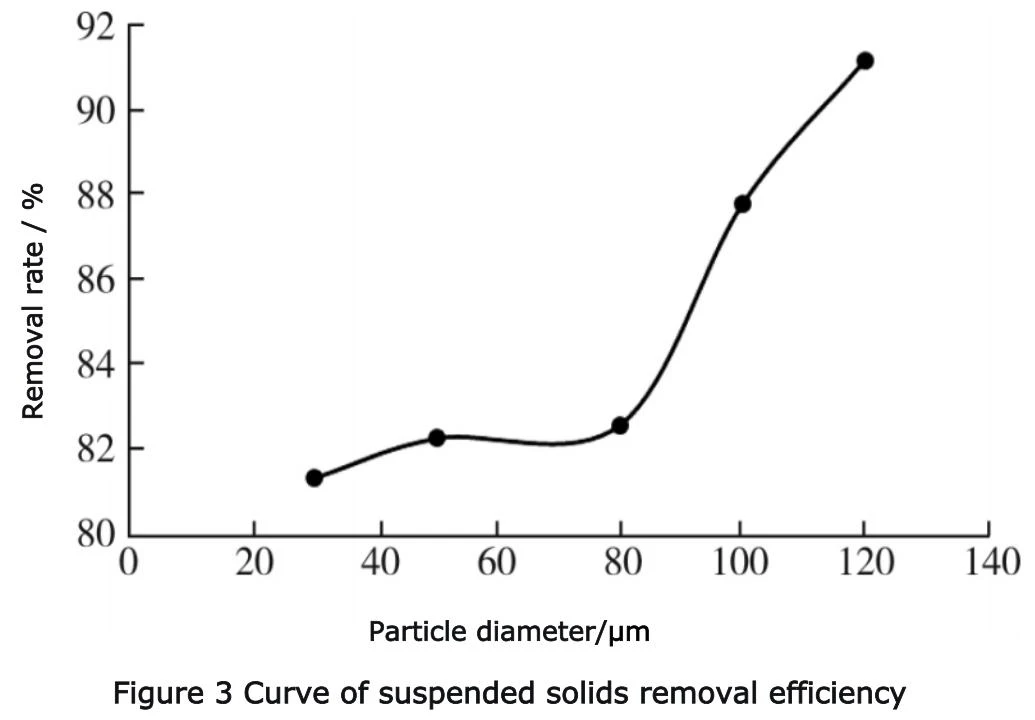
The data reveals two regimes:
| Particle Size Range | Behaviour | Engineering Implication |
| 30–80 μm | Removal efficiency increases only gradually with particle size. The slope is shallow. | Coagulant optimisation within this range yields diminishing returns. Incremental floc size gains do little for effluent quality. |
| >80 μm | Removal efficiency rises sharply. Each additional 10–20 μm in diameter produces a significant improvement. | Coagulant dose, mixing intensity, and flocculation time should be tuned to push flocs past 80 μm. Below this threshold, the tube settler is underutilised. |
The reason is hydraulic: particles below 80 μm have settling velocities low enough that the upward flow in the tubes can carry them out, regardless of how well the tank is designed. Above 80 μm, the settling velocity overtakes the upward velocity by a widening margin, and removal becomes effective. The 80 μm threshold is specific to this tank's geometry and operating conditions (40 mm tube diameter, 60° inclination, 0.1 m/s inlet velocity) - but the principle applies broadly: every tube settler has a critical particle size below which removal is poor, and that size is determined by the upward velocity in the tubes.
WHAT THIS MEANS FOR YOUR PLANT
1. Coagulant dosing has a target, and it is 80 μm. The purpose of coagulation and flocculation - beyond neutralising charge and bridging particles - is to grow flocs past the critical size where the tube settler can capture them. Jar testing should confirm that your formed flocs exceed the threshold diameter for your specific tank geometry.
2. If your effluent is turbid and floc size is below threshold, the tubes are not the problem - the flocculation stage is. Adding more tubes or reducing the upward velocity will help marginally. But the real fix is upstream: better flocculation to produce larger, denser particles that the existing tubes can capture.
3. The critical size is tank-specific. This simulation found 80 μm for a 40 mm tube at 60° with 0.1 m/s inlet velocity. A smaller tube diameter, a flatter angle, or a lower upward velocity would shift the threshold downward - meaning smaller particles become removable. This is why tube geometry and hydraulic loading are not just design parameters; they directly set the minimum particle size your settler can handle.
4. CFD simulation is a practical design tool, not an academic exercise. The k-ε + Mixture model combination used here can predict, for any tank geometry and operating condition, the particle size–removal efficiency curve. Before building or retrofitting, simulation can answer the question that empirical design rules cannot: will this tank remove the particles in my raw water?
Need Tube Settler Media Sized for Your Particle Distribution?
Juntai supplies PVC and PP inclined tube settler media with full hydraulic design support - including tube diameter selection, inclination angle optimisation, and surface loading calculations matched to your raw water particle characteristics and effluent targets. If you are designing a new settler or troubleshooting an underperforming one, we can help you specify tube geometry that captures the particles you need to remove.
| Tube Settler Product Specs | Request Hydraulic Design Support | Full Product Range |