


How Fill Rate, Reflux Ratio, and HRT Affect Biofilm Formation and Cold-Weather Startup
June 2026 | Research & Development
Rapid Start-Up of A/MBBR at Low Temperatures - Finding the Optimal Process Parameters
Low-temperature wastewater treatment in cold, high-altitude regions presents a persistent challenge: biological processes slow down, biofilm formation takes longer, and meeting discharge standards during startup becomes difficult. For Anaerobic MBBR (A/MBBR) technology, shortening the startup period is critical for widespread adoption. This study systematically investigated how fill rate, reflux ratio, and HRT affect the startup of A/MBBR reactors treating rural domestic wastewater at 8–12°C, identifying optimal parameters for rapid biofilm establishment.
Background & Motivation
Why A/MBBR for Cold Regions?
Anaerobic Moving Bed Biofilm Reactors (A/MBBR) combine the advantages of biofilm protection and low energy consumption, making them a promising solution for rural wastewater treatment in cold climates. However, biofilm reactors operating at 8–12°C have a notoriously long startup period - approximately 168 days in the reference reactor used in this study. Unlike previous research that focused solely on pollutant removal rates, this study goes beyond to examine biofilm growth rate and specific respiratory activity, revealing the underlying mechanisms that govern cold-weather startup performance.
Experimental Design
Experimental Setup
The study employed K3 biofilm carriers with natural biofilm attachment in a series of parallel A/MBBR reactors. Three key operating parameters were systematically tested: fill rate (20%, 40%, 60%), reflux ratio (0%, 20%, 40%), and hydraulic retention time (HRT) (8h, 12h, 24h). The feed wastewater was prepared by diluting real domestic sewage to match typical rural Tibetan effluent quality. The raw sewage and diluted test influent compositions are summarized below.
| Parameter | Unit | Raw Sewage (Range) | Test Influent (Range) |
| CODCr | mg/L | 800 – 1,300 | 100 – 200 |
| NH3-N | mg/L | 60 – 80 | 20 – 32 |
| TN | mg/L | 104 – 140 | 22 – 35 |
| TP | mg/L | 4.0 – 6.0 | 2.0 – 6.0 |
| pH | - | 6 – 9 | 6 – 9 |
| DO | mg/L | 3 – 4 | 0.5 – 1.5 |
Table 1: Raw sewage versus diluted test influent composition used in the A/MBBR startup experiments.
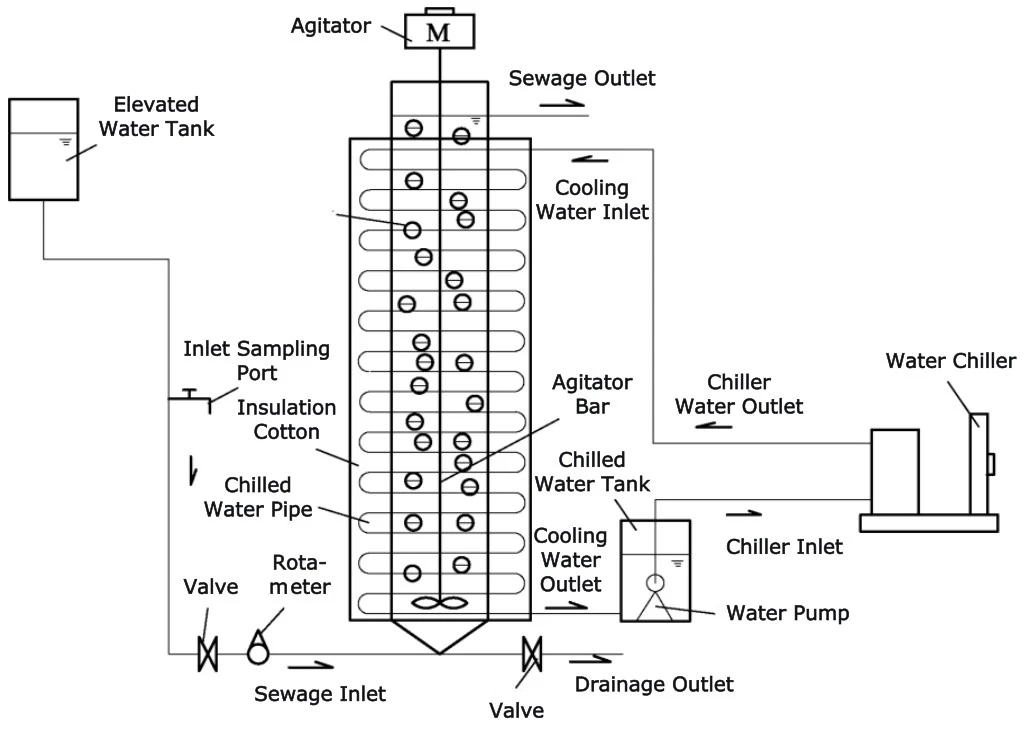
Figure 1 - Schematic diagram of the A/MBBR reactor experimental setup.

Figure 2 - MLVSS changes during the 168-day baseline startup at 8–12°C.
Results & Analysis
Effect of Fill Rate
Fill rate emerged as a critical parameter governing startup performance. The 20% fill rate showed the poorest pollutant removal across all indicators, primarily due to insufficient total biomass and higher organic loading per individual carrier, which caused greater performance fluctuation and poorer shock resistance. The 60% fill rate achieved the highest overall pollutant removal, driven by the large amount of total biomass available. However, the biological activity metrics told a more nuanced story.
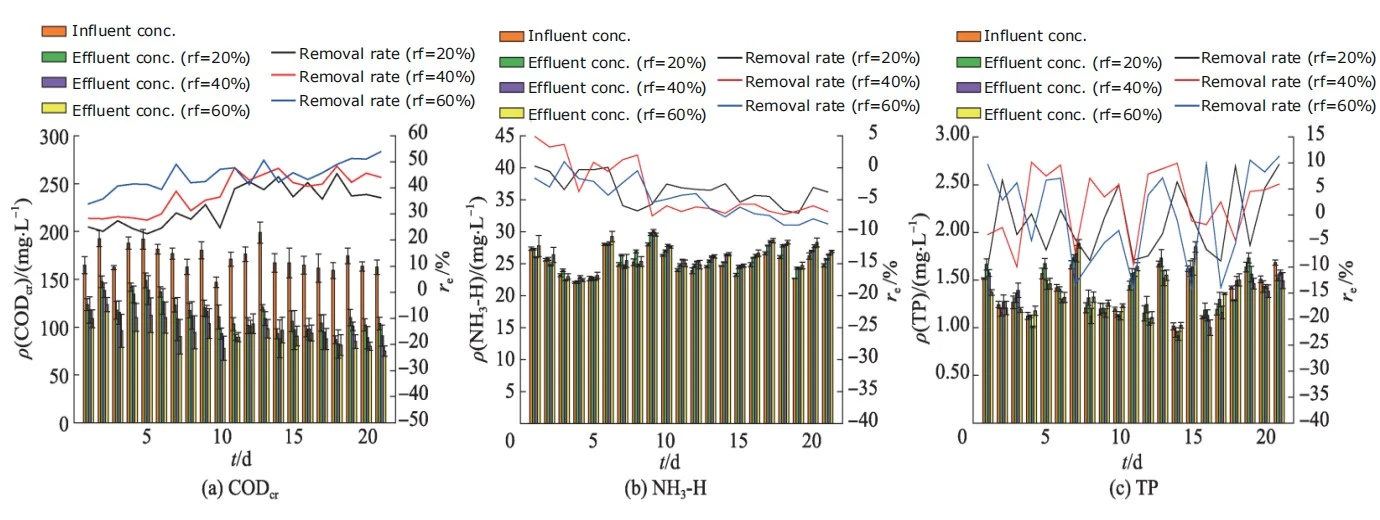
Figure 3 - Pollutant removal efficiencies at 20%, 40%, and 60% carrier fill rates.
Examining biomass and respiratory activity revealed distinct trade-offs. The 20% fill condition produced the highest per-carrier biofilm mass and respiration rate, indicating that individual carriers were highly active when competition for substrate was low. The 60% fill condition delivered the highest total biomass but also exhibited the highest endogenous respiration, meaning more biomass was engaged in self-decay rather than substrate utilization. The 40% fill rate provided the best balance of biofilm activity and total biomass, avoiding both the biomass limitations of low fill and the excessive endogenous decay at high fill.

Figure 4 - Biomass accumulation and respiration rates at different fill rates.
Effect of Reflux Ratio
The reflux ratio significantly influenced CODCr removal performance. A 20% reflux ratio consistently outperformed the 0% (no reflux) condition, demonstrating that partial effluent recirculation improves the biodegradability of the feed wastewater. However, increasing the reflux ratio further to 40% yielded diminishing returns, with only marginal improvement over the 20% condition and evidence of biofilm inhibition at the higher recirculation rate.

Figure 5 - CODCr removal at 0%, 20%, and 40% reflux ratios.
The mechanism behind reflux-driven improvement was confirmed by comparing the biodegradability (B/C ratio) of raw sewage versus reactor effluent. As shown in Table 2, the effluent consistently exhibited a higher B/C ratio than the raw influent across all measured time points, confirming that reflux returns partially hydrolyzed organics to the reactor inlet, making the feed more readily biodegradable for the biofilm community.
| Time (h) | Raw CODCr | Raw BOD5 | Raw B/C | Effl. CODCr | Effl. BOD5 | Effl. B/C |
| 1 | 191.41 | 110.12 | 0.58 | 94.06 | 62.85 | 0.67 |
| 7 | 148.70 | 88.20 | 0.59 | 64.34 | 40.14 | 0.62 |
| 14 | 146.73 | 75.74 | 0.52 | 62.61 | 40.24 | 0.64 |
| 21 | 210.75 | 135.45 | 0.64 | 92.06 | 52.21 | 0.57 |
Table 2: Biodegradability comparison - raw sewage versus effluent B/C ratios. Effluent consistently shows higher biodegradability, confirming that reflux improves feed quality for biofilm microorganisms. All values in mg/L except B/C ratio (dimensionless).

Figure 6 - Biomass and respiration at different reflux ratios. Optimal reflux ratio: 20%.
Effect of HRT
Hydraulic retention time was tested at three levels: 8h, 12h, and 24h. As expected, longer HRT improved pollutant removal by providing extended contact time between the wastewater and biofilm. The ranking was clear: 24h > 12h > 8h for removal efficiency. However, the improvement exhibited strong diminishing returns beyond 12 hours. The jump from 8h to 12h produced major gains across all pollutant indicators, while the step from 12h to 24h delivered only minimal additional benefit that did not justify the doubled reactor volume.
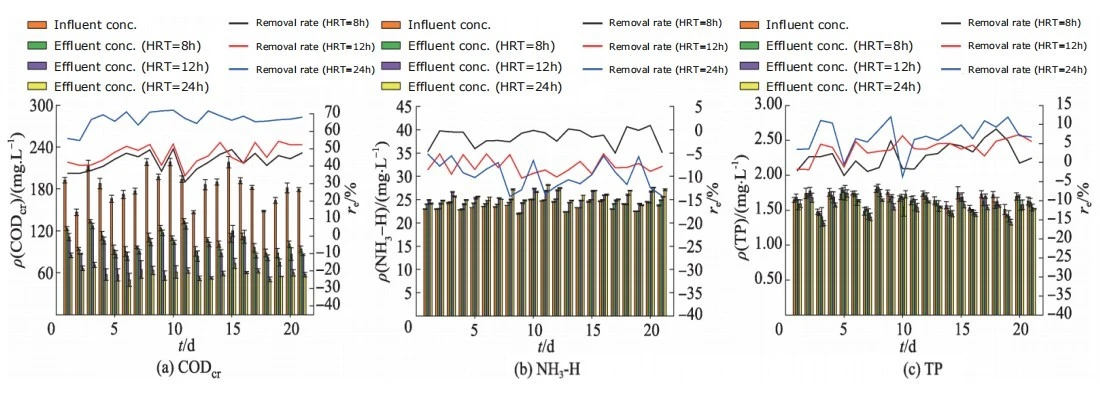
Figure 7 - Pollutant removal at 8h, 12h, and 24h HRT. 24h > 12h > 8h, but diminishing returns beyond 12h.
Interestingly, the biofilm growth data revealed a counterintuitive finding. The 8h HRT condition produced the fastest biofilm growth rate and highest specific respiratory activity per unit biomass. The shorter retention time maintained a higher organic loading rate, which stimulated more vigorous biofilm development. In contrast, the 24h HRT condition showed signs of biofilm detachment, likely due to substrate limitation causing endogenous decay and weakening of the EPS matrix anchoring the biofilm to carriers. This finding has important implications: during startup, a shorter HRT accelerates biofilm establishment, after which the HRT can be extended for polishing treatment.
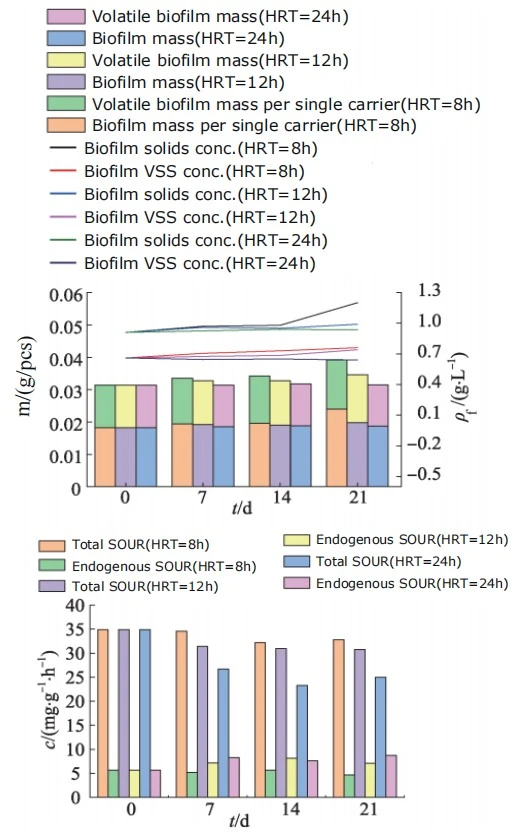
Figure 8 - Biomass and respiration at different HRT. 8h HRT shows fastest biofilm growth and highest activity.
Summary of Optimal Parameters
The comprehensive analysis across all three parameters yielded a clear optimization strategy for cold-weather A/MBBR startup:
Fill rate: 40% - best balance of treatment performance, biofilm activity, and total biomass without the excessive endogenous respiration observed at 60% fill.
Reflux ratio: 20% - improves startup by making feed water more biodegradable through partial hydrolysis, without the biofilm inhibition seen at 40% recirculation.
HRT during startup: 8h - accelerates biofilm growth by maintaining higher organic load; increase to 12h after startup is complete for stable long-term operation.
Expected outcome: approximately 23% reduction in startup time, from ~168 days in the baseline reactor to ~129 days under optimized conditions.
Key Takeaways
The 40% fill rate provides the best balance of treatment performance, biofilm activity, and total biomass for cold-weather startup - neither biomass-limited like 20% nor decay-dominated like 60%.
Moderate 20% reflux improves startup by making feed water more biodegradable, as confirmed by consistently higher effluent B/C ratios across all measurement periods.
Short 8h HRT accelerates biofilm growth during startup by maintaining higher organic load; biofilm growth was fastest and most active under this condition.
A 23% reduction in startup time is significant for cold regions with limited construction windows, where every day of faster commissioning translates to operational and economic benefits.
Biofilm activity metrics are essential for understanding startup dynamics - pollutant removal rates alone are insufficient, as they mask underlying differences in biomass health, endogenous respiration, and biofilm structural integrity.
Conclusion
This study provides a clear, experimentally validated framework for optimizing A/MBBR startup at 8–12°C: 40% fill rate, 20% reflux, and 8h HRT during the startup phase. These parameters were validated through simultaneous measurement of treatment performance, biofilm growth kinetics, and respiratory activity, providing a comprehensive picture that goes beyond simple effluent quality monitoring.
For designers and operators in cold-climate regions, these findings offer practical, evidence-based guidance for reducing commissioning time and accelerating the path to stable operation. The 23% reduction in startup duration represents a meaningful improvement for projects facing seasonal temperature constraints and tight construction schedules.
Need MBBR Media for Your Cold-Region Wastewater Project?
Juntai Plastic provides high-performance HDPE MBBR biofilm carriers engineered for rapid startup and stable operation across wide temperature ranges. Our K3 and K5 media are backed by technical sizing support and on-site commissioning guidance.
| Product Specs | Request Support | Full Product Range |