


Since 1997, two flotation-sedimentation tanks ran on PVC inclined plates. They handled high-turbidity raw water without complaint - until the 2020 flood. Plates cracked. Frames corroded. High-pressure washdowns, once routine, became demolition events. The plant faced a choice: patch the PVC again, or switch to a material that would outlast the next flood. They chose 304 stainless steel. Here is exactly how the retrofit was done - and what changed after.
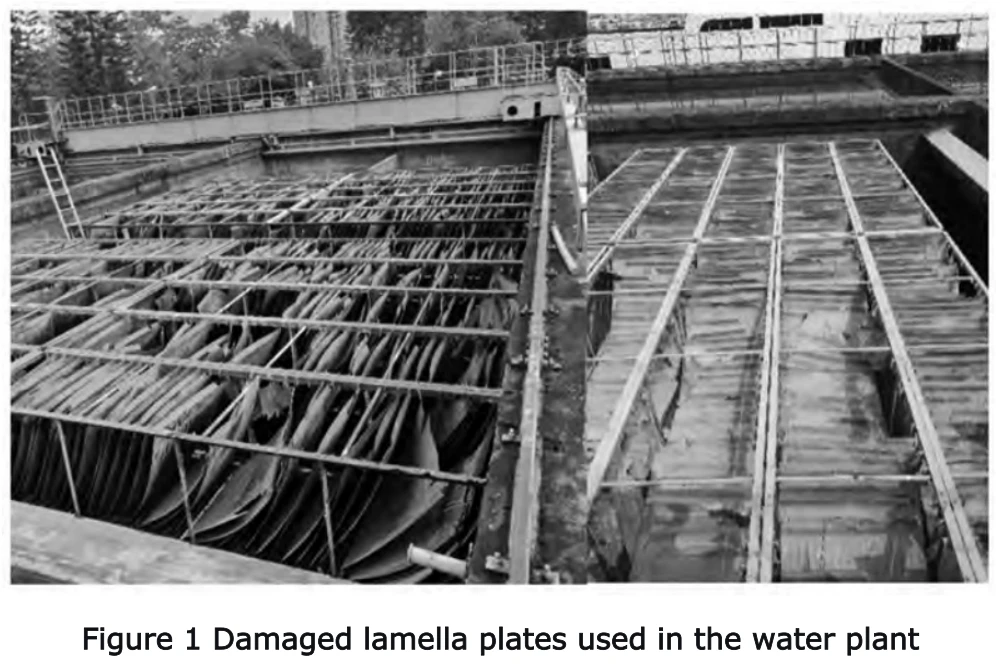
THE PROBLEM: PVC PLATES AFTER 25 YEARS OF SERVICE
The waterworks operates two flotation-sedimentation tanks, each equipped with two groups of inclined plates. Each group measures 9 m in length by 5 m in width, divided into three sections - upper, middle, and lower - with each section having an inclined length of 1 m and an inclination angle of 60°, arranged in a staggered layout. The original plates were made of PVC, assembled on frames welded from angle steel, with the lower section supported by I-beams at 2 m intervals.
These plates were commissioned with the plant in 1997 and performed reliably for over two decades, showing good sedimentation performance when treating high-turbidity raw water. But PVC has a well-known weakness: it ages. Ultraviolet exposure, chemical oxidation, and repeated thermal cycling gradually embrittle the material. High-pressure water flushing - a standard maintenance procedure - became increasingly destructive as the plates lost structural integrity. The final blow came during a high-turbidity flood event in 2020, which left the plates severely damaged and no longer operable.
The plate support frames suffered as well. Years of immersion had corroded the angle steel to the point where it could no longer reliably support the plates. Production was impacted. A like-for-like PVC replacement would reset the clock - but restart the same aging cycle. The plant decided on a material upgrade: 304 stainless steel.
HOW INCLINED PLATES WORK - AND WHY THE MATERIAL MATTERS
The inclined-plate flotation-sedimentation tank builds on horizontal flow sedimentation but multiplies the effective settling area by stacking multiple layers of parallel plates. The inclined geometry increases the wetted cross-section and hydraulic radius, which does two things simultaneously: it lowers the Reynolds number (Re drops below 500, typically settling around 50) and raises the Froude number (Fr exceeds 10⁻⁵). Together, these shifts stabilise the flow regime. Water moving between the plates stays in a predictable laminar state - far less sensitive to fluctuations in raw water quality, temperature, or flow rate than conventional open-tank sedimentation.
This is why plate condition matters so acutely. Cracked, warped, or collapsed plates destroy the laminar flow geometry. Spacing becomes uneven, short-circuiting develops, and the carefully designed Reynolds number advantage evaporates. The material choice - PVC versus stainless steel - is not just about durability. It determines whether the hydraulic design continues to function as intended over decades of operation.

THE RETROFIT: STEP BY STEP
Step 1 - I-Beam Support Restoration
After removing the old PVC plates, the I-beam supports were pressure-rinsed, air-dried, and treated with a rust inhibitor to arrest further corrosion and shorten the overall construction timeline. Once derusting was complete, the beams received a three-coat application of 8710 anti-corrosion coating - a specialised epoxy formulated for drinking water contact surfaces. Three coats, applied with no gaps, ensure the restored supports will resist immersion conditions for years.
Step 2 - New Plate Fabrication and Assembly
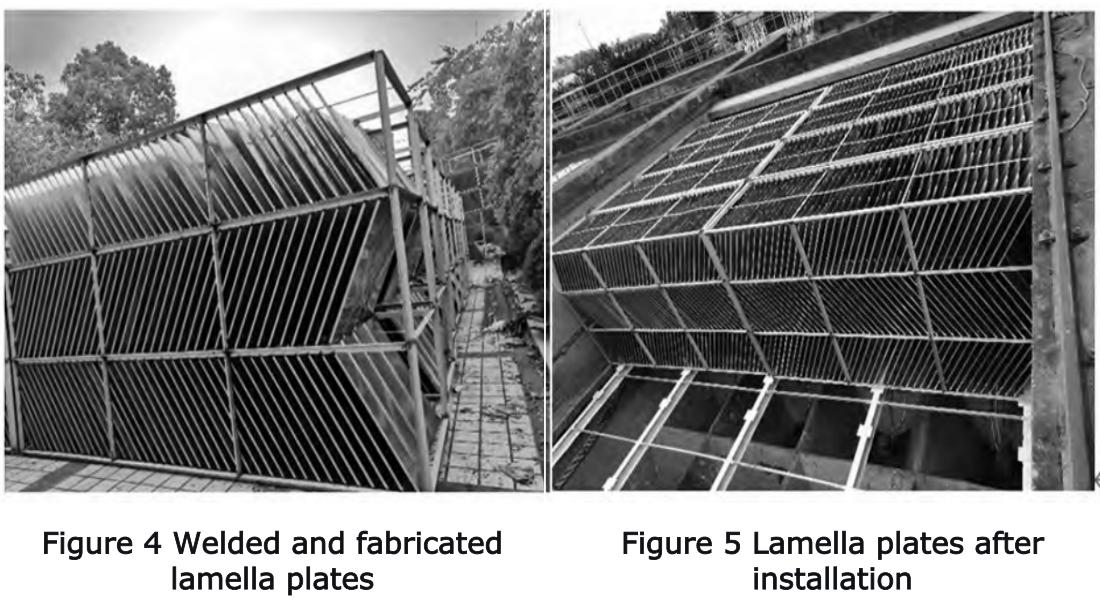
The replacement plates are 304 stainless steel, each measuring 1,250 mm × 1,000 mm × 0.8 mm. The plate surface is reinforced with vertically pressed triangular grooves 30 mm wide, with three reinforcing ribs per plate. Both vertical edges are bent to form 20 mm wide reinforced edges - a detail that dramatically improves stiffness without adding weight.

The plate support frame was fabricated from 50 mm angle steel, 4 mm thick, also in 304 stainless steel. Stainless steel strips measuring 25 mm × 3 mm were used to reinforce and fix the upper and lower plate edges. These strips were slotted at 100 mm intervals to match the plate spacing - a precision detail that ensures every plate sits at exactly the design gap.
Step 3 - Welding and On-Site Logistics
Because the flotation-sedimentation tank interior did not provide sufficient space for fabrication work, all welding and plate assembly were carried out in an open area within the plant compound. Each assembled unit was then lifted into position by crane - a sequence that required careful planning but eliminated the safety and quality risks of confined-space welding.
During assembly, each plate was welded to the frame at a 60° inclination with 100 mm plate spacing. The upper and lower edges were welded to the stainless steel strips. Each plate received six fixing points: the four corners plus both sides at the top and bottom. This six-point system ensures uniform spacing and a flat, true surface across the entire plate array. After the first layer (lower section) was installed and verified, the second and third layers were completed in sequence.
VERIFIED RESULTS: 57 PARAMETERS, ALL PASSED
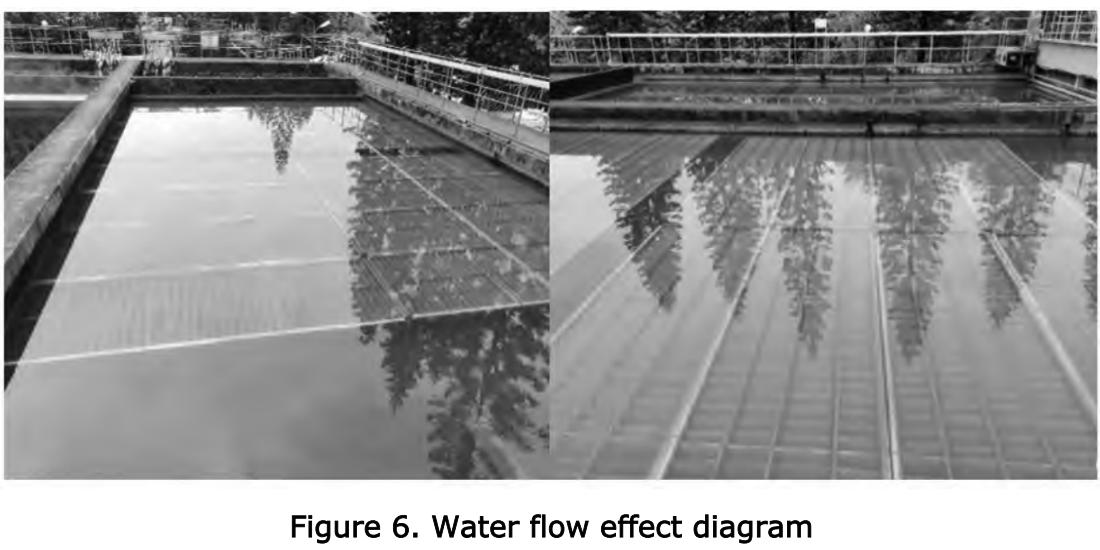
After the retrofit was completed, the finished water was tested across 57 parameters spanning five categories:
| Category | Scope | Result |
| Microbiological | Total coliforms, thermotolerant coliforms, E. coli, total bacterial count | Pass |
| Toxicological | Arsenic, cadmium, chromium (VI), lead, mercury, selenium, cyanide, fluoride, nitrate, and 10+ more | Pass |
| Sensory & Physical | Colour, turbidity, odour, taste, visible matter, pH, total hardness, TDS, and 10+ more | Pass |
| Disinfectant | Free residual chlorine, total chlorine, chlorite, chlorate | Pass |
| Unconventional | Sulphide, sodium, aluminium, iron, manganese, copper, zinc, and more | Pass |
All 57 parameters met the requirements of the "Standards for Drinking Water Quality" (GB 5749-2006). The retrofit delivered not just a material upgrade but a verified water quality outcome.
WHY STAINLESS STEEL BEAT PVC - AND WHAT IT MEANS FOR YOUR PLANT
1. Laminar flow stability. The 304 SS plates hold their shape and spacing over time. Warped PVC plates create uneven channels that destroy the Re < 500 flow regime. Rigid stainless steel preserves the hydraulic design indefinitely.
2. Cleaning without damage. High-pressure water flushing - which had become a liability with brittle PVC - is routine and safe with stainless steel. The plates resist mechanical impact and do not crack under pressure.
3. Oxidation and corrosion resistance. 304 stainless steel is inherently resistant to the oxidising environment of a water treatment tank. Unlike PVC, it does not embrittle with age. Unlike carbon steel, it does not rust.
4. Service life. A PVC inclined plate installation typically lasts 10–15 years before material degradation becomes significant. The 304 SS replacement is designed to outlast that cycle several times over - and the original PVC plates had already served for 25 years before the flood accelerated their failure.
5. Verified compliance. The retrofit was not assumed to work - it was tested. All 57 parameters under GB 5749-2006 passed. This is not a theoretical improvement; it is a measured result.
Planning an Inclined Plate Retrofit or New Installation?
Juntai supplies both PVC/PP and 304 stainless steel inclined plate and tube settler media - with full hydraulic design support including plate sizing, spacing calculations, frame design, and installation planning. Whether you are replacing aged plates or designing a new sedimentation stage, we can help you specify the right material and geometry for your water quality targets.
| Inclined Plate & Tube Settler Products | Request Retrofit Design Support | Full Product Range |