


MBBR K1 & K3 Bio Carrier Media | Biofilm Media Selection Guide for Municipal & Industrial Wastewater
K1 or K3? The Right Choice Depends on More Than Surface Area.
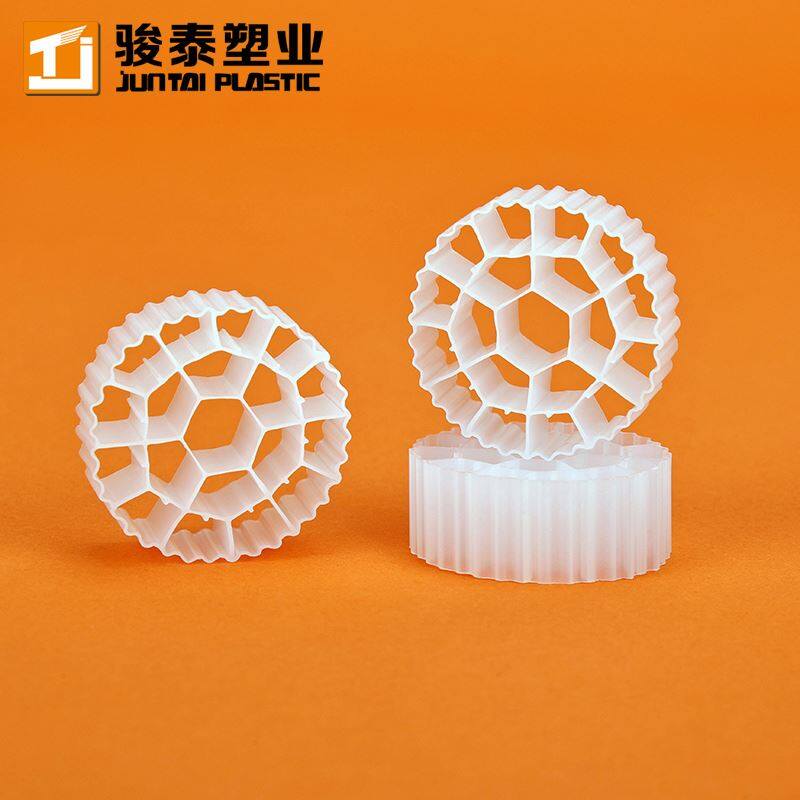
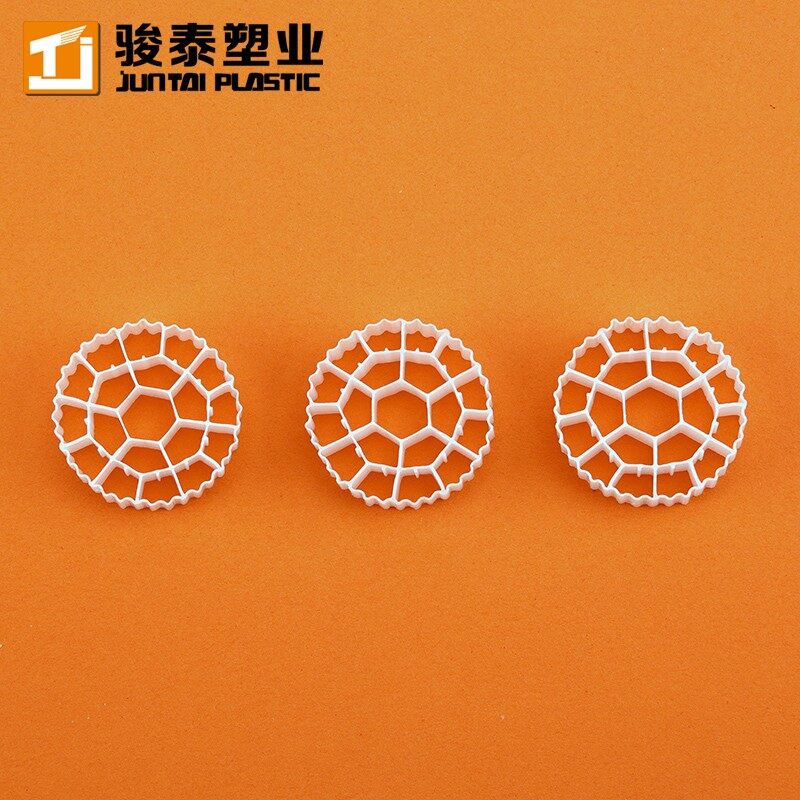
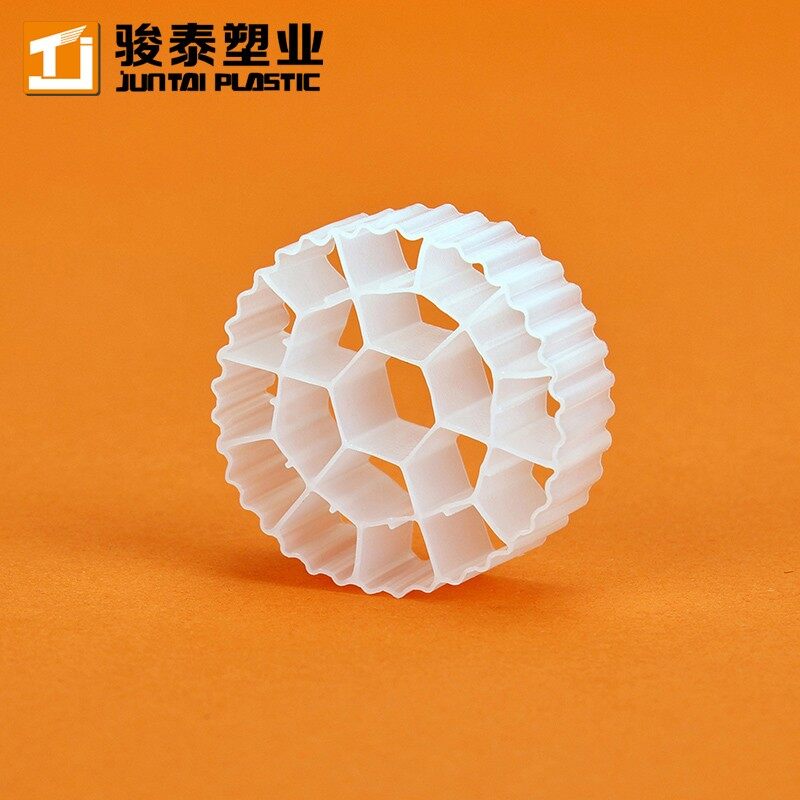
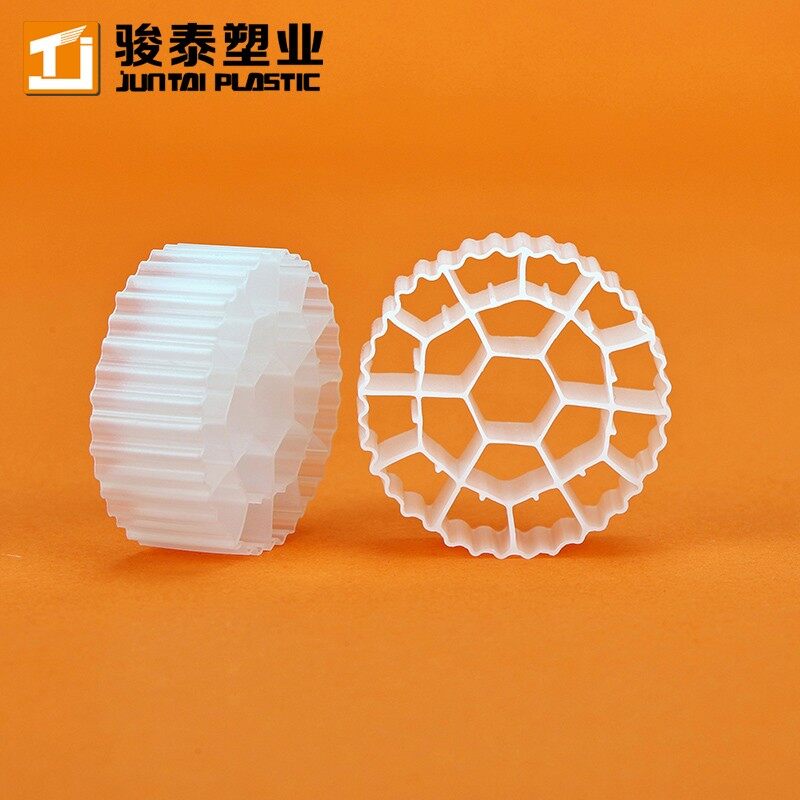
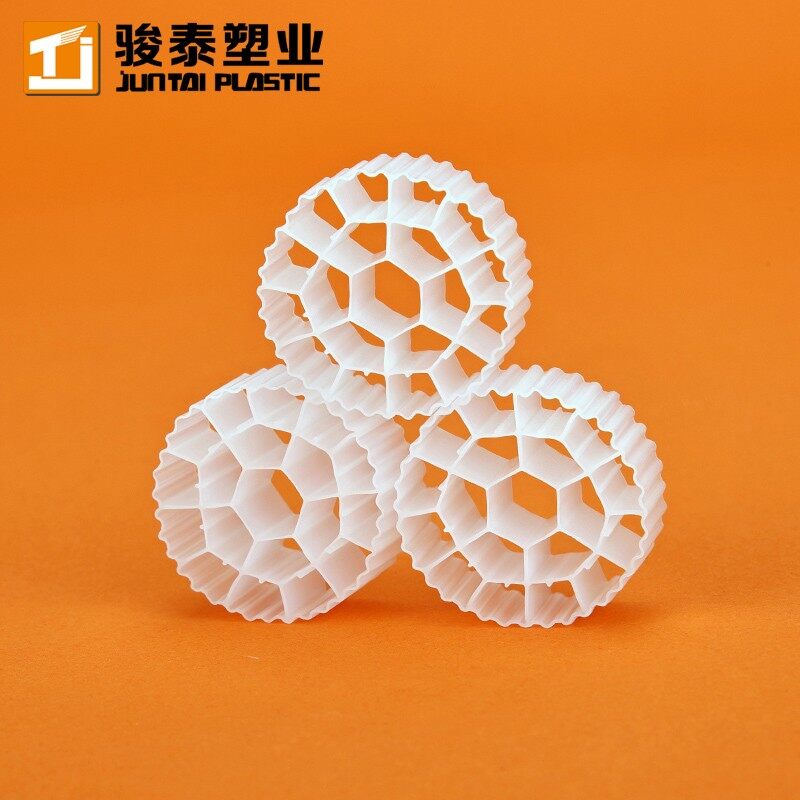
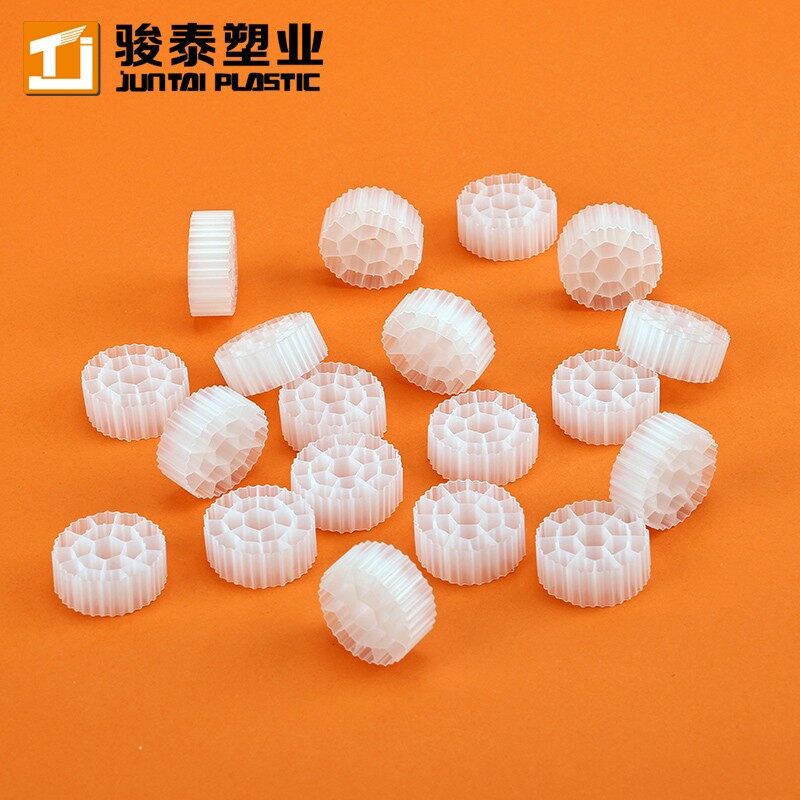
K1 and K3 are the two most widely deployed MBBR carrier geometries in the world - and the two most frequently confused. Both are cylindrical HDPE biofilm carriers with cross-wall internal structures and a nominal specific surface area of 500 m²/m³. But their dimensional differences create meaningfully different hydraulic behavior, biofilm thickness profiles, and optimal application ranges. This page explains exactly when to use each, backed by engineering parameters rather than marketing language.
All K1 and K3 carriers are manufactured at Juntai's ISO 9001-2015 certified facility in Anhui, China, from 100% virgin HDPE with UV stabilization available as standard.
K1 vs K3 - Side-by-Side Specification Comparison
| Parameter | MBBR K1 | MBBR K3 |
| Outer Diameter | 9.5 mm | 25 mm |
| Height | 7 mm | 12 mm |
| Internal fins | 4 fins | 6 fins |
| Specific Surface Area (SSA) | 500 m²/m³ | 500 m²/m³ |
| Packing density | ~550,000 pcs/m³ | ~47,000 pcs/m³ |
| Density | 0.96–0.98 g/cm³ | 0.96–0.98 g/cm³ |
| Material | 100% Virgin HDPE | 100% Virgin HDPE |
| Fill ratio (typical) | 40–67% | 40–55% |
| Aeration requirement | Moderate | Lower (easier to suspend) |
| Biofilm formation time | 7–14 days | 10–21 days |
| Service life | 15+ years | 15+ years |
| Color options | White, black, custom | White, black, custom |
| Primary application | BOD removal, nitrification, compact systems | Nitrification, denitrification, large-scale municipal STP |
Why Same SSA Doesn't Mean Same Performance
The most common misconception about K1 and K3 is that because both have 500 m²/m³ SSA, they are interchangeable. In practice, their dimensional difference creates three significant behavioral differences that affect treatment outcomes:
1. Biofilm Thickness and Oxygen Penetration
K1's smaller diameter (9.5 mm) means shorter diffusion pathways from the outer edge to the center of each internal fin channel. This allows oxygen to penetrate more uniformly across the biofilm, supporting thinner, more aerobically active biofilm layers - favorable for nitrification where oxygen availability directly controls nitrification rate. K3's larger diameter (25 mm) creates longer internal channels where oxygen gradients develop naturally, producing aerobic outer zones and partially anoxic inner zones within the same carrier. This gradient makes K3 slightly better suited to systems where some denitrification within the biofilm is acceptable or desired.
2. Hydraulic Behavior and Suspension Energy
K1's smaller mass means it requires less aeration energy to remain in suspension. In low-intensity aeration zones - such as pre-anoxic compartments with mechanical mixing rather than air - K1 stays mobile where K3 may settle. Conversely, K3's larger size means it is less likely to pass through retention screens, reducing the risk of carrier loss through overflow weirs in high-flow events.
3. Retention Screen Requirements
K1 requires retention screens with slots no wider than 6–7 mm, while K3 can tolerate 8–10 mm slot widths. In retrofit applications where existing screen infrastructure is already installed, this can influence carrier selection - replacing screens adds cost and downtime.
Which to Choose: K1 or K3?
| Your Situation | Recommended | Reason |
| Primary goal is nitrification (NH₄-N removal) | K1 or K3 (both suitable) | Similar nitrification performance at equivalent SALR |
| Compact reactor, limited aeration capacity | K1 | Lower suspension energy requirement |
| Large municipal STP, open basin design | K3 | Easier to retain, lower screen maintenance |
| Retrofit into existing basin with 8–10 mm screens | K3 | Compatible with wider slot screens already installed |
| High BOD load, need rapid biofilm startup | K1 | Faster colonization due to smaller size |
| Combined BOD removal + nitrification (single stage) | K1 | Better oxygen distribution for mixed community |
| Budget-sensitive project, cost per m³ is priority | K3 | Lower unit cost per m³ of media volume |
| Need higher surface area than K1/K3 can provide | MBBR 04 or MBBR 64 | SSA of 900–1,200 m²/m³ for compact high-rate systems |
Application Scenarios
Municipal Sewage Treatment Plants (Secondary Treatment)
K1 and K3 are the global standard for municipal MBBR secondary treatment. In a two-stage configuration - BOD removal first, nitrification second - K1 or K3 in the aerobic stage achieves BOD reduction from 200–300 mg/L to below 20 mg/L and NH₄-N reduction from 30–50 mg/L to below 5 mg/L, meeting Grade 1A and equivalent international discharge standards. The 15+ year service life makes both carriers a low-maintenance, long-term infrastructure asset.
IFAS Retrofit (Integrated Fixed-Film Activated Sludge)
K3 is the preferred carrier for IFAS retrofits into existing activated sludge aeration basins, due to its compatibility with standard retention screens and its stability under the variable aeration intensities typical of legacy blower systems. Adding K3 at 30–40% fill ratio to existing aeration tanks increases nitrification capacity by 50–100% without new civil works - the most cost-effective STP upgrade path available.
Packaged MBBR Units and Containerized Plants
For pre-engineered packaged treatment plants where reactor volume is fixed and must be minimized, K1's lower suspension energy and faster startup make it the default choice. Packaged units using K1 at 50–60% fill ratio achieve full biological performance in tanks as small as 5 m³.
Industrial Pre-Treatment
Both K1 and K3 are used for biological pre-treatment of industrial effluent before discharge to municipal sewer - reducing BOD, COD, and NH₄-N to levels that comply with trade effluent consent limits. For high-TDS or chemically complex industrial streams, consider MBBR 37 instead, which is specifically engineered for industrial conditions.
Aquaculture Biofilters
In land-based recirculating aquaculture systems (RAS), K1 is commonly used in nitrification biofilters due to its small size (fits compact biofilter vessels), fast startup, and excellent nitrification rate at the low NH₄-N concentrations typical of fish culture systems (0.5–5 mg/L). For ultra-compact RAS biofilters, MBBR 04 (SSA > 900 m²/m³) offers an even higher surface area in the same vessel volume.
Design Parameters
| Design Parameter | K1 | K3 |
| BOD SALR (design) | 5–10 g BOD/m²·day | 5–10 g BOD/m²·day |
| Nitrification SALR (design) | 0.5–1.5 g NH₄-N/m²·day | 0.5–1.5 g NH₄-N/m²·day |
| Typical fill ratio | 40–67% | 40–55% |
| Retention screen slot width | 6–7 mm | 8–10 mm |
| Aeration (coarse bubble) | 0.3–0.5 Nm³/h·m² floor | 0.3–0.5 Nm³/h·m² floor |
| Design DO (bulk liquid) | 2–4 mg/L | 2–4 mg/L |
| Operating temperature | 5°C – 40°C | 5°C – 40°C |
| Operating pH | 6.5–8.5 | 6.5–8.5 |
For a complete step-by-step MBBR sizing calculation including SALR, reactor volume, HRT, and aeration demand, see our MBBR Design & Calculation Guide.
Juntai K1 & K3 Quality Standards
100% virgin HDPE - No recycled material. Virgin resin ensures consistent density (0.96–0.98 g/cm³) and chemical inertness. Carriers made from recycled HDPE vary in density lot-to-lot, causing inconsistent buoyancy and uneven distribution in the reactor.
Precision extrusion - All K1 and K3 carriers are produced on automated extrusion lines with in-line dimensional QC. Fin geometry and wall thickness are held to tight tolerances to ensure SSA consistency across every batch.
UV stabilization available - For outdoor installations or open-air basins, UV-stabilized HDPE compound is available as standard option at no additional lead time.
ISO 9001-2015 certified - Full quality management system certification covering raw material intake, production, and final inspection.
SGS and RoHS compliant - Third-party tested. Documentation available on request for project compliance submissions.
Packaging & Logistics
| Item | K1 | K3 |
| Packaging | Woven PP bags | Woven PP bags |
| MOQ | No minimum | No minimum |
| Shipping terms | FOB Ningbo / Shanghai | FOB Ningbo / Shanghai |
| Samples | Available on request | Available on request |
Frequently Asked Questions
Can K1 and K3 be mixed in the same reactor?
Technically possible, but not recommended. Mixed sizes create uneven hydraulic distribution - smaller K1 pieces tend to concentrate in high-flow zones while larger K3 settles in low-energy areas. For best results, use a single carrier type per reactor stage.
How long does it take for biofilm to establish on K1/K3?
Under normal conditions with adequate nutrient supply, visible biofilm forms within 7–14 days on K1 and 10–21 days on K3. Seeding with return activated sludge (RAS) from an existing plant reduces startup time by 30–50%. Water temperature below 15°C significantly slows colonization - plan accordingly for cold-climate startups.
What pre-treatment is required before the MBBR stage?
Bar screening (≤ 3 mm) and grit removal are essential. Coarse solids accumulate in carrier channels over time, reducing effective surface area. For high-TSS industrial influent (> 200 mg/L), a settling or DAF stage ahead of the MBBR is recommended.
Do I need K1/K3, or would MBBR 04 or 64 serve me better?
K1 and K3 at 500 m²/m³ are the right choice for most municipal and light industrial applications where reactor volume is not severely constrained. If you need to maximize treatment capacity in a fixed tank volume, consider MBBR 04 (> 900 m²/m³) or MBBR 64 (> 1,200 m²/m³). Our engineering team can help you compare options for your specific flow and load conditions.
Are samples available before bulk order?
Yes. Sample quantities of K1 and K3 are available for biofilm pilot trials, laboratory testing, or client approval. Contact us to arrange.
Related Products
Looking for higher surface area or specialized applications? Explore the full Juntai MBBR carrier range:
• MBBR 19 - 25×12mm, >650 m²/m³ - cost-effective large-scale municipal projects
• MBBR 37 - 25×12mm, >800 m²/m³ - industrial high-TDS, pharmaceutical, chemical wastewater
• MBBR 04 - 11×7mm, >900 m²/m³ - aquaculture RAS, compact high-rate nitrification
• MBBR 64 - 25×4mm, >1,200 m²/m³ - ultra-high-rate, space-critical applications
• HPU Bio Filler - polyurethane sponge, >6,000 m²/m³ - SND, high-concentration industrial WW
Key Advantages:
Aquaculture operations often struggle with ammonia and nitrogen buildup, which our media efficiently neutralizes. By fostering a healthier aquatic environment, it not only eliminates odors but also boosts efficiency, allowing aquatic life to thrive. The media is primarily deployed in the aerobic zones of MBBR systems, though some users integrate it into deodorizing towers for enhanced odor control.
About JunTai Plastic:
Our company is committed to environmental sustainability and leads the industry in water treatment solutions. We offer a wide range of products on our website, reflecting our dedication to providing diverse options for our clients. With top-tier R&D and production capabilities, we continuously push boundaries to deliver innovative, eco-friendly technologies.


One-stop Watertreatment Products Factory in China


