


Upgrading Design and Practice of the Xin'an Qianhe Water Quality Purification Plant Based on the AAOAO-MBBR Process and Ozone Oxidation
Qingdao, as a key national coastal central city, has achieved significant results in ecological governance. However, compared to top-tier international metropolises, its urban water environment management system still faces structural challenges.
Currently, there are gaps between the coverage rate of the drainage pipe network, the operational efficiency of wastewater treatment facilities, and public expectations for a high-quality water environment. There is also a distance from realizing the ecological vision of building a "Beautiful Qingdao."
To address these challenges, Qingdao urgently needs to implement systematic measures such as scientific planning, optimized resource allocation, and strengthened infrastructure investment. These efforts aim to comprehensively enhance the efficiency of the wastewater collection network and terminal treatment capacity, thereby solidifying the ecological foundation for the city's sustainable development.
The Xin'an Qianhe Water Quality Purification Plant project is located in the West Coast New Area of Qingdao. It has a designed treatment capacity of 50,000 m³/d, a total site area of 33,154 m², and a total investment of 182.4 million yuan. The feasibility study report for the project was completed in March 2021, the preliminary design and budget were approved in June of the same year, and construction officially commenced in April 2023. It is currently in the construction phase. The original design required that key effluent parameters meet the Class V standards specified in GB 3838-2002 "Environmental Quality Standards for Surface Water," while total nitrogen (TN) and other indicators were to meet the Grade A standards of GB 18918-2002 "Discharge Standard of Pollutants for Municipal Wastewater Treatment Plants."
In March 2022, the Qingdao Water Affairs Administration issued the "Notice on Carrying Out Upgrading and Renovation Work for Urban Wastewater Treatment Plants in Qingdao." This notice required treatment plants around Jiaozhou Bay, Bohai Bay, and along rivers to complete upgrades, raising the discharge standard to quasi-Class IV surface water quality, with effluent TN controlled between 10-12 mg/L. The release of this policy fell within the interval between the project's preliminary design approval (June 2021) and its physical commencement (April 2023), creating a technical gap between the already approved original design standards and the latest environmental requirements. As a new wastewater treatment facility in the West Coast New Area, to ensure compliance upon completion, it became imperative to concurrently carry out process optimization during the construction phase and develop an economically feasible upgrading plan through feasibility studies.
1. Process Scheme Design and Selection
1.1 Designed Effluent Quality
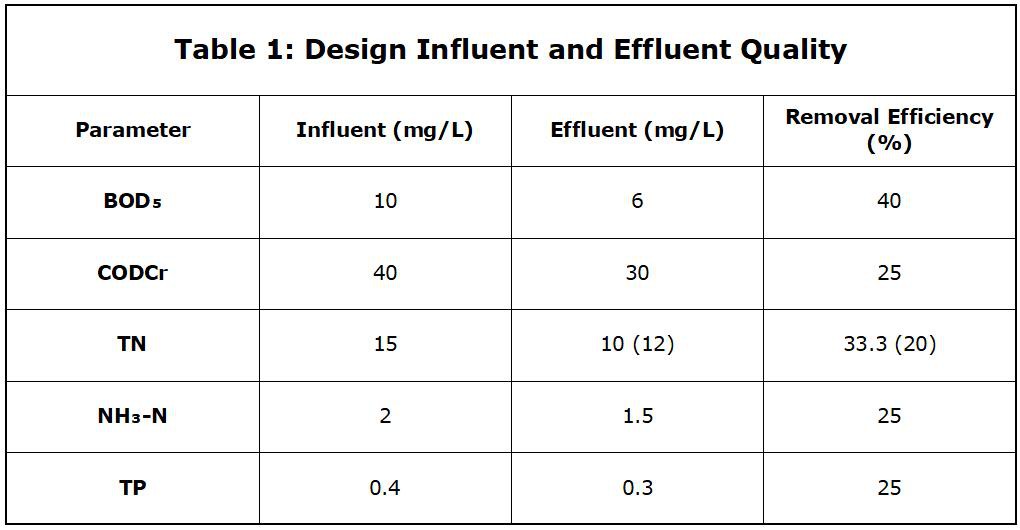
The project's effluent standards were upgraded from quasi-Class V to quasi-Class IV surface water quality. Reasonable technical solutions were needed to further reduce values of indicators such as BOD, CODCr, TN, NH₃-N, and TP in the effluent. Specific analysis is shown in Table 1.
1.2 Engineering Technical Scheme Selection
The process flow of the plant under construction is shown in Figure 1.
The plant under construction adopts the "Pretreatment + Modified AAOAO Biochemical Tank + Secondary Sedimentation Tank + High-Efficiency Sedimentation Tank + V-Type Filter + Ozone Oxidation" process. The layout of the structures is compact, leaving no surplus land for the upgrading project, which therefore must be based on the ongoing construction. The upgrade primarily targets the removal of pollutants such as CODCr, NH₃-N, TN, and TP. Two comparative schemes were proposed, as detailed in Table 2.


Scheme 1: AAOAO-MBBR + High-Efficiency Sedimentation Tank Process
- Biochemical System Modification: Optimize the structure of the AAOAO biochemical tank under construction. Enhance denitrification capacity by expanding the anoxic zone volume. Simultaneously, add MBBR carriers locally in the aerobic zone to form a composite process, strengthening the biochemical removal efficiency of NH₃-N and TN.
- Physicochemical System Upgrade: Optimize the tank structure and supporting equipment parameters of the high-efficiency sedimentation tank to ensure stable TP compliance.
- Advanced Treatment Enhancement: Increase the dosage in the ozone oxidation unit to further degrade refractory organic matter, ensuring CODCr discharge compliance.
Scheme 2: High-Efficiency Sedimentation Tank + Denitrifying Deep Bed Filter Process
- Operation Mode Optimization: Maintain the original structure of the AAOAO biochemical tank. Add adjustable aeration devices in the post-anoxic zone to dynamically switch between anoxic/aerobic modes based on influent quality, ensuring NH₃-N treatment effectiveness.
- Physicochemical System Upgrade: Optimize the tank structure and supporting equipment parameters of the high-efficiency sedimentation tank to ensure stable TP compliance.
- Adoption of Denitrifying Filter: Convert the V-type filter to a denitrifying deep bed filter, utilizing carbon source dosing to enhance TN removal capability.
- Advanced Treatment Enhancement: Increase the dosage in the ozone oxidation unit to further degrade refractory organic matter, ensuring CODCr discharge compliance.
Both schemes can meet the requirements for nitrogen and phosphorus removal. Scheme 1 utilizes modifications to the biochemical tank to achieve TN removal. Its advantage lies in making full use of the influent carbon source. When influent TN fluctuates, an external carbon source can also be added in the anoxic zone for TN removal. In comparison, the denitrifying deep bed filter used in Scheme 2 necessitates the use of an external carbon source and requires long-term maintenance of microbial activity in the filter, increasing operational costs. Although the construction investment costs for both schemes are comparable, based on multidimensional considerations including operational cost control, process stability, and carbon source utilization efficiency, Scheme 1-which offers both economic efficiency and operational flexibility-was ultimately selected as the implementation process for the upgrading project.
2. Key Engineering Design Points
2.1 Biochemical System Modification
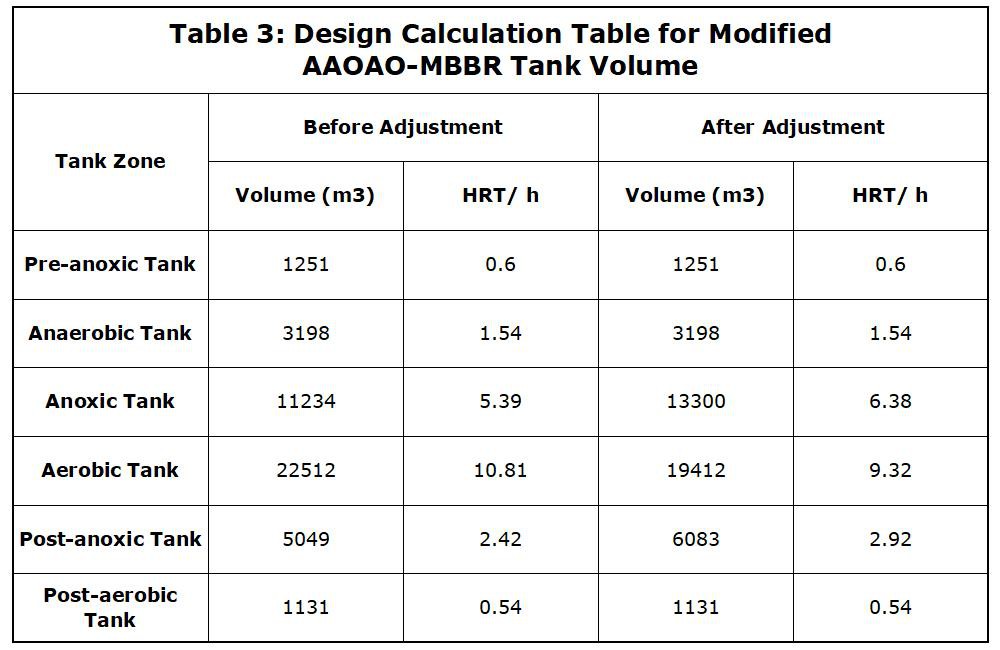
The core technology of the MBBR process lies in achieving efficient fluidized movement of suspended carriers through design, thereby significantly enhancing the system's biodegradation efficiency for pollutants. This process system consists of five key elements: high-mechanical-strength biofilm carriers, an adapted hydraulic tank structure, a directional aeration system, a precise interception screen device, and fluid propulsion equipment. Based on the adjusted tank volumes and the design parameters of an operational 20,000 m³/d wastewater treatment equipment (MBBR) rental project within the regional sewage system, the calculated total required effective surface area of the suspended carriers is approximately 2,164,000 m². The designed effective specific surface area of the MBBR carriers is greater than 750 m²/m³. The design calculation table for the modified AAOAO-MBBR tank volume is shown in Table 3.
2.2 Physicochemical System Upgrade
The high-efficiency sedimentation tank is designed to operate in two parallel groups. This unit's renovation adopts a process package form, with the equipment supplier providing full-process technical guarantees and performance commitments. The core process parameters and equipment configurations are as follows.
The coagulation tank consists of two groups with a total of 4 compartments. The designed single compartment size is 2.675 m × 2.725 m × 5.9 m. The peak detention time is approximately 3.8 minutes, with a velocity gradient (G) ≥ 250 s-¹. Each agitator is configured with a single-unit power of 4 kW.
The flocculation tank consists of two groups with a total of 2 compartments. The designed single compartment size is 5.65 m × 5.65 m × 5.9 m. The peak detention time is approximately 8.3 minutes. The inner diameter of the draft tube is 2,575 mm. It is configured with Φ2,500 mm turbine-type agitators, each with a power of 7.5 kW.
The sedimentation tank consists of two groups. The inclined tube area for a single group is approximately 84 m². The sedimentation tank diameter is 11.7 m. The designed average hydraulic loading rate on the inclined tube surface is 12.4 m³/(m²·h), with a peak value of 16.1 m³/(m²·h). The designed average hydraulic loading rate for the sedimentation zone is 7.6 m³/(m²·h), with a peak value of 9.9 m³/(m²·h).
The chemical dosing system is configured as follows: Commercial Polyaluminum Chloride (PAC) liquid (10% Al₂O₃) is designed as the coagulant, dosed at multiple points in the influent section of the coagulation tank. The designed maximum dosage is 300 mg/L, with an average dosage of 150–200 mg/L. Mechanical diaphragm metering pumps are used, configured with a 10-fold online dilution system. Anionic Polyacrylamide (PAM) is designed as the flocculant, dosed in the flocculation section of the high-efficiency sedimentation tank. A set of fully automatic continuous PAM solution preparation and dosing unit is used, with a solution concentration of 2 g/L. The designed maximum dosage is 0.6 mg/L, with an average dosage of 0.3 mg/L. Dosing pumps are screw-type metering pumps, also equipped with a 10-fold online dilution system.
2.3 Pilot-Scale Ozone Oxidation Experiment Verification
To verify the feasibility of the upgraded plant's effluent stably meeting Class IV surface water standards (COD concentration ≤ 30 mg/L), this study selected the secondary effluent from the first and second phases of the Lianwanhe Water Quality Purification Plant as the research subject in June 2024. A performance verification experiment for the "Sand Filtration + Ozone Oxidation" advanced treatment process was conducted. The experiment aimed to evaluate the applicability of this process to the Xin'an project design and the achievability of the target.
This experiment utilized the existing small-scale sand filtration unit (treatment capacity 1.5 m³/h) within the Lianwanhe plant. A pilot-scale ozone oxidation reaction device (tower reactor, effective volume 0.5 m³) was set up on-site. The existing secondary sedimentation tank effluent was filtered by the small sand filter, then lifted by a pump to enter the ozone oxidation tower from the top. The oxidizing effect of ozone was used to remove refractory organic matter from the influent, achieving further COD reduction.
2.3.1 Performance of "Sand Filtration + Ozone Oxidation" at Ozone Dosage of 20 mg/L and HRT of 30 min
During this research phase, the influent COD concentration ranged from 38.2 to 43.4 mg/L, with an average of 40.4 mg/L. After treatment by the "Sand Filtration + Ozone Oxidation" process, the final effluent COD averaged 28.8 mg/L. The experiment found that when the COD concentration was high, there were still instances where the effluent COD failed to meet the standard. Additionally, the final effluent color from the pilot test remained higher than the influent, not meeting the discharge standard. Details are shown in Figure 2(a).

2.3.2 Performance of "Sand Filtration + Ozone Oxidation" at Ozone Dosage of 25 mg/L and HRT of 30 min
To further improve COD removal and reduce effluent color, this phase continued to increase the ozone dosage while maintaining the HRT at 30 min. In this experimental phase, the influent COD concentration ranged from 36.3 to 46.2 mg/L, averaging 40.4 mg/L. After treatment, the COD concentration was reduced to 28 mg/L. The final effluent color from the pilot test still remained higher than the influent, not meeting the discharge standard. Details are shown in Figure 2(b).
2.3.3 Performance of "Sand Filtration + Ozone Oxidation" at Ozone Dosage of 30 mg/L and HRT of 30 min
Under the conditions of an ozone dosage of 30 mg/L and an HRT of 30 min, the "Sand Filtration + Ozone Oxidation" process showed good treatment effectiveness for secondary effluent COD. In this test phase, the influent COD concentration ranged from 38.2 to 42.2 mg/L, averaging 40.2 mg/L. After treatment, the effluent COD concentration remained stable below 30 mg/L, averaging 26 mg/L. In this phase, the process also demonstrated good color removal effectiveness, with measured color consistently below 20, stably meeting the discharge standard. Details are shown in Figure 2(c).
2.3.4 Experimental Conclusion
Based on the experimental results, under optimal reaction conditions, the ratio of ozone dosage (30 mg/L) to COD removal (12.2 mg/L) in the ozone treatment unit was 2.45:1.00.
The pilot experiment proved that the "Sand Filtration + Ozone Oxidation" advanced treatment process can effectively reduce the COD value of the representative secondary effluent from the Lianwanhe plant. Therefore, adopting the "Sand Filtration + Ozone Oxidation" process as the advanced treatment process for the Xin'an Qianhe project has good feasibility and can ensure the project's effluent COD remains stable below 30 mg/L.
3. Conclusion
This research focuses on three core modification modules: the biochemical treatment system adopts the AAOAO-MBBR hybrid (suspended and attached growth) process; the physicochemical treatment unit optimizes the tank structure and equipment selection for the high-efficiency sedimentation tank; and the advanced treatment link is validated through a pilot-scale ozone oxidation experiment.
Through the synergistic optimization of this process chain, a full-process treatment system of "Biochemical Enhancement – Physicochemical Improvement – Advanced Safeguard" is constructed. Simultaneously, this engineering design follows the objective fact of the ongoing current project construction, necessitating coordinated optimization of construction sequences for all structures to maximize the use of existing facilities and minimize renovation workload.
The project uses the effluent quality standard of the plant under construction as the benchmark for design influent quality. The discharge concentrations of CODCr, BOD₅, NH₃-N, and TP shall comply with the Class IV standards (TN ≤ 10/12 mg/L) specified in GB 3838-2002 "Environmental Quality Standards for Surface Water." Other indicators shall comply with the Grade A standards of GB 18918-2002 "Discharge Standard of Pollutants for Municipal Wastewater Treatment Plants." This upgrading project has a design scale of 50,000 m³/d, a total investment of 27.507 million yuan, an operating cost of 0.3 yuan/m³, a total cost of 0.39 yuan/m³, and an operating water price of 0.45 yuan/m³.