


MBR Installation Mastery: Critical Field Protocols from a Wastewater Systems Specialist
With 23 years designing and commissioning membrane bioreactors, I've documented how a single installation oversight-like improper membrane cassette spacing or flawed permeate piping-can trigger irreversible fouling, reduce flux rates by 40–60%, and incur $500K+ in premature replacement costs. MBRs demand hyper-precise integration of biological, hydraulic, and membrane systems. Below are battle-tested installation imperatives rarely covered in vendor manuals.
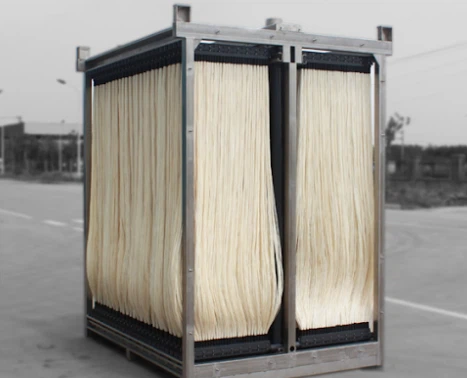
I. Pre-Installation: Beyond Warehouse to Basin Readiness
1.1 Membrane Material & Configuration Validation
Industrial vs. Municipal Systems:
- PVDF membranes dominate municipal applications but fail catastrophically in oil/grease-laden food wastewater (>50 mg/L FOG). For slaughterhouses or refineries, PTFE membranes with hydrophobic surfaces are non-negotiable. A dairy plant retrofit saw PVDF flux decline 80% in 3 months; PTFE sustained >25 LMH post-correction.
Cassette Orientation:
- Parallel flow (end-to-end header alignment) minimizes dead zones but requires 1.2× basin width.
- Series flow (staggered headers) fits narrow basins but risks 15–20% flux imbalance. Laser-scan basin dimensions before finalizing layout.
1.2 Bioreactor Conditioning: The Overlooked Catalyst
Active Sludge Seeding:
- Inject 2,500–3,000 mg/L MLSS from operational bioreactors 72 hours pre-membrane immersion.
- Critical parameter: F/M ratio 0.05–0.1 kg BOD/kg MLSS/day. Higher ratios trigger irreversible pore blinding during commissioning.
Pre-Aeration Calibration:
- Fine-bubble diffusers must achieve >2.0 mg/L DO basin-wide before membrane submersion. An electronics factory startup failed because DO gradients varied from 0.8–4.2 mg/L-membranes fouled asymmetrically.
Pre-Installation Verification Checklist:
| Checkpoint | Acceptance Threshold | Verification Tool | Consequence of Deviation |
|---|---|---|---|
| Concrete basin flatness | ≤3 mm/m² | Laser level + straight edge | Membrane cassette stress fractures |
| Permeate pipe debris | Zero particulates >50 µm | Endoscope + white glove test | Blocked headers, flux collapse |
| MLSS concentration | 2,500±300 mg/L | Portable TSS analyzer | Biomass shock during commissioning |
| Residual construction chemicals | Chlorine <0.1 ppm, oils ND | Hach DR900 colorimeter | Membrane oxidation/surface fouling |
II. Membrane Cassette Installation: Surgical Precision Protocols
2.1 Handling & Submersion: Avoiding $10,000 Mistakes
- Crane Lifting: Use spreader bars with 4-point attachment. Single-point lifts bend frames >2°, warping fiber alignment.
- Submersion Rate: Lower at 0.3 m/minute. Faster rates trap air pockets, causing buoyancy-induced frame collisions.
- Anti-Scour Padding: Place 30 mm EPDM mats under frames if basin floor has abrasive finishes.
2.2 Leveling & Spacing: Geometry Dictates Performance
- Level Tolerance: <2 mm/m (checked via digital inclinometer).
- Inter-Cassette Gap: Minimum 100 mm for air scour uniformity. In Shanghai's WWTP, 70 mm gaps caused 30% lower scouring at center cassettes.
- Wall Clearance: 200 mm minimum to prevent vortex fouling.

III. Piping & Instrumentation: Hidden Hydraulic Traps
3.1 Permeate Piping – The Silent Flux Killer
- Slope: 0.5° upward toward collection header prevents air locking.
- Velocity: Maintain 1.0–1.5 m/sec. Velocities <0.8 m/sec promote sludge settling; >2.0 m/sec erodes PVDF fibers.
- Pulsation Dampeners: Install if pump stroke frequency exceeds 45 Hz to prevent fiber fatigue.
3.2 Air Scour System Integration
- Manifold Balancing: Adjustable orifices mandatory per cassette row. Field measurements should show <5% airflow variation.
- Pipe Material: Use SCH 80 CPVC for ozone-resistant air lines. Standard PVC cracks within 18 months when ozonation is used.
IV. Commissioning: The 72-Hour Make-or-Break Protocol
Phase 1: Membrane Conditioning (0–24 hrs)
- Flux: 50% design flux (e.g., 15 LMH for 30 LMH nominal)
- Aeration: Continuous coarse bubble (50 Nm³/hr per cassette)
- Permeate: Recirculate to bioreactor-never discharge yet
Phase 2: Biomass Acclimation (24–48 hrs)
- Increment flux by 5 LMH/hour until reaching 80% design
- Monitor TMP every 15 minutes; abort if ΔP >0.3 bar/hour
Phase 3: Stabilization (48–72 hrs)
- Sustain target flux + relaxation cycles (9 min filtration / 1 min pause)
- Performance Pass/Fail: TMP stability ±0.05 bar/hour
V. Avoiding Catastrophic Failures: Post-Installation Safeguards
5.1 Membrane Parking Protocol (>48 hr idle periods)
- Wet Parking: Immerse in 200 ppm NaHSO₃ solution (pH 3.5–4.0)
- Dry Parking: Flush with 1,000 ppm citric acid + N₂ purging
5.2 First 90-Day Maintenance Lockdown
- Daily: Record TMP, flux, MLSS, COD removal efficiency
- Weekly: 0.1% citric acid CIP at 35°C (even if TMP stable)
- Monthly: Fiber integrity test (pressure decay <5%/min)

VI. Long-Term Performance Optimization
Critical Data Correlation:
- Sludge Viscosity vs. Flux: MLSS >12,000 mg/L requires reducing flux 0.5 LMH per 1,000 mg/L increase.
- Temperature Compensation: Permeability drops 2% per °C below 15°C-increase SADm accordingly.