


Microporous Aeration Discs for Indonesia's Palm Oil & Food Processing Wastewater
Indonesia's industrial sector, led by palm oil and food processing, is a cornerstone of the national economy-but it generates massive volumes of high-strength wastewater with extreme COD and BOD levels. Palm oil mill effluent (POME) alone accounts for over 60 million cubic meters of wastewater annually, with raw COD concentrations reaching 20,000 mg/L or more. Nata de coco and fish processing facilities add to the burden, producing effluents with complex organic contaminants that damage waterways and violate Indonesia's Ministry of Environment and Forestry (MOEF) Regulation No. 5 of 2014. Outdated coarse bubble and mechanical aeration systems fail to treat these high-concentration effluents efficiently, leading to non-compliance, hefty fines and environmental harm. Microporous aeration discs have emerged as the game-changing solution, delivering the high oxygen transfer efficiency needed to break down Indonesia's industrial wastewater pollutants while slashing energy and maintenance costs.
-
Why Indonesia's Industrial Sector Needs Microporous Aeration Discs
Indonesia's industrial wastewater treatment faces distinct challenges: ultra-high COD/BOD levels in palm oil and nata de coco effluents, strict discharge limits (COD < 200 mg/L for direct release), scattered industrial facilities across rural and urban areas, and the need for low-energy solutions in a country with high electricity costs. Traditional aeration methods-such as water wheel aerators and coarse bubble diffusers-have an oxygen transfer efficiency (OTE) of just 8-15% in industrial wastewater, requiring excessive energy to treat high-pollutant loads and often failing to meet MOEF standards.
Microporous aeration discs solve these issues by delivering an OTE of 30-35% in actual industrial effluents, enabling efficient biodegradation of high-concentration organics. For palm oil mills-the backbone of Indonesia's agribusiness-these discs reduce POME's COD from 20,000+ mg/L to below 175 mg/L, fully complying with local discharge rules. For nata de coco facilities, they maintain a consistent COD removal efficiency of 96% even with fluctuating organic loads, a critical advantage for this fast-growing food processing sector.
-
How Microporous Aeration Discs Work for Indonesia's Industrial Wastewater
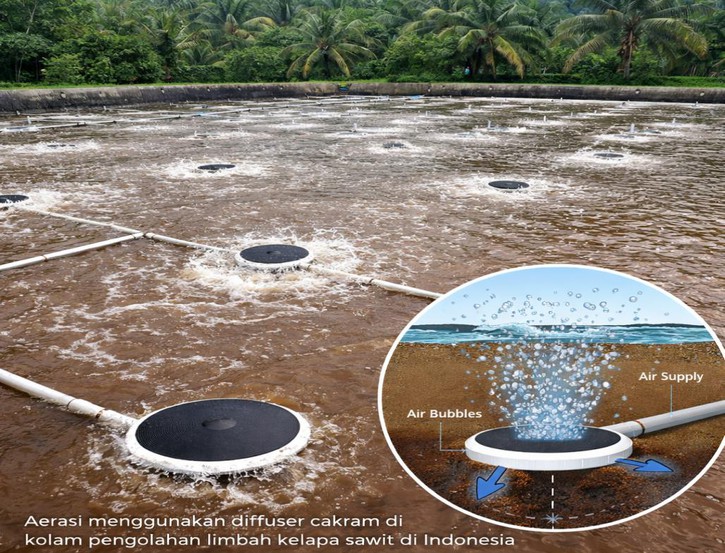
Installed at the bottom of aeration tanks (3-4m depth, optimal for Indonesia's typical tank design), microporous aeration discs connect to energy-efficient air blowers. Compressed air is forced through 80-100 micron pores in EPDM or ceramic membranes, creating 1-3mm microbubbles that rise slowly through the dense, high-organic wastewater. This slow ascent maximizes gas-liquid contact time-up to 3x longer than traditional aerators-ensuring efficient oxygen dissolution to fuel aerobic microbes that break down palm oil fats, nata de coco sugars and food processing organics.
The large surface area-to-volume ratio of microbubbles is the key: it delivers 2-3x more oxygen per kWh of energy than coarse bubbles, making it possible to treat Indonesia's high-strength wastewater without the excessive energy use of outdated systems. For palm oil mills, this means effective treatment of POME in aerobic ponds without the need for costly anaerobic pre-treatment upgrades.
-
Key Benefits of Microporous Aeration Discs for Indonesian Industries
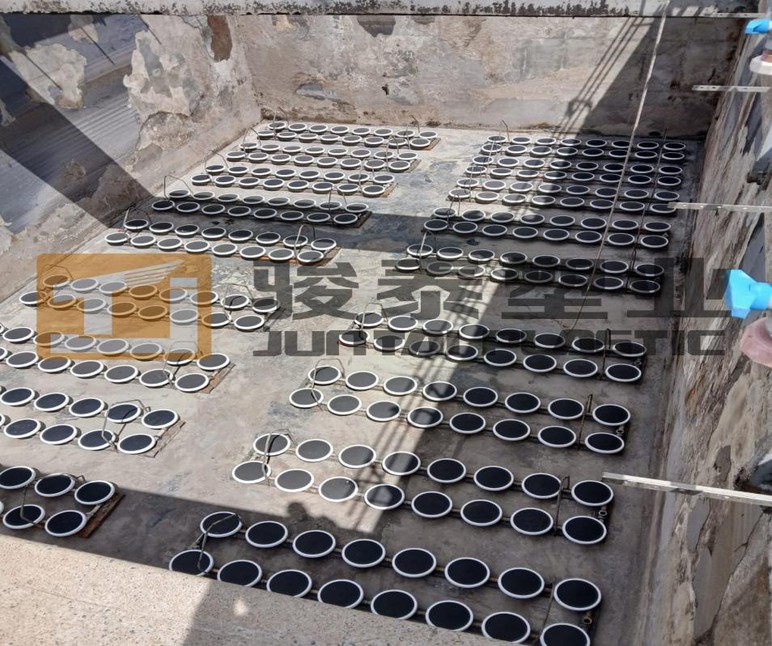
Ultra-High Pollutant Removal: Reduces palm oil mill effluent COD to 130-175 mg/L and BOD to 67-78 mg/L, fully meeting Indonesia's MOEF 5/2014 standards. For nata de coco facilities, maintains 96% COD removal efficiency even with organic load fluctuations (0.56-0.64 kg COD/m³·day).
Energy Savings of 30-50%: Aeration accounts for 60-70% of a palm oil mill's wastewater treatment energy use-microporous discs cut this by over a third, with energy consumption of just 0.8-1.2 kWh per m³ vs. 1.8-2.5 kWh for coarse bubble aerators.
Durability in Harsh Effluents: EPDM and ceramic discs resist clogging from palm oil grease and suspended solids, with a lifespan of 5-8 years-critical for Indonesia's remote palm oil mills with limited maintenance access.
Compliance with Regional Rules: Meets not only national MOEF standards but also provincial environmental regulations (e.g., West Java's strict POME treatment rules for Bogor and Cianjur regencies).
Scalability: Adapts to small-scale nata de coco factories (100 m³/day) and large palm oil mills (10,000+ m³/day), with modular installation that requires no tank redesign.
Microporous Aeration Disc vs. Traditional Aeration (Indonesia Industrial Use Case)
|
Comparison Factor |
Microporous Aeration Discs |
Coarse Bubble Aerators |
Water Wheel Aerators |
|
Oxygen Transfer Efficiency (OTE) |
30-35% (industrial wastewater) |
8-12% (industrial wastewater) |
10-15% (industrial wastewater) |
|
Energy Consumption (per m³ wastewater) |
0.8-1.2 kWh |
1.8-2.5 kWh |
1.5-2.2 kWh |
|
Compliance with Indonesia's MOEF 5/2014 |
Fully meets COD/BOD limits for all industries |
Fails for palm oil/nata de coco (high COD) |
Meets only low-COD food processing standards |
|
Maintenance Requirements |
Low (1x/year cleaning; no part replacement) |
High (monthly unclogging for grease buildup) |
High (quarterly mechanical repairs for rust/wear) |
|
Lifespan |
5-8 years |
2-3 years |
3-4 years |
|
Ideal Indonesian Industrial Use Cases |
Palm oil, nata de coco, fish processing, food manufacturing |
Small-scale low-COD food factories |
Agricultural wastewater (low organic load) |
|
5-Year Cost-Effectiveness |
High (low energy + maintenance costs) |
Low (high energy + frequent replacement costs) |
Low (high energy + repair downtime costs) |
-
Real Project Case: Palm Oil Mill in Padang, West Sumatra
A medium-scale palm oil mill in Padang (1,500 m³/day POME) was struggling with non-compliance: its old coarse bubble aeration system only reduced COD to 800 mg/L, far above Indonesia's 200 mg/L limit, and cost $12,000 per month in energy. In 2022, the mill installed EPDM microporous aeration discs (Φ300mm, 0.9mm aperture) with a pre-treatment sedimentation tank for grease removal.
Project Results:
- COD reduced to 165 mg/L, BOD to 72 mg/L-100% compliance with Indonesia's MOEF 5/2014 regulations
- Monthly energy costs cut to $5,500 (54% total energy savings)
- Maintenance time reduced from 16 hours per month to 4 hours per year (only annual cleaning required)
- Zero unplanned operational downtime in 2 consecutive years of use
-
Best Practices for Using Microporous Aeration Discs in Indonesia
POME Pre-Treatment: Add a grease trap and sedimentation tank to remove palm oil fats and large suspended solids-prevents pore clogging and extends disc lifespan by 2-3 years.
Optimal Installation: Space discs 1.5 meters apart in palm oil mill aerobic ponds (deeper than standard tanks) to ensure uniform oxygen distribution; avoid installation near pond inlets where grease accumulates.
Target DO Levels: Maintain dissolved oxygen of 3-4 mg/L for POME (higher than standard industrial wastewater) to support microbes breaking down high-concentration organics.
Material Selection: Choose EPDM discs for palm oil/food processing (resists grease and organic buildup); ceramic discs for chemical-laden food processing effluents (e.g., canned fish with preservatives).
Customized Cleaning Schedule: Clean EPDM discs annually for general food processing wastewater; clean every 6 months for palm oil mill effluent due to higher grease content.
-
Conclusion: Microporous Aeration Discs-The Core of Indonesia's Sustainable Industrial Wastewater Treatment
Indonesia's palm oil and food processing sectors can no longer afford outdated, inefficient aeration systems that fail to meet environmental rules and drain profits. Microporous aeration discs address the country's unique challenge of high-strength industrial wastewater, delivering the pollutant removal efficiency needed for compliance while slashing energy and maintenance costs. For remote palm oil mills or urban nata de coco factories, they offer a scalable, durable solution that requires no major infrastructure overhauls.
By investing in microporous aeration discs, Indonesian industrial operators turn wastewater from a liability into an opportunity-treated effluent can be reused for palm oil plantation irrigation or factory cleaning, reducing water costs and supporting Indonesia's national sustainability goals. Whether you run a palm oil mill in Sumatra or a nata de coco factory in Java, microporous aeration discs are the proven choice for efficient, regulation-compliant wastewater treatment.
Contact Us For Customized Solution:
WhatsApp:+86 137 9555 6548
Email:[email protected]