


Operation Effect of Upgrade Project of Sewage Treatment Plant in Tianjin
A wastewater treatment plant in Tianjin underwent an upgrading and renovation project adopting the Modified Bardenpho-MBBR process, elevating the effluent quality from the Grade A standard specified in the "Discharge Standard of Pollutants for Municipal Wastewater Treatment Plants" (GB 18918-2002) to the Class A standard of the Tianjin local standard DB 12/599-2015. The Moving Bed Biofilm Reactor (MBBR) process involves adding MBBR suspended carriers into the reactor, providing sites for microbial attachment and forming attached biofilms, thereby increasing the effective biomass in the system and achieving pollutant removal. The MBBR process offers advantages such as high treatment loading, strong resistance to shock loads, stable treatment performance, simple operational management, and flexible process operation. An increasing number of WWTPs in China are adopting the MBBR process for renovation. This paper analyzes the operational performance of a Tianjin WWTP after its upgrading, aiming to provide a reference for similar upgrading projects.
1. Current Biological Nitrogen and Phosphorus Removal Process
The original biological tank utilized an A²/O process with a treatment capacity of 12,500 t/d. The design total sludge age was 14 days, mixed liquor suspended solids (MLSS) concentration was 3,500 mg/L, design water temperature was 10°C, sludge yield was 0.936 kgSS/kgBOD, and sludge loading was 0.082 kgBOD/kgMLSS. The effective water depth of the biological tank was 6 m, with a total tank volume of 9,052.2 m³ and a total hydraulic retention time (HRT) of 17.4 hours. The HRT distribution was: selector zone 0.58 h, anaerobic zone 1.38 h, anoxic zone 2.85 h, swing zone 0.92 h, and aerobic zone 11.67 h. Sludge recycle was 100%, and mixed liquor internal recycle was 300%. The original biological tank primarily consisted of anaerobic-anoxic-aerobic sections. Operating parameters could be adjusted based on influent conditions and effluent requirements to achieve nitrogen and phosphorus removal, with effluent quality meeting the Grade A standard of GB 18918-2002.
2. Overview of the Upgrading and Renovation Project
This upgrade aimed to improve the effluent quality to meet the Class A standard of the Tianjin local standard "Discharge Standard of Pollutants for Municipal Wastewater Treatment Plants" (DB 12/599-2015). The designed influent and effluent quality are shown in Table 1. According to the design influent and effluent TN values, achieving an effluent TN below 10 mg/L requires a denitrification rate of 75.6% in the biological tank system. The original biological tank used an A²/O configuration. Calculations based on the original tank configuration indicated that the internal recycle ratio would need to increase from the original 200% to 310%, along with the addition of a large amount of external carbon source. This would not only increase operating costs but also, the large volume of internal recycle flow could disrupt the anoxic environment. This could lead to the actual HRT in the anoxic zone being less than the minimum requirement, affecting denitrification efficiency. The MBBR process enhances the system's denitrification capability and improves effluent quality by adding suspended carriers to increase the biomass concentration within the tank, thereby meeting the upgrade requirements.

Without changing the existing biological tank volume, the internal functional zones of the biological tank were reconfigured. The original A²/O configuration (anaerobic-anoxic-aerobic) was modified to a Bardenpho 6-stage configuration: anaerobic zone, anoxic zone, swing zone, aerobic zone, post-anoxic zone, and post-aerobic zone. Specifically, the original selector zone was converted to an anaerobic zone. The original anaerobic zone, swing zone (front part), and anoxic zone were all used as the pre-anoxic zone. The front half of the first corridor in the original aerobic zone was adjusted to a swing zone. The original first, second, and third aerobic corridors were converted into the MBBR zone, where suspended carriers were added, along with inlet/outlet screening systems and a bottom auxiliary aeration system. The fourth aerobic corridor was converted to a post-anoxic zone. The original swing zone was functionally partitioned and adjusted into post-anoxic and post-aerobic zones. The parameters of the renovated biological tank are shown in Table 2.

Regarding process operation, mixed liquor from the aerobic zone is recycled to the anoxic zone, and a carbon source is added within the anoxic zone. Denitrifying bacteria utilize the carbon source for denitrification to remove nitrate nitrogen produced in the aerobic zone. Residual nitrate nitrogen enters the post-anoxic zone, where additional carbon source is added to continue denitrification. After renovation, the mixed liquor suspended solids (MLSS) concentration is 4,000 mg/L, sludge recycle is 50%–100%, mixed liquor internal recycle is 200%–250%, and dissolved oxygen in the MBBR zone is 2–5 mg/L. The process flow chart after renovation is shown in Figure 1.

3. System Commissioning After Biological Tank Renovation
After the biological tank renovation was completed, the commissioning phase began. Dewatered sludge from another WWTP was added to the biological tank, rapidly increasing the sludge concentration to above 3,000 mg/L in a short time. This shortened the sludge cultivation and acclimation period, enabling quick startup of the biological tank and restoration of its nitrogen and phosphorus removal capacity. During the trial operation period, due to relatively low influent flow and pollutant concentrations, the actual operational load was lower than the design load. The approach was to first cultivate and acclimate the activated sludge until the biological system stabilized and effluent quality met standards, then add MBBR carriers for biofilm formation.
After the carriers were added to the aerobic section of the biological tank, they were first immersed. Microorganisms gradually attached to their surfaces. Visually, the color of the carrier surface changed from white to a faint earthy yellow as more microorganisms attached and the biofilm became denser. The carrier color gradually deepened. Two months after carrier addition, biofilm formation was good, with the carrier surface appearing yellowish-brown and the color gradually deepening. Four months after carrier addition, the biofilm on the carrier surface appeared dark brown and was dense. The progression of biofilm formation could be intuitively observed based on changes in carrier color, as shown in Figure 2. In December 2021, microscopic examination of activated sludge from the biological tank and sludge from the carriers revealed compact floc structures with good adsorption and settling properties. Visually, the carriers showed obvious biofilm formation. Microscopic examination identified organisms such as Vorticella, Opercularia, and Epistylis, with occasional sightings of a few mobile ciliates, indicating the completion of the biofilm formation stage.

4. Operational Performance After Biological Tank Renovation
4.1 Removal Performance for COD and BOD After Renovation
The effluent COD and BOD values for 2022 are shown in Figure 3. Effluent COD ranged from 10.2 to 24.9 mg/L, with an average of 18.0 mg/L. Effluent BOD ranged from 2.1 to 4.9 mg/L, with an average of 3.4 mg/L. Both effluent COD and BOD stably met the Tianjin local Class A standard. The renovated system not only demonstrated good removal performance for COD and BOD but also maintained stable and compliant effluent COD and BOD levels during the flood season, even when the plant's actual influent load reached 110% of its design capacity. This indicates that the system possesses good resistance to shock loads.

4.2 Removal Performance for TN and NH₃-N After Renovation
The effluent TN and NH₃-N values for 2022 are shown in Figure 4. TN ranged from 3.72 to 8.74 mg/L, with an average of 6.43 mg/L. NH₃-N ranged from 0.02 to 1.25 mg/L, with an average of 0.12 mg/L. During winter operation, due to lower temperatures, nitrification and denitrification rates decreased. In practice, the sludge concentration was increased to above 6,000 mg/L. Operating at high sludge concentration is beneficial for improving the biological system's resistance to shock loads, especially at low temperatures. The synergy between high sludge concentration and the biofilm attached to MBBR carriers enhances the biological system's treatment effect.
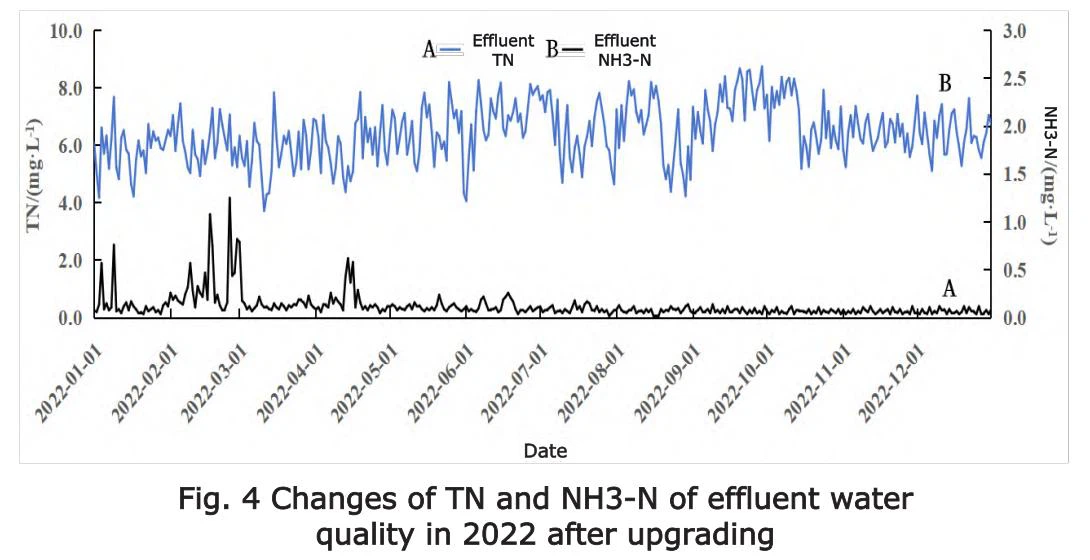
MBBR carriers provide a favorable environment for microbial communities, supporting their growth and reproduction. After acclimation and maturation, the nitrification and denitrification capacity of the biofilm strengthens. Microorganisms attach and grow layered on the carrier surface, increasing the density of zoogloea and forming large, dense, and rapidly stable sludge structures. When facing external water quality changes, microorganisms on the carrier surface secrete extracellular polymeric substances (EPS) for self-protection, thereby reducing the impact of sudden water quality changes on the inner-layer microorganisms.
In WWTPs employing the MBBR process, simultaneous nitrification and denitrification (SND) phenomena have been observed in the aerobic carrier zone. Testing the TN values of influent and effluent from the aerobic carrier zone revealed a difference of 2–6 mg/L. This difference was more pronounced, especially when the dissolved oxygen in the aerobic tank was controlled below 2 mg/L, indicating more significant SND under low dissolved oxygen conditions. The effluent TN from the secondary sedimentation tank has fully met the standards, meaning TN removal was completed within the biological treatment stage. In actual operation, the denitrifying deep-bed filter operates as a safeguard process. Under normal conditions, it functions as a regular filter to ensure the SS indicators meet standards.
4.3 Removal Performance for TP and SS After Renovation
The effluent TP and SS values for 2022 are shown in Figure 5. The WWTP's effluent TP ranged from 0.04 to 0.22 mg/L, with an average of 0.10 mg/L. Effluent SS ranged from 1 to 4 mg/L, with an average of 2.2 mg/L. After the upgrade, the secondary sedimentation tank effluent TP was around 1.0 mg/L and SS around 26 mg/L. By adding ferric chloride and PAM in the high-efficiency sedimentation tank to enhance coagulation and through further purification in the denitrifying deep-bed filter, the effluent TP and SS stably met the Tianjin local Class A standard, and the color value was significantly reduced.

5. Conclusion
To meet the Tianjin local Class A standard, the original A²/O process at the WWTP was transformed into a Bardenpho five-stage configuration, incorporating the MBBR process in the aerobic section to enhance biological nitrogen removal, reducing effluent TN and NH₃-N. During the flood season with overload flow, all indicators stably met standards, demonstrating good impact resistance. After the biological tank renovation, the internal recycle ratio was 200%–300%, external sludge recycle was 50%–100%, sludge concentration was 4,000–6,000 mg/L, dissolved oxygen in the aerobic zone was controlled at 3–5 mg/L, and dissolved oxygen in the anaerobic zone was controlled at 0.2–0.5 mg/L. In 2022, the WWTP's effluent quality was: COD 10.2–24.9 mg/L, average 18.0 mg/L; BOD 2.1–4.9 mg/L, average 3.4 mg/L; NH₃-N 0.02–1.25 mg/L, average 0.12 mg/L; TN 3.72–8.74 mg/L, average 6.43 mg/L; TP 0.04–0.22 mg/L, average 0.1 mg/L; SS 1–4 mg/L, average 2.2 mg/L. All stably met the Class A standard of the Tianjin local standard "Discharge Standard of Pollutants for Municipal Wastewater Treatment Plants" (DB 12/599-2015).