


Sewage Treatment Technology of Pre-anaerobic Micro-pore Aeration Oxidation Ditch
Introduction
Analysis of the conventional oxidation ditch process reveals that by adjusting and optimizing aeration intensity and flow patterns, wastewater is treated sequentially through anaerobic, anoxic, and aerobic reaction tanks, ensuring effective organic matter removal. However, issues such as high overall investment and low oxygen transfer efficiency are common, leading to suboptimal nitrogen and phosphorus removal. To address these limitations, in-depth research on the pre-anoxic microporous aeration oxidation ditch wastewater treatment technology has been conducted, aiming to enhance the operational efficiency of urban wastewater treatment plants and improve water resource utilization.
1. Project Overview
The wastewater treatment plant in X City primarily treats domestic sewage and industrial wastewater, with a significant volume of industrial effluent. The designed treatment capacity is 10×10⁴ m³/d. The quality standards for influent and effluent are shown in Table 1. Currently, 30% of the treated effluent is reused as reclaimed water for thermal power plants, while the remaining 70% is discharged into rivers. Based on surface water functional classifications and the Pollutant Discharge Standards for Urban Wastewater Treatment Plants, the plant must meet the Grade 1B discharge standard. With ongoing urban economic development and increasing wastewater discharge, the plant has implemented interceptive sewage treatment for domestic wastewater, expanded the sewer network, and adopted the pre-anoxic microporous aeration oxidation ditch process to reduce pollution of urban surface water sources.

2. Process Flow of the Pre-Anoxic Microporous Aeration Oxidation Ditch
The core of this process is the combination of a pre-anoxic tank and a microporous aeration oxidation ditch. The treatment sequence is as follows: wastewater → coarse screen → inlet pump house → fine screen → vortex grit chamber → anaerobic tank → anoxic/aerobic zones → secondary sedimentation tank → disinfection tank → effluent. A portion of the sludge from the secondary sedimentation tank is discharged to the sludge dewatering facility before final disposal. The process focuses on phosphorus release, biological nitrogen removal, and phosphorus removal.
2.1 Phosphorus Release
In the anaerobic tank, fermentative bacteria convert biodegradable macromolecules into smaller molecular intermediates, primarily volatile fatty acids (VFAs). Under prolonged anaerobic conditions, polyphosphate-accumulating organisms (PAOs) grow slowly and release phosphate from their cells into the solution by breaking down polyphosphates. This process provides energy for the uptake and conversion of low-molecular fatty acids into polyhydroxybutyrate (PHB) granules.
2.2 Biological Nitrogen Removal
Ammonia nitrogen is converted to nitrite and nitrate by nitrifying bacteria under aerobic conditions. In the anoxic zone, denitrifying bacteria reduce nitrate to nitrogen gas, which is released into the atmosphere. This process effectively reduces nitrogen levels in the wastewater.
2.3 Phosphorus Removal
Under aerobic conditions, PAOs utilize carbon sources and PHB to absorb orthophosphate, synthesizing polyphosphates within their cells. The accumulated phosphorus is subsequently removed from the system with the waste sludge, achieving efficient phosphorus removal.
Compared to conventional processes, the pre-anoxic microporous aeration oxidation ditch simplifies operations by eliminating primary sedimentation or reducing its duration. This allows larger organic particles from the grit chamber to enter the biological system, addressing carbon source deficiencies. The alternating anaerobic-anoxic-aerobic conditions inhibit filamentous bacteria growth, improve sludge settleability, and integrate nitrogen removal, phosphorus removal, and organic degradation. The anaerobic and anoxic zones create favorable environments for nitrogen and phosphorus removal, while the aerobic zone supports simultaneous phosphorus release and nitrification. The volume of the aerobic zone must be carefully calculated to ensure efficiency:

Where:
- X: Microbial sludge concentration (mg/L)
- Y: Sludge yield coefficient (kgMLSS/kgBOD)
- Se: Effluent concentration (mg/L)
- S0: Influent concentration (mg/L)
- θC0: Hydraulic retention time (s)
- Q: Influent flow rate (L/s)
- V0: Effective volume of aerobic reactor (L)
3. Key Aspects of the Pre-Anoxic Microporous Aeration Oxidation Ditch Technology
3.1 Pre-Anoxic Tank Technology
The pre-anoxic tank hosts anaerobic microorganisms that preliminarily decompose and transform organic matter, reducing sludge production and alleviating the load on subsequent treatment stages.
3.1.1 Process Flow
3.1.1.1 Influent Pretreatment
Screening removes suspended solids like plastics, hair, and kitchen waste using advanced biological screens. Flow and quality regulation ensure homogeneity, while sedimentation (natural or chemical-assisted) removes suspended solids and organic/inorganic matter.
3.1.1.2 Anaerobic Reaction
Controlled temperature, pH, and retention time facilitate thorough mixing of anaerobic sludge and wastewater, enhancing organic matter removal. Anaerobic reactors employ mixing or circulation to promote fermentation, producing CO₂, CH₄, and traces of H₂S. Gas-liquid-solid separation and tail gas treatment follow.
3.1.1.3 Post-Treatment and Effluent
Resistant inorganic and organic pollutants are treated via aerobic processes or activated carbon adsorption. Online monitoring tracks microbial activity and water quality indicators (e.g., F/M ratio, dissolved oxygen). The F/M ratio should average 0.06; dissolved oxygen in anaerobic zones should be 0.5–1 mg/L.
3.1.2 Process Control
Key measures include:
Cultivating anaerobic sludge with high degradation capacity and maintaining optimal nutrient ratios (C:N:P ≈ 100:5:1).
Controlling organic load, temperature (30–35°C), and pH (6.5–7.5). The organic load should be 3–6 kgBOD₅/(m³·d).
Implementing sludge recycling to maintain microbial concentration and activity. Dewatered sludge can be repurposed as fertilizer or feed.
3.2 Microporous Aeration Oxidation Ditch Technology
Sludge bulging, often caused by filamentous bacteria or zoogloea expansion, impairs settleability. The following equations describe microbial growth:
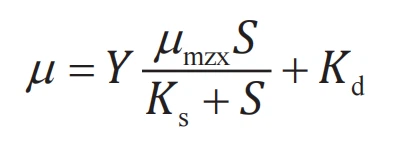
Where:
- Kd: Microbial decay coefficient (d-1)
- S: Substrate concentration (mg/L)
- Ks: Half-saturation coefficient (mg/L)
- Y: Yield coefficient (kgMLSS/kgCOD)
- μmax: Maximum specific growth rate (d-1)
- μ: Microbial growth rate (d-1)

Where:
- Smin: Minimum substrate concentration at steady state (mg/L)
- Kd: Microbial decay coefficient (d-1)
- Ks: Half-saturation coefficient, i.e., the substrate concentration when μ=μmax/2μ=μmax/2 (mg/L)
- Y: Yield coefficient (kgMLSS/kgCOD)
- μmax: Maximum specific growth rate (d-1)
3.2.1 Process Design Parameters
Wastewater passes through screens, grit chambers, and anaerobic tanks (with mixers) before entering the oxidation ditch. Microporous aerators and submerged propellers create alternating aerobic/anoxic conditions. The system includes two anaerobic tanks (2.8h HRT) and four oxidation ditches (8.64h HRT). Sludge age is 11.3 days.
3.2.2 Pilot-Scale Device Design
The pilot system includes an aerated grit chamber, pumps, anaerobic selector, oxidation ditch, sludge Reflux pump, secondary settler, and effluent pump. The anaerobic selector (2.35 m³) has three compartments with mixers and monitors (ORP, pH). The oxidation ditch (26.3 m³) features multiple inlets/outlets and microporous diffusers. Testing showed influent averages: SS 160 mg/L, COD 448 mg/L, TP 4 mg/L.
Conclusion
The integration of pre-anoxic and microporous aeration oxidation ditch technologies significantly improves nitrogen and phosphorus removal. Future efforts should focus optimizing sludge age, dissolved oxygen, and sludge reflux ratio to further enhance treatment efficiency.