


▬ Main product view
01 Why HPU Beats Plastic Carriers
Plastic MBBR carriers grow biofilm only on channel surfaces, so biomass stays exposed to shear, startup drags on for weeks, and nitrogen removal needs separate anoxic tanks. Juntai HPU Bio-Filler turns that model on its head: an open-cell sponge matrix that physically entraps biomass, colonizes in 3-7 days and creates aerobic and anoxic zones inside a single piece of media.
|
3-7 days
Rapid Biofilm Startup
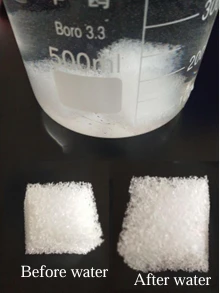
Hydrophilic active groups (amino, carboxyl, epoxy) attract water and microorganisms instantly - no pre-soaking, no 2-3 week commissioning delay.
|
77-87%
TN Removal via SND
Aerobic nitrifiers near the surface and anoxic denitrifiers in the core deliver simultaneous nitrification and denitrification in one reactor stage.
|
>6,000
m2/m3 Surface Area
The dual macro/micro-pore foam gives 5-12x the specific surface of HDPE plastic carriers - far lower carrier volume for the same treatment load.
|
Entrapped
Biomass Retention
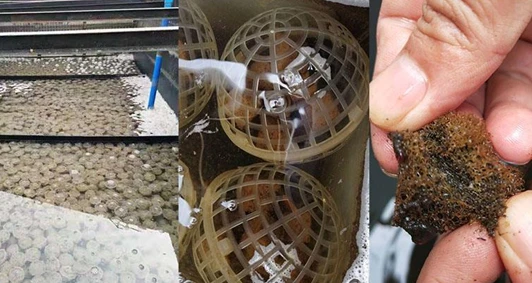
Microorganisms are trapped inside the 3D foam matrix, so shock loads and hydraulic surges cannot strip the biofilm the way they strip plastic carriers.
|
02 Technical Specifications
|
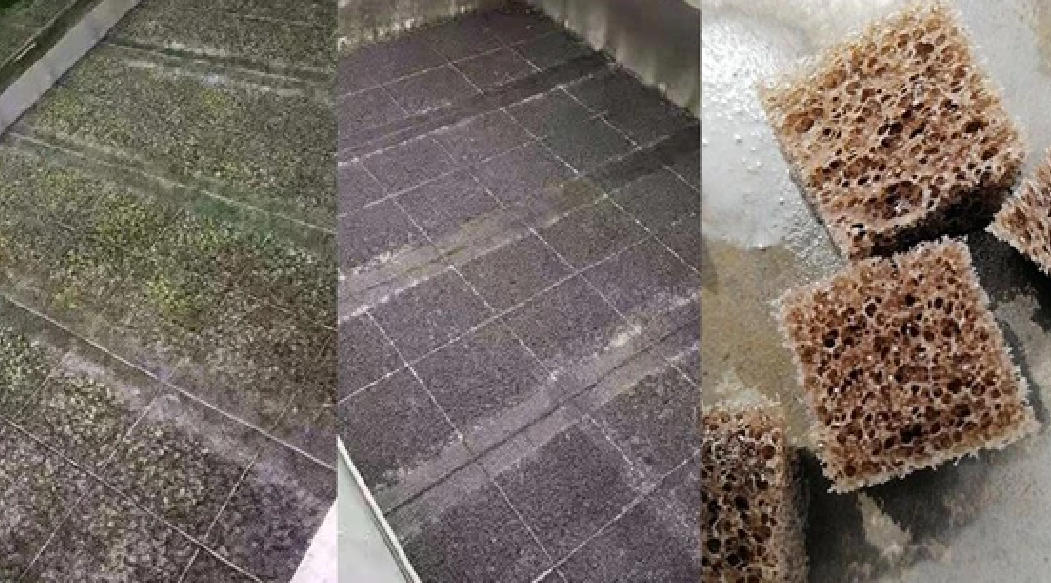
▬ Cross-section & grid layout |

03 HPU Sponge vs Plastic MBBR Carriers
The table below compares Juntai HPU sponge media with conventional HDPE plastic MBBR carriers on the parameters that drive biological treatment performance and reactor cost.
|
Property
|
HPU Sponge (Juntai)
|
HDPE Plastic Carrier
|
|
Specific surface area
|
> 6,000 m²/m³
|
500–1,200 m²/m³
|
|
Biofilm retention
|
Entrapped inside foam pores
|
Attached to channel surfaces
|
|
Biomass concentration
|
Very high (protected interior)
|
Moderate
|
|
Biofilm startup
|
3–7 days
|
7–21 days
|
|
SND capability
|
Excellent (aerobic + anoxic in one piece)
|
Limited
|
|
Fill ratio
|
10–30%
|
30–67%
|
|
Best for
|
High-strength industrial WW, SND, river remediation
|
Municipal STP, BOD removal, nitrification
|
04 HPU Bio-Filler Sizes
HPU bio-filler is offered in four standard sizes for MBBR, aerobic, SND and anaerobic applications, with custom dimensions available on request.
|
Φ20×20 mm
Size: 20×20 mm
Surface area: > 6,000 m²/m³
Biofilm startup: 3–7 days
Service life: > 5 years
|
Φ30×30 mm
Size: 30×30 mm
Packing density: 44,000 ± 2,000 pcs/m³
Fill ratio: 10–30%
Biofilm startup: 3–7 days
|
Φ50×50 mm
Size: 50×50 mm
Surface area: > 6,000 m²/m³
Bulk weight: ~13 kg/m³ (dry)
COD removal: ≥ 95%
|
Φ80×80 mm
Size: 80×80 mm
Fill ratio: 10–30%
Biofilm startup: 3–7 days
Service life: > 5 years
|
05 Application Scenarios
|
High-Concentration Industrial Wastewater
Influent BOD above 1,000 mg/L - food, dairy, slaughterhouse, chemical and pharmaceutical effluent where plastic carriers hit oxygen-transfer limits.
Simultaneous Nitrification & Denitrification
Single-tank total nitrogen removal (77-87%) without separate anoxic reactors - the most compact solution for space-constrained plants.
Municipal Domestic Sewage
>= 95% COD and >= 96% NH4-N removal at 40% fill ratio and 4-5 h HRT, meeting Grade 1A discharge standards.
River & Lake Remediation
Rapid 3-7 day startup and high biomass retention for compact, ex-situ water-body remediation units.
Recirculating Aquaculture (RAS)
Ultra-high surface area for nitrification in limited space; soft foam texture avoids fish injury from rigid plastic media.
MBR Pre-Treatment
Hybrid MBBR-MBR systems reduce SMP/EPS and membrane fouling, extending cleaning intervals and cutting operating cost.
|
▬ Typical field application |
06 From Our Factory
▬ Production line


