


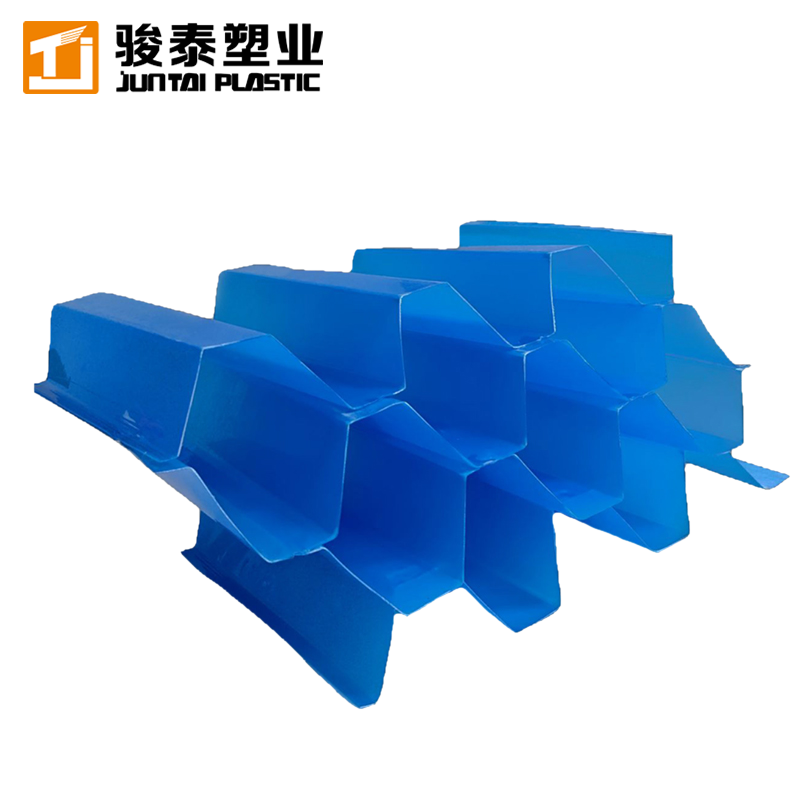
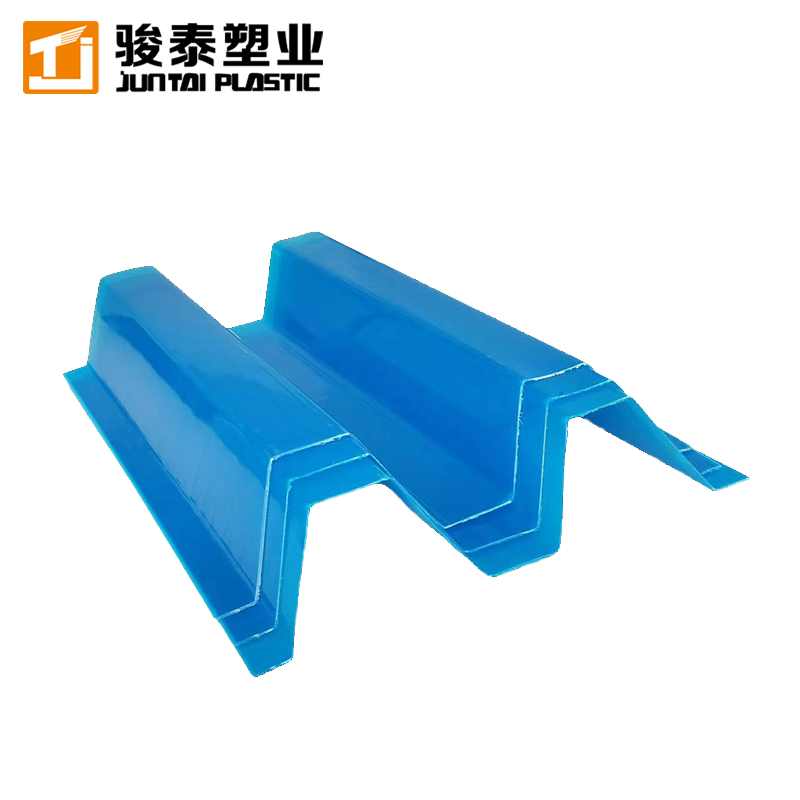
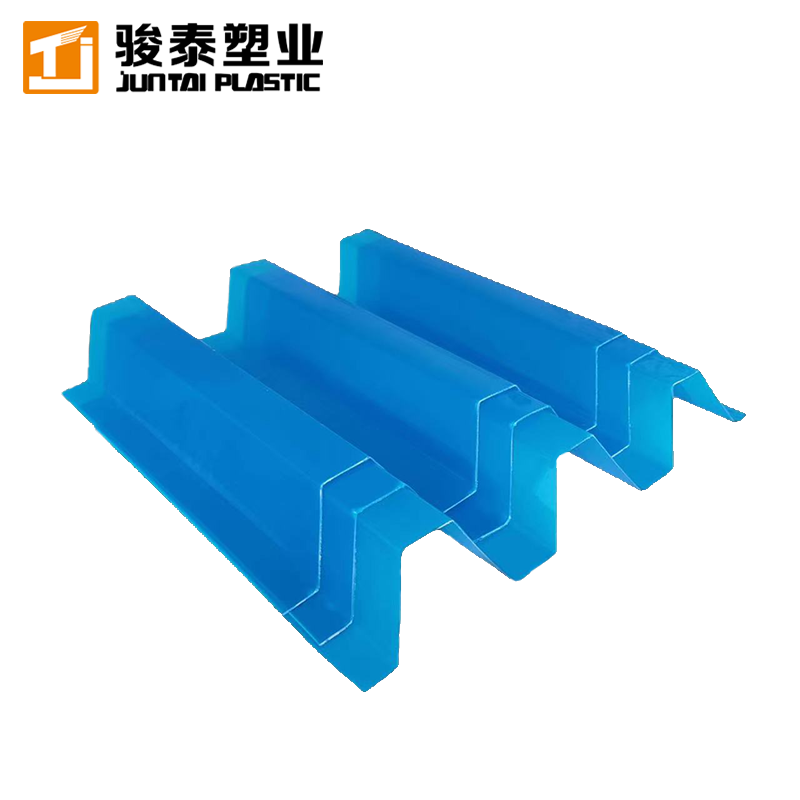
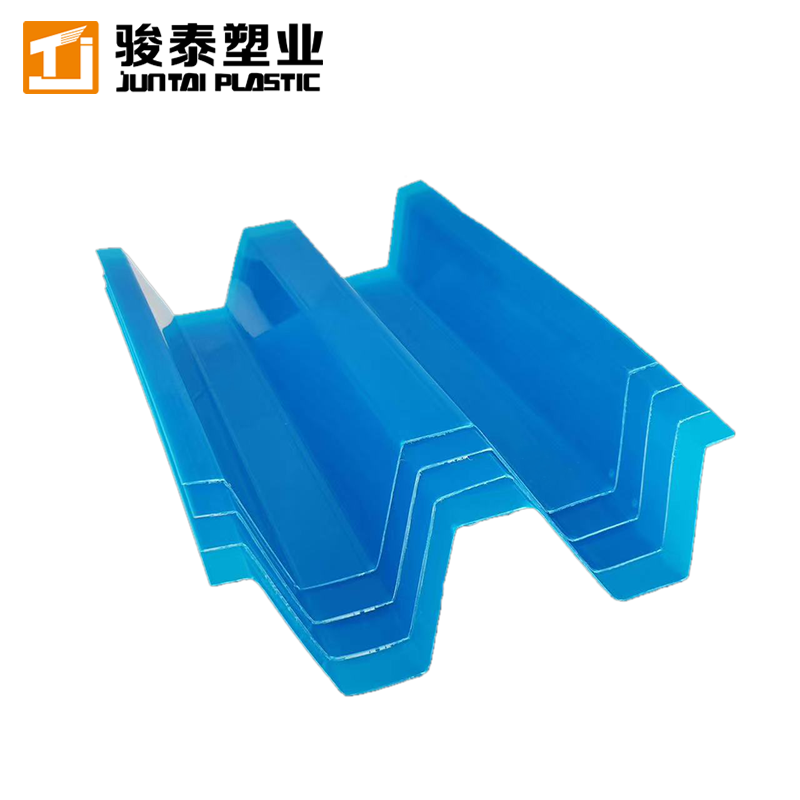
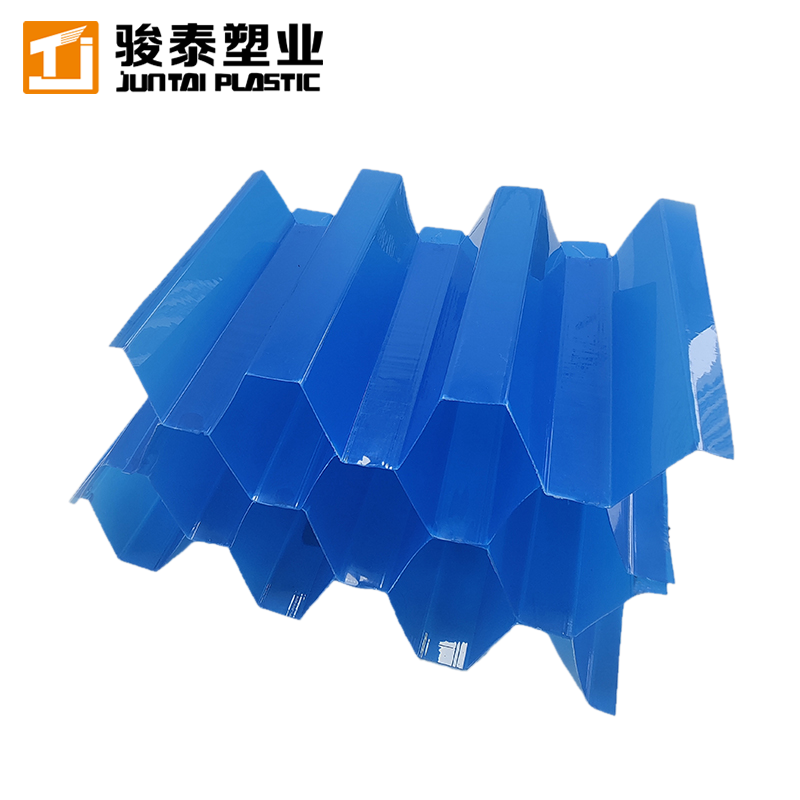
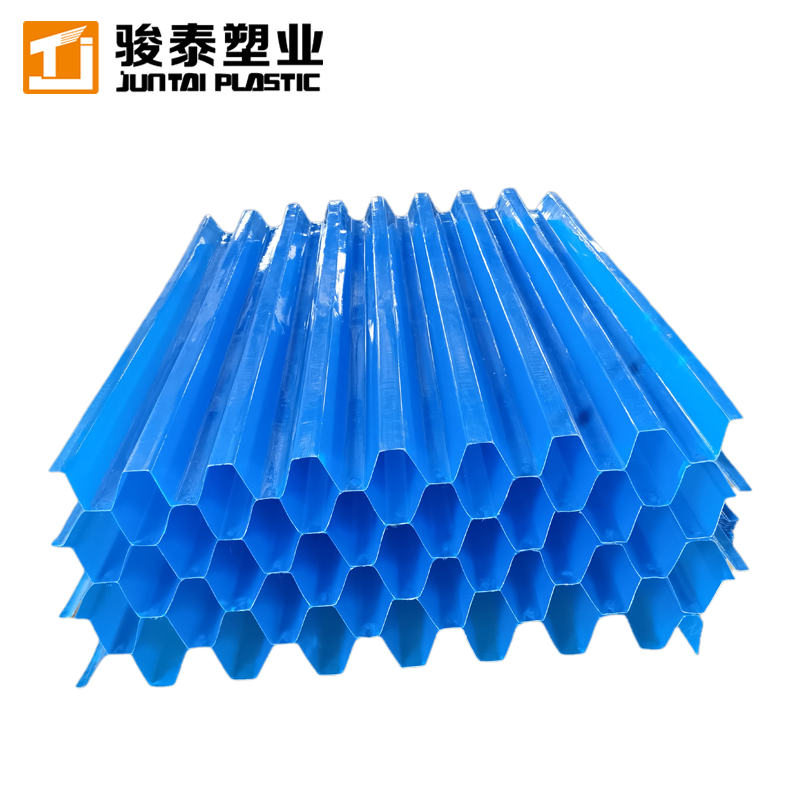

▬ Juntai PP PVC tube settler lamella clarifier media hexagonal honeycomb modules 60 degree inclined
01 Key Advantages
Conventional basins settle across 2–4 metres of water depth. Tube settlers collapse that settling path to millimetres by dividing the same flow into hundreds of inclined 25–80 mm hexagonal channels - at 60° each metre of module height projects ~0.87 m² of effective settling area per channel layer, and laminar flow (Re < 500) prevents re-entrainment while the incline continuously self-cleans.
|
85%
Smaller Footprint
Effective settling area multiplied 6–10× by inclined channels. A 1,000 m³/d plant fits in ~8 m² vs ~50 m² for open basins. Retrofit existing tanks to double or triple capacity without a single cubic metre of new concrete.
|
15–30 min
HRT: From Hours to Minutes
Laminar flow through 25–80 mm channels delivers 15–30 minute retention vs 2–4 hours for conventional basins. The 50–160× reduction in settling path length is the physics behind the speed.
|
2–5 days
Retrofit Without Civil Works
Modular tongue-and-groove panels drop into existing rectangular or circular clarifiers. Install in 2–5 days, commission within 72 hours. Zero concrete. Zero downtime for adjacent treatment units.
|
30–50%
Less Coagulant
Efficient solids contact in the laminar regime reduces chemical demand vs turbulent open basins. Verified across 500+ installations - recurring opex savings that compound year after year. Most plants recover media cost within 12–24 months.
|
02 Technical Specifications
|
▬ Juntai tube settler module structure & 60° grid layout |

03 Material Options: PP vs PVC
Juntai manufactures tube settler media in two proven materials. PP (polypropylene) is the choice for drinking water and high-temperature applications. PVC (polyvinyl chloride) offers superior rigidity, smoother surfaces, and longer maintenance intervals - preferred for demanding industrial environments. Both are UV-stabilised for outdoor installations. Tube and plate settlers are often used interchangeably, but Juntai's hexagonal honeycomb channels deliver 15–20% more settling area per cubic metre than flat-plate equivalents at the same volume - each channel is a self-reinforcing, hydraulically independent hexagon.
|
Parameter
|
PP (Polypropylene)
|
PVC (Polyvinyl Chloride)
|
|
Density
|
0.90–0.91 g/cm³ (lighter, easier handling)
|
1.38–1.45 g/cm³ (heavier, more rigid)
|
|
Tensile Strength
|
30–40 MPa
|
50–60 MPa (superior rigidity)
|
|
Heat Distortion Temp.
|
110 °C (better for hot processes)
|
65 °C
|
|
Cold Resistance
|
Brittle below 0 °C
|
Impact-resistant to -15 °C
|
|
Surface Smoothness (Ra)
|
0.8–1.2 μm
|
0.4–0.6 μm (better sludge sliding)
|
|
Chemical Resistance
|
pH 1–13, excellent general resistance
|
pH 2–12, excellent acid/alkali resistance
|
|
Assembly Method
|
Hot-air welding (260–300 °C)
|
Solvent bonding (faster, simpler)
|
|
Certification
|
NSF/ANSI 61 (drinking water approved)
|
WRAS, ISO 9001
|
|
Maintenance Interval
|
~3 years
|
~5 years (20–30% longer life)
|
|
Best Applications
|
Drinking water, food & beverage, aquaculture, high-temperature processes
|
Municipal STP, mining, chemical, cold-climate outdoor installations
|
04 Tube Diameter Selection Guide
Choosing the right channel diameter is the single most important design decision for tube settler performance. The diameter determines the specific surface area (SSA), which directly controls settling capacity, and the channel width, which determines clogging resistance. A diameter too small for your solids load will clog; too large and you leave settling capacity unused. Use this table to match diameter to your application. For plants with significant diurnal or seasonal flow variation, size at the peak-hour rate - the φ50 mm and φ80 mm channels provide additional hydraulic buffer.
|
Diameter
|
SSA
(m²/m³) |
Sheets per m²
|
Influent TSS Limit
|
Best For
|
|
φ25 mm
|
~139
|
60–62
|
≤ 300 mg/L
|
Drinking water treatment, low-turbidity raw water, polishing after primary treatment, fine floc applications
|
|
φ35 mm
|
~109
|
40–44
|
≤ 800 mg/L
|
Municipal STP secondary clarifiers, general industrial wastewater, food processing effluent
|
|
φ50 mm
|
~87
|
30–32
|
≤ 1,500 mg/L
|
Most popular choice. Mining effluent, sewage primary treatment, high-TSS industrial wastewater, balanced performance
|
|
φ80 mm
|
~50
|
19–20
|
≤ 2,000 mg/L
|
Extreme solids loading, coarse/heavy particles, primary treatment, lowest clogging risk
|

▬ Juntai tube settler four diameter comparison 25mm 35mm 50mm 80mm PP PVC hexagonal channels
05 Application Scenarios
|
Drinking Water
Typical: φ25–35 mm, PP, NSF-certified. Key: NSF/ANSI 61 compliance mandatory; low-temperature operation reduces loading rate - size conservatively for winter flow.
Municipal STP
Typical: φ35–50 mm, PVC or PP. Key: handles 500–50,000 m³/d; retrofit into existing secondary clarifiers to double capacity without expanding basin footprint.
Mining & Minerals
Typical: φ50–80 mm, PVC, heavy-gauge. Key: high abrasive solids - specify 1.0–1.2 mm sheet thickness; PVC preferred for acid mine drainage resistance.
Food & Beverage
Typical: φ35–50 mm, PP, FDA-grade. Key: CIP chemical resistance (pH 1–13 at up to 85 °C); PP withstands hot washdowns that would soften PVC.
Chemical Processing
Typical: φ50–80 mm, PVC. Key: superior for acidic/alkaline effluent; verify compatibility chart for specific process streams before specifying.
Aquaculture
Typical: φ35–50 mm, PP, food-grade. Key: solids removal from recirculating aquaculture systems (RAS); PP preferred for fish-safe, non-toxic operation.
|
▬ Juntai tube settler applications across drinking water, municipal, mining and industrial clarifiers |


