

Application of AO + Fenton Reaction Tank + BAC Combined Process to Treat Circulating External Drainage in Power Plants
The circulating water system is an essential cooling system required for power plant operations. Its principle involves introducing cold water into the condenser for continuous circulation to cool the units. The system achieves balance through continuous blowdown and replenishment with new water sources. Part of the water in the circulating water system becomes heated and generates steam, which is discharged to the atmosphere through the top, while another part is discharged to the environment as circulating external drainage from the power plant.
Currently, most domestic power plants use a "pretreatment + ultrafiltration + reverse osmosis" process for treating circulating external drainage. However, the ultrafiltration and reverse osmosis process has several problems: (1) Inadequate pretreatment processes result in poor pretreatment effects, which reduces the treatment efficiency of subsequent processes. (2) During operation, membranes are frequently and severely clogged by pollutants, requiring operators to perform frequent membrane chemical cleaning, shortening membrane service life, necessitating frequent membrane replacement, and resulting in high membrane replacement costs. Scale inhibitors and corrosion inhibitors precipitate during operation, clogging cartridge filters and reverse osmosis membranes, leading to frequent membrane chemical cleaning and filter cartridge replacement during operation. Additionally, scale inhibitors and corrosion inhibitors easily react with high-valent ions, affecting floc formation, resulting in poor coagulation effectiveness. (3) Membrane systems require high construction investment and demand high technical expertise from operators during operation and maintenance.
A comprehensive wastewater treatment plant at a certain power plant adopted the AO + Fenton reaction tank + BAC combined process to treat circulating external drainage. This process not only achieves good effluent quality and simple operation but also significantly reduces the plant's operating costs and protects the surrounding ecological environment.
1 Wastewater Quality Analysis
The circulating external drainage from the power plant mainly comes from water used for cooling units through continuous circulation in the condenser. This type of wastewater is characterized by low organic matter concentration and poor biodegradability. Additionally, to prevent pipeline scaling during the recirculation of cooling water, the power plant regularly adds scale inhibitors and corrosion inhibitors to the circulating water, resulting in relatively high total nitrogen content in the circulating cooling water. Other characteristics include high salinity, high concentrations of high-valent ions such as Fe³⁺, Ca²⁺, Mg²⁺, Al³⁺, and relatively high hardness.
Based on these wastewater characteristics, the comprehensive wastewater treatment plant first installed an AO tank to remove ammonia nitrogen and total nitrogen from the wastewater. Subsequently, a Fenton reaction tank was installed after the biological treatment process to generate strong oxidants through the chemical reaction between hydrogen peroxide and ferrous sulfate, decomposing recalcitrant organic compounds into easily degradable ones and reducing chemical oxygen demand and total phosphorus. Finally, an inclined tube sedimentation tank and BAC tank were used to remove SS and ammonia nitrogen, achieving compliance.
2 Project Overview
2.1 Flow Rate and Water Quality
The flow rate is 220 m³/h. Influent water quality was determined based on monitoring data, and effluent quality must comply with the Class A discharge standards of the "Discharge Standard of Pollutants for Municipal Wastewater Treatment Plant" (GB18918-2002). As shown in Table 1, the influent wastewater in this project is characterized by high CODcr, total nitrogen, total phosphorus, and SS, with relatively low ammonia nitrogen and total phosphorus.
| Table 1 Influent and Effluent Water Quality | ||
| Parameter | Influent Water Quality / (mg/L) | Effluent Water Quality / (mg/L) |
| CODcr | ≤ 240 | ≤ 50 |
| BOD₅ | ≤ 20 | ≤ 10 |
| Total Nitrogen (TN) |
≤ 90 | ≤ 15 |
| Total Phosphorus (TP) |
≤ 2 | ≤ 0.5 |
| Ammonia Nitrogen (NH₃-N) |
≤ 0.5 | ≤ 5 |
| Suspended Solids (SS) |
≤ 200 | ≤ 10 |
2.2 Key Challenges of the Project
The wastewater in this project is circulating external drainage from the power plant. The key challenges in treatment are the recalcitrant pollutants such as CODcr, total phosphorus, and total nitrogen in the production wastewater.
(1) The wastewater has low B/C ratio. During actual operation of this project, the influent may contain a significant amount of recalcitrant organic matter that is difficult to biodegrade, with a B/C ratio of approximately 0.08, which falls into the difficult-to-biodegrade category. The treatment process for this project needs to incorporate advanced oxidation measures to increase the B/C ratio and thereby improve biodegradability. This represents a key challenge in treating the wastewater for this project.
(2) The wastewater contains high levels of macromolecular organic compounds, which are difficult to remove through conventional biological treatment alone. This is another key challenge in treating the wastewater for this project.
(3) To reduce operating costs and improve project efficiency, the design should minimize the number of pumps used for lifting wastewater and sludge, and make maximum use of gravity flow. This represents a key focus for this project and is highly significant for reducing operating costs.
2.3 Treatment Process
(1) Pretreatment process. The wastewater in this project contains many types of pollutants, has complex composition, and exhibits significant pH variation, making comprehensive treatment difficult and costly. An equalization tank was separately installed in the pretreatment process to homogenize and equalize the flow, reducing the impact of water quality fluctuations on the wastewater treatment system.
(2) Biological treatment process. The process needs to be advanced, mature, efficient, easy to operate, highly intelligent, require minimal space, and have low operating costs. The "AO" process was selected for this project. This process is widely used in China, featuring advanced and mature technology, high purification efficiency, convenient manufacturing, low residual sludge production, and reliable effluent quality.
(3) Advanced treatment process. The "Fenton oxidation + inclined tube sedimentation tank + BAC" process was selected as the advanced treatment process for this project. This process utilizes the strong oxidizing free radicals generated by the Fenton reaction to oxidize and decompose residual recalcitrant organic compounds, converting them into organic compounds that can be degraded by natural microorganisms. Simultaneously, it enhances phosphorus removal through chemical measures, serving as a safeguard to ensure total phosphorus compliance. Subsequently, organic matter removal is completed through sedimentation in the inclined tube sedimentation tank and adsorption and biodegradation in the BAC tank, meeting discharge standards.
(4) Sludge treatment process. The sludge thickening tank has strong storage capacity, low power consumption, low operating costs, and simple operation. The screw press has low equipment and maintenance costs, occupies minimal space, consumes less chemicals, produces low noise, and achieves sludge cake dryness between 20% and 25%, demonstrating good dewatering performance.
2.4 Process Flow Diagram
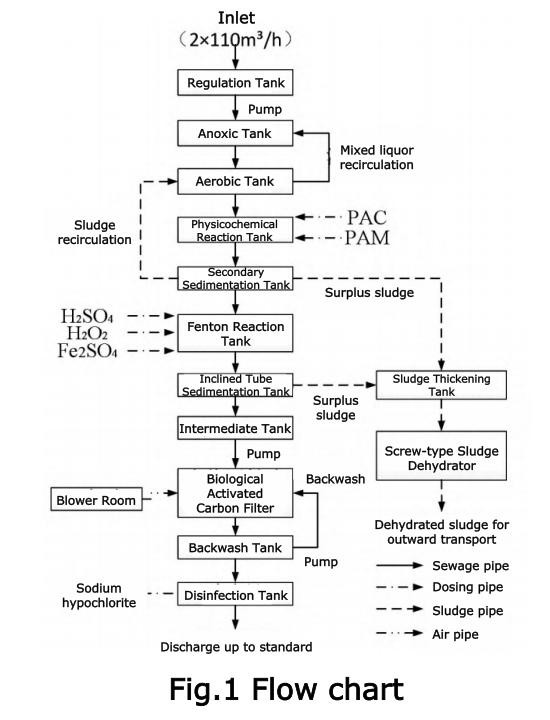
The wastewater treatment plant adopts the "AO tank + secondary sedimentation tank + Fenton reaction tank + inclined tube sedimentation tank + BAC + disinfection tank" process, as shown in Figure 1.
2.5 Process Units and Functions
(1) Equalization tank. Reduces the impact of organic load fluctuations on subsequent treatment processes, prevents rapid changes in flow rate or water quality from affecting downstream treatment processes (biological or chemical), and maintains a stable environment for microorganisms in biological treatment processes and a stable reaction environment in chemical treatment processes. Submersible pumps are installed in the tank for lifting wastewater to the anoxic tank.
(2) AO tank. The AO tank is equipped with combined packing and submersible mixers. The combined packing provides ample living space for denitrifying microorganisms and aerobic microorganisms, while the submersible mixers ensure uniform distribution of organic matter in the water. In the anoxic tank, the majority of ammonia nitrogen is removed. In the aerobic tank, most organic matter is removed, ammonia nitrogen is converted to nitrate nitrogen, and an aerobic environment is created for phosphorus-accumulating organisms to uptake phosphorus. The phosphorus-rich sludge is ultimately removed in the secondary sedimentation tank as sludge.
(3) Secondary sedimentation tank. The secondary sedimentation tank is equipped with a traveling bridge scraper and sludge pumps. After sedimentation, sludge is scraped into the sludge hopper by the traveling bridge scraper and then pumped to the sludge tank by sludge pumps, significantly reducing SS in the wastewater.
(4) Fenton reaction tank. At low pH, H₂O₂ is catalytically decomposed by Fe²⁺ to produce ·OH, which can oxidize most organic compounds in water. It can also completely oxidize organic compounds that are difficult to treat with biological or conventional chemical oxidation reactions. ·OH reacts with organic substances in the wastewater, decomposing them into CO₂ and water, significantly reducing the concentration of difficult-to-treat organic compounds in the wastewater and increasing the B/C ratio, thereby improving the treatment efficiency of the subsequent BAC tank.
(5) Inclined tube sedimentation tank. The inclined tube packing in the inclined tube sedimentation tank aggregates suspended solids and flocs formed in the Fenton reaction tank on the surface of the inclined tubes. Through gravity, sludge settles at the bottom and is pumped to the sludge thickening tank by sludge pumps, reducing SS in the wastewater.
(6) Intermediate tank. Ensures stable wastewater quality and flow rate, guaranteeing uniform and stable filtration in the biological activated carbon filter and improving the filtration efficiency of the BAC tank.
(7) BAC tank and backwash tank. The BAC tank contains activated carbon filter media, which have strong adsorption capacity, effectively filtering harmful substances and microorganisms in the water and removing suspended solids. The backwash tank is equipped with backwash pumps to backwash the filter media in the filter, preventing clogging.
(8) Disinfection tank. Sodium hypochlorite is added to the tank to kill harmful bacteria in the water, reducing the harmful bacterial content of the wastewater.
(9) Sludge tank and screw press. Sludge from the AO tank, secondary sedimentation tank, inclined tube sedimentation tank, and BAC tank is pumped into the sludge tank by sludge pumps. After thickening, the sludge is pumped into the screw press by sludge pumps (with cationic PAM added during dewatering). Through the sludge thickening tank and screw press, the moisture content of the sludge is significantly reduced, facilitating disposal.
2.6 Characteristics of the Combined Process
(1) The AO tank has high removal efficiency for organic matter, ammonia nitrogen, and other pollutants in the wastewater. In the anoxic tank, bacteria consume organic compounds containing C to supplement their energy and reduce nitrate nitrogen returned from the aerobic tank to N₂, completing denitrification while also removing part of the BOD₅. Hydrolysis reactions also occur in the anoxic tank, increasing the B/C ratio of the wastewater and improving its biodegradability. In the aerobic tank, the majority of organic matter and phosphorus are removed, and ammonia nitrogen is converted to nitrate nitrogen.
(2) The Fenton reaction tank uses strong oxidizing Fenton reagents (Fe²⁺ and H₂O₂ mixed in a certain proportion) to produce highly oxidizing ·OH, which provides good oxidation treatment effects. The reaction products CO₂ and water are non-toxic and harmless. The process has good operational characteristics, relatively low treatment speed and cost at room temperature, high oxidation efficiency, low treatment costs, and can significantly reduce the difficulty of wastewater treatment.
(3) From an enterprise perspective, arranging the AO tank first and then the Fenton reaction tank significantly reduces operating costs compared to arranging the Fenton reaction tank first and then the AO tank. If the Fenton reaction tank were placed first and then the AO tank, the organic load on the AO tank would increase, requiring it to treat high-valent organic molecules formed from the oxidation of recalcitrant organic compounds in the Fenton reaction tank. This would necessitate the addition of large amounts of carbon sources during operation, significantly increasing carbon source procurement costs and operating costs. Arranging the AO tank first and then the Fenton reaction tank allows for the treatment of degradable organic matter in the front section and recalcitrant organic matter in the back section, reducing operating costs while significantly lowering organic matter concentration in the wastewater.
(4) Considering the high COD in the influent, BAC was selected as the advanced treatment process to further reduce organic matter in the wastewater. Activated carbon has a large specific surface area, allowing organic matter and microorganisms to adhere to it, extending their contact time and thereby improving microbial decomposition efficiency. In addition to activated carbon, the tank is also equipped with an aeration system, which not only increases the movement speed of organic matter in the water, provides oxygen to microorganisms, and improves purification efficiency, but also promotes contact between suspended microorganisms and organic substances in the influent, enhancing the treatment efficiency of suspended microorganisms.
2.7 Process Units and Parameters
The process units and parameters for this project are shown in Table 2.
| Table 2 Process Unit Parameters | ||||
| Unit | HRT (h) | Effective Water Depth (m) |
Effective Volume (m3) |
Remarks |
| Equalization Tank | 1.7 | 5.5 | 378 | |
| Anoxic Tank | 15.3 | 6.1 | 3355 | |
| Aerobic Tank | 5.1 | 6 | 1122 | |
| Secondary Sedimentation Tank | / | 5.6 | / | Surface Loading Rate: 1.05 m3/(m2·h) |
| Fenton Reaction Tank | 4 | 5.5 | 1072.5 | |
| Inclined Tube Sedimentation Tank |
/ | 5.1 | / | Surface Loading Rate: 1.13 m3/(m2·h) |
| Intermediate Tank | 0.2 | 5.1 | 51 | |
| BAC Tank | / | 5.5 | 275 | Water Backwash Intensity: 25 m3/(m2·h) |
| Air Backwash Intensity: 40 m3/(m2·h) |
||||
| Backwash Tank | 1.7 | 5.5 | 374 | |
| Disinfection Tank | 0.54 | 5.4 | 118.8 | |
3 Operation Status
This project passed acceptance in June 2022, with all pollutant indicators in the effluent meeting the specified discharge standards, shown in Table 3.
| Table 3 Operation Status | ||
| Parameter | Monitored Effluent Indicator /(mg/L) |
Design Effluent Indicator /(mg/L) |
| CODcr | 36–40 | ≤ 50 |
| BOD₅ | 7–9 | ≤ 10 |
| Total Nitrogen (TN) |
11–13.5 | ≤ 15 |
| Total Phosphorus (TP) |
0.2–0.4 | ≤ 0.5 |
| Ammonia Nitrogen (NH₃-N) |
0.3–0.5 | ≤ 5 |
| Suspended Solids (SS) |
5–8 | ≤ 10 |
4 Operating Costs
The total operating costs for this project are shown in Table 4.
| Table 4 Total Operating Costs | |||||
| No. | Cost Item | Cost /(RMB/month) |
Treatment Cost /(RMB/ton) |
Treatment Capacity /(m3/h) |
Remarks |
| 1 | Electricity Cost | 62,944.27 | 0.4 | 220 | Calculated based on 30 days per month |
| 2 | Water Cost | 6,849.75 | 0.04 | ||
| 3 | Chemical Cost | 272,776.01 | 1.72 | ||
| 4 | Labor Cost | 27,000.00 | 0.17 | ||
| 5 | Total | 369,570.03 | 2.33 | ||
5 Economic, Social, and Environmental Benefits
5.1 Economic Benefits
The implementation of this project has significant economic benefits. First, it reduces enterprise costs. Without this project, the treatment of circulating external drainage from the power plant would require outsourcing to qualified entities. Due to the high concentration and large volume of the circulating external drainage, outsourcing treatment and transportation costs are high. Failure to outsource treatment to qualified entities would result in fines from relevant authorities. Therefore, the implementation of this project significantly reduces the enterprise's wastewater treatment costs and potential fines. Second, it reduces social costs. If the circulating external drainage were discharged untreated, the resulting water pollution would reduce agricultural and fishery yields, affecting the development of surrounding agriculture and fisheries. Thus, the implementation of this project significantly reduces social costs. Third, it indirectly reduces residents' medical expenses. Without this project, the groundwater environment would inevitably be polluted, endangering the health of surrounding residents and significantly increasing their medical expenses. Therefore, the implementation of this project indirectly reduces residents' medical expenses. Finally, it increases land value. The implementation of this project reduces pollution from the power plant's circulating external drainage, making the surrounding land more attractive for investment and factory construction.
5.2 Social Benefits
The implementation of this project has significant social benefits. First, it protects the surrounding water environment. Direct discharge of circulating external drainage with high concentrations of harmful substances would cause great harm to the surrounding water environment and affect the aquatic ecosystem. Second, it protects the health of nearby residents and enhances their quality of life. The high organic matter concentration in the circulating external drainage would cause rivers to become black and odorous if discharged. In addition, it would significantly affect water quality, making it impossible for aquatic animals such as fish to survive, leading to foul-smelling fish and affecting the living environment and quality of life of surrounding residents. Therefore, the implementation of this project greatly protects the health of nearby residents.
5.3 Environmental Benefits
The implementation of this project significantly reduces pollution of surrounding water bodies from the power plant's circulating external drainage and protects the living environment of nearby residents. It reduces annual CODcr by approximately 385 tons, BOD₅ by approximately 23 tons, TN by approximately 150 tons, TP by approximately 3 tons, and SS by approximately 370 tons.
6 Conclusion
This project case demonstrates that the AO + Fenton reaction tank + BAC combined process effectively treats pollutants in circulating external drainage from power plants, achieving stable effluent quality that meets specified discharge standards. CODcr reduction reaches 85%, total nitrogen reduction reaches 87%, and total phosphorus reduction reaches 90%. Although removal rates for BOD₅ and ammonia nitrogen are not high due to their low influent concentrations, they still consistently meet standards. This demonstrates that the AO + Fenton reaction tank + BAC combined process achieves significant treatment effects and excellent effluent quality for power plant circulating external drainage. This combined process can achieve a high degree of automation, has low technical requirements, and offers simple operation and management. It provides valuable reference for other projects treating circulating external drainage from power plants while delivering significant economic, social, and environmental benefits, holding great significance for the sustainable development and operation of power plants.