

Analysis of Pollutant Removal Performance in an S-MBBR System for Low C/N Ratio Wastewater Treatment
Introduction
With the acceleration of urbanization and industrialization, the discharge of low C/N ratio (low carbon-to-nitrogen ratio) wastewater is increasing, mainly originating from domestic sewage, food processing, agriculture, and circulating cooling water. To address the poor total nitrogen (TN) removal efficiency in low C/N ratio wastewater, short-cut nitrification-denitrification and simultaneous nitrification and denitrification (SND) have attracted attention in recent years. Relatively speaking, the reaction conditions of the SND process are easier to control, and it can achieve both carbon removal and nitrogen removal simultaneously. Therefore, it has a significant advantage in nitrogen removal treatment for low C/N ratio wastewater. The sequencing batch reactor (SBR) facilitates nitrogen and phosphorus removal by controlling dissolved oxygen concentration. When coupled with the moving bed biofilm reactor (MBBR) to form an S-MBBR system, the biofilm on the carriers provides stratified growth conditions for aerobic nitrifying bacteria and anoxic denitrifying bacteria, creating an SND microenvironment while simultaneously increasing the specific surface area and microbial stability of the system. Studies have shown that S-MBBR is superior to traditional processes in terms of nitrogen and phosphorus removal efficiency, shock resistance, and system stability.
1 Materials and Methods
1.1 Experimental setup. The experimental setup mainly consisted of an influent tank, an air blower, a stirring device, an effluent tank, and the main reactor. The effective volume of the reactor was 1.8 L, and the treatment capacity per cycle was 1 L. The reactor was filled with a new type of bio-affinitive carrier at a filling ratio of approximately 25%. The initial mixed liquor volatile suspended solids (MLVSS) concentration in the reactor was 3000 mg/L.
1.2 Experimental materials. The affinity-modified carrier filler was prepared by physical blending and screw extrusion technology. The specific procedure was as follows: 3% zero-valent iron, HDPE, and auxiliary materials (2% natural zeolite, 2% polyquaternium-10, and 1% talc powder) were mixed uniformly. Then, the mixture was melted using an SJ-20 single-screw extruder and extruded into granular strips (approximately 5 mm in diameter, 5–10 mm in length). Finally, these solid particles were extruded using an SJ-30 single-screw extruder to produce the final carrier.
1.3 Operating conditions. Two reactors were set up: one with carriers (S-MBBR, designated as R1) and one without carriers (SBR, designated as R2). All other conditions were kept the same. The first stage was biofilm attachment start-up, operated in an SBR mode with a 3:3:2 ratio. The operating cycle included influent, static, aeration reaction, anoxic stirring, settling, and effluent stages (3 h anaerobic, 3 h aeration, 2 h stirring/settling/influent/effluent). NaHCO₃ was used to adjust the influent pH to around 8. After successful biofilm attachment, the ammonia nitrogen concentration was changed to reduce the C/N ratio and the experiment began, as detailed in Table 1.
| Table 1 Reactor Operating Conditions | ||||
| Parameter | Stage I | Stage II | Stage III | Stage IV |
| Anaerobic phase (h) |
3 | 3 | 3 | 2 |
| Aeration phase (h) |
3 | 3 | 3 | 4 |
| Anaerobic mixing phase (h) |
1.17 | 1.17 | 1.17 | 1.17 |
| Settling phase (h) |
0.5 | 0.5 | 0.5 | 0.5 |
| Total HRT (h) | 8 | 8 | 8 | 8 |
| COD (mg/L) | approx. 500 | approx. 500 | approx. 320 | approx. 320 |
| NH₄⁺-N (mg/L) | approx. 25 | approx. 40 | approx. 40 | approx. 60 |
| TN (mg/L) | approx. 25 | approx. 40 | approx. 40 | approx. 40 |
| TP (mg/L) | 5 | 5 | 5 | 10 |
1.4 Experimental water and inoculated sludge. The COD, NH₄⁺-N, and total phosphorus (TP) in the synthetic wastewater used for biofilm start-up were provided by C₆H₁₂O₆, NH₄Cl, and KH₂PO₄, respectively. Trace elements were composed of EDTA-2Na (18.76 g/L), CoCl₂·6H₂O (0.3 g/L), CuSO₄·5H₂O (0.32 g/L), NiCl₂·6H₂O (0.24 g/L), H₃BO₄ (0.018 g/L), ZnSO₄·7H₂O (0.54 g/L), MnCl₂·4H₂O (1.24 g/L), NaMoO₄·2H₂O (0.28 g/L), and NaWO₄·2H₂O (0.1 g/L). The composition of the synthetic wastewater was: C₆H₁₂O₆ (0.47 g/L), NH₄Cl (0.095 g/L), KH₂PO₄ (0.022 g/L), NaCl (0.1 g/L), NaHCO₃ (0.15 g/L), MgSO₄·7H₂O (0.15 g/L), CaCl₂ (0.05 g/L), FeSO₄·7H₂O (0.02 g/L), and trace elements (1 mL/L). The sludge was taken from the secondary sedimentation tank of a wastewater treatment plant in Dalian.
1.5 Analytical methods. Routine indicators were measured according to the standard methods specified in the "Standard Methods for the Examination of Water and Wastewater" (4th edition) and national standards, including pollutant removal capacity analysis, membrane fouling analysis, and gas production analysis. Specifically: NH₄⁺-N was measured by the salicylic acid reagent spectrophotometric method; TP by the ammonium molybdate spectrophotometric method; NO₃⁻-N by the salicylic acid-concentrated sulfuric acid reagent spectrophotometric method; NO₂⁻-N by the N-(1-naphthyl)ethylenediamine spectrophotometric method; TN was the sum of the concentrations of all nitrogen forms; COD was measured by the rapid digestion method; and sludge concentration (including MLSS and MLVSS) was measured by the gravimetric method.
2 Results and Analysis
2.1 COD Removal Performance
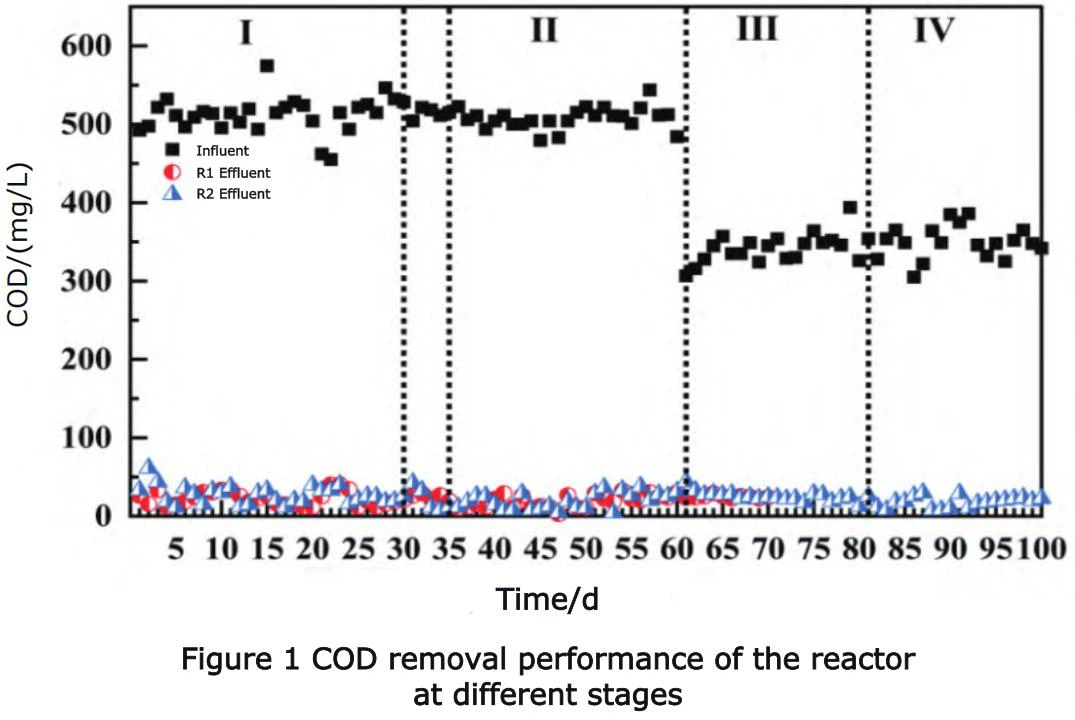
Organic matter entering the reactor was removed through stages including anaerobic, aerobic (aeration), anoxic stirring, settling, and effluent. Figure 1 shows the COD removal performance of the reactors at different operational stages. Stage I was the biofilm attachment stage, and Stages II, III, and IV were the stages where the C/N/P ratio was reduced to 100:8:1, 64:8:1, and 32:6:1, respectively. The average removal rates for R1 in each stage were 95.57%, 96.25%, 92.70%, and 94.18%, respectively; the average removal rates for R2 in each stage were 94.71%, 96.19%, 92.54%, and 94.68%, respectively. It can be seen that this process has good organic matter removal performance, and under relatively stable effluent conditions, it met the requirements of the GB 18918-2002 standard (COD concentration < 50 mg/L). Since the system was operated at a low C/N ratio, carbon source became the limiting substrate driving efficient metabolism. There was no significant difference in COD removal between R1 and R2, demonstrating that the modified carrier had little effect on COD removal.
2.2 NH₄⁺-N and TN Removal Performance
The TN removal process includes two major steps: nitrification and denitrification. Nitrification, as an aerobic process, relies on sufficient aerobic microorganisms to convert ammonia nitrogen into nitrate. Figures 2 and 3 show the NH₄⁺-N and TN removal performance of the reactors, respectively. NH₄⁺-N and TN were mainly removed during the aerobic aeration and anoxic static stages. Stage I was the biofilm attachment stage, and Stages II, III, and IV were the stages where the C/N/P ratio was reduced to 100:8:1, 64:8:1, and 32:6:1, respectively. The average NH₄⁺-N removal rates for R1 were 92.53%, 95.83%, 99.70%, and 98.31%, respectively; the average NH₄⁺-N removal rates for R2 were 84.34%, 91.82%, 99.70%, and 97.52%, respectively. The average TN removal rates for R1 were 89.53%, 87.21%, 82.44%, and 83.20%, respectively; the average TN removal rates for R2 were 78.3%, 78.89%, 73.26%, and 76.66%, respectively. Compared to R2, the average NH₄⁺-N removal rates for R1 increased by 9.7%, 4.36%, 0%, and 0.82%, respectively; the average TN removal rates increased by 14.35%, 10.55%, 12.54%, and 8.3%, respectively. It can be seen that the R1 system outperformed R2 in nitrogen removal at all stages, especially in the early stages of system operation, with the difference gradually stabilizing in later stages.
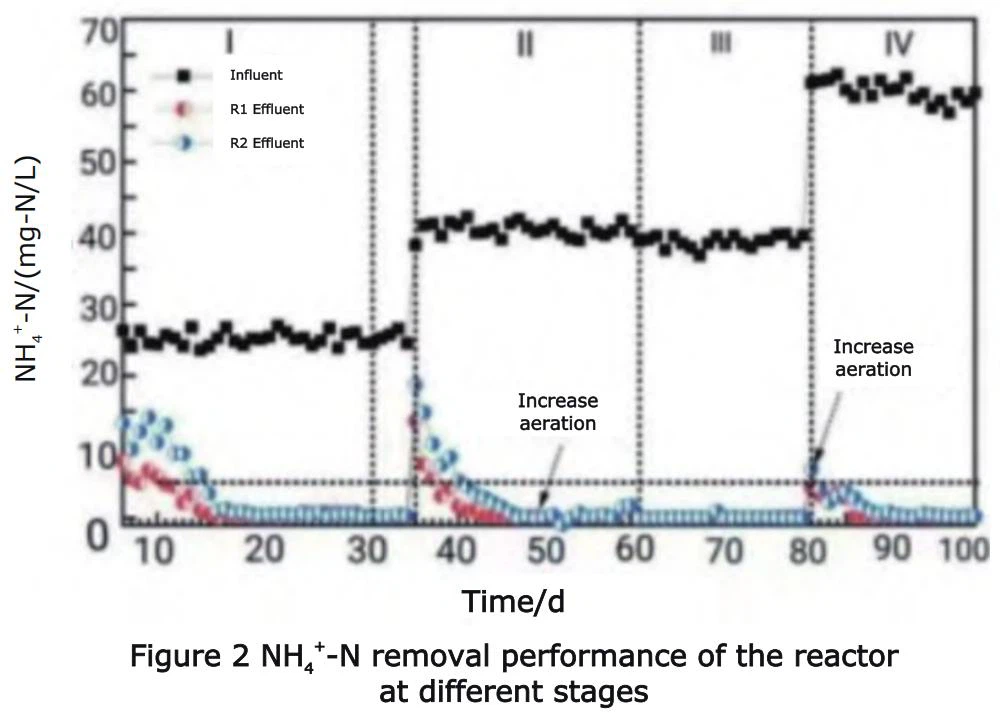
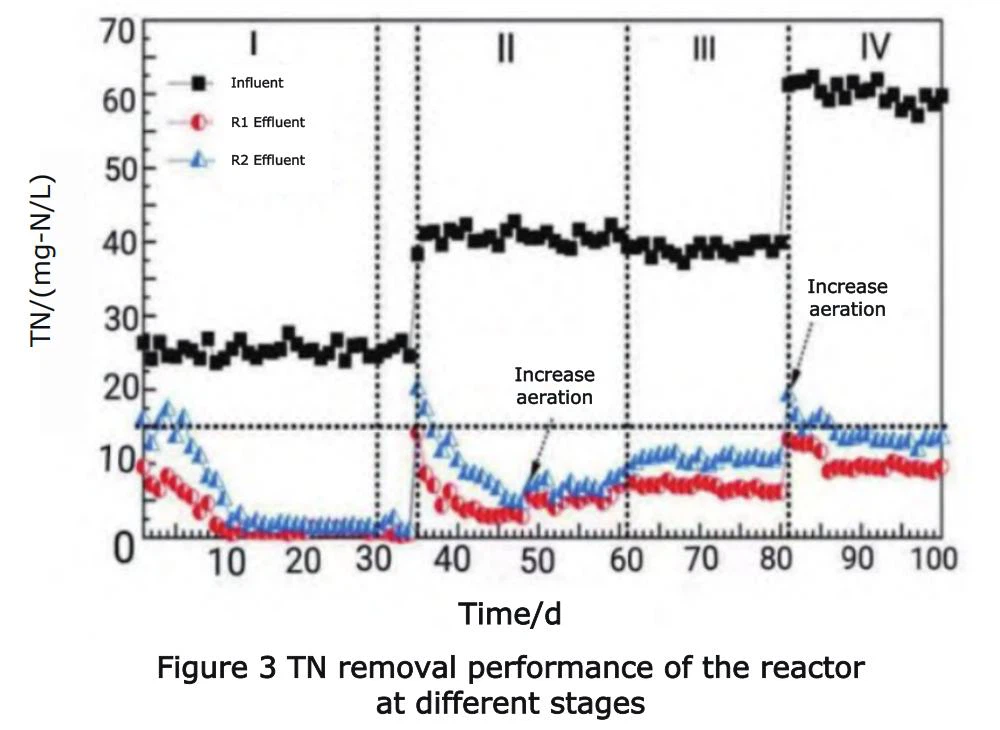
During Stage I, the influent NH₄⁺-N concentration was low, and the carbon source was relatively sufficient to basically meet denitrification requirements, so the effluent TN concentration was low. The inoculated microorganisms were still in the adaptation stage, and the functional microbial community within the system was not fully established, resulting in unstable NH₄⁺-N removal, but it gradually stabilized later. No significant difference was observed between the two reactors (R1 and R2) during this stage. Entering Stage II, the influent NH₄⁺-N concentration suddenly increased, but the aeration conditions were not adjusted simultaneously, causing significant fluctuations in the system, especially in the removal of NH₄⁺-N and TN. After about 6 days of operation, the two reactors gradually recovered stability. It is speculated that the high ammonia nitrogen load promoted the rapid proliferation of nitrifying bacteria, thereby improving the efficiency of the nitrification process. As system operation continued, the nitrification-denitrification system within the reactors gradually established and stabilized, and the fluctuation of TN concentration decreased. Due to the presence of the modified carrier, the R1 system achieved lower residual TN, with the carrier improving the TN removal rate of the reactor and also enhancing the system's adaptability to shock loads. On day 49, to improve PO₄ removal, the aeration intensity was increased, promoting a more complete nitrification process. However, the increase in nitrate produced by nitrification led to a higher demand for carbon sources for denitrification, while the influent carbon source was relatively insufficient at this stage, resulting in a certain degree of increase in effluent TN. In Stage III, COD was further reduced, making the carbon source available for denitrification within the reactor even more scarce, further limiting TN removal, and the overall level of effluent TN concentration increased. Nevertheless, the R1 system still maintained better TN removal performance than R2, demonstrating the enhancing effect of the carrier. In Stage IV, the ammonia nitrogen concentration was further increased. Based on experience from the previous stage, aeration was slightly increased and the aeration time was extended to 4 hours, promoting the activity of nitrifying bacteria, making the nitrification process more complete, and further improving NH₄⁺-N removal efficiency. However, facing the challenge of carbon source deficiency, the denitrification process was limited, and the TN concentration increased slightly in the later stage. Overall, the R1 reactor was still superior to R2, showing stronger TN removal capacity, indicating that after long-term operation, the stable biofilm structure and synergistic aerobic-anoxic environment formed in R1 provided good space and conditions for the simultaneous nitrification and denitrification (SND) process. Zhang Kefang et al. used an SBR process to treat low C/N ratio wastewater, achieving organic matter oxidation, nitrification, and denitrification within a single reactor, with a TN removal rate exceeding 80%. These results effectively demonstrate that single-stage biological denitrification is entirely feasible.
2.3 TP Removal Performance
In wastewater treatment, phosphorus removal mainly relies on specific microorganisms, such as phosphorus-accumulating organisms (PAOs), which absorb soluble phosphorus under aerobic conditions and release phosphorus under anaerobic conditions. Figure 4 shows the TP removal performance of the reactors. TP was removed during the aerobic aeration stage. The TP concentration in Stages I, II, and III remained unchanged, with an average influent concentration of 5.01 mg/L. In Stage IV, the average influent TP concentration was 10.30 mg/L. The average effluent concentrations for R1 in each stage were 0.27 mg/L, 0.16 mg/L, 0.13 mg/L, and 1.92 mg/L, respectively, with average removal rates of 94.73%, 96.78%, 97.54%, and 81.35%, respectively. The average effluent concentrations for R2 were 0.39 mg/L, 0.35 mg/L, 0.33 mg/L, and 0.33 mg/L, respectively, with average removal rates of 92.19%, 93.01%, 93.61%, and 68.79%, respectively. Compared to R2, the average TP removal rates for R1 increased by 2.75%, 4.05%, 4.20%, and 18.26% in each stage, respectively.
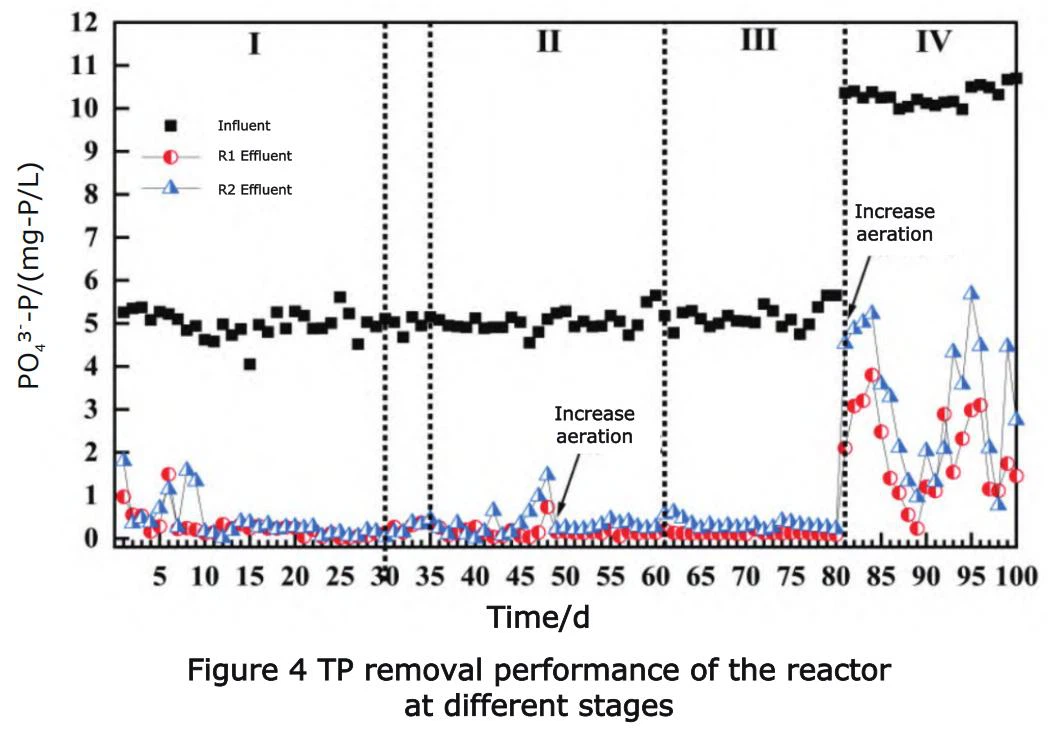
In the R1 system, the carrier provides a surface for microbial attachment, promoting the growth and metabolism of PAOs, helping to form a stable biofilm, enhancing the activity of the microbial community, thereby improving the phosphorus removal capacity of the reactor and making the biological phosphorus removal process more efficient. In Stage II, by changing the NH₄⁺-N concentration to promote nitrification, the system's oxygen consumption increased. Therefore, on day 49, aeration was increased to accelerate phosphorus removal. In Stage III, the reduction in COD led to carbon source deficiency, which not only hindered the denitrification process but also affected the metabolic activity of PAOs. In Stage IV, the system collapsed because the C/N ratio in the reactor dropped from 8 to 5.3. The intensified competition for carbon sources reduced the available carbon source for PAOs in the anaerobic stage, leading to a decrease in PHA synthesis, which in turn affected polyphosphate hydrolysis and PHA oxidation under aerobic conditions, ultimately hindering PAO growth and phosphorus uptake capacity, and resulting in decreased phosphorus removal efficiency. However, the residual phosphorus in R1 was still lower than that in R2, indicating that the carrier's promoting effect still existed.
3 Conclusion
A comparative experiment was conducted between the constructed S-MBBR system and the SBR system to systematically evaluate their nitrogen and phosphorus removal performance under low C/N ratio wastewater conditions. The results showed that the S-MBBR system outperformed the conventional SBR system in the removal of COD, NH₄⁺-N, TN, and TP. Especially under carbon source-deficient conditions, the maximum increases in removal rates for TN and NH₄⁺-N reached 14.35% and 8.19%, respectively. In addition, the S-MBBR system exhibited strong resistance to load shocks and effluent stability at different operational stages. The introduction of suspended carriers effectively optimized the microenvironmental structure of the system, promoted the occurrence of simultaneous nitrification and denitrification (SND), enhanced microbial diversity and metabolic activity, and improved the overall treatment capacity of the system. The research results indicate that S-MBBR technology has good application prospects for low C/N ratio wastewater treatment and can provide technical support for the optimization and upgrading of existing wastewater treatment processes.