

The $1.2M Annual Loss: Why Industrial Diffusers Fail Prematurely
Industrial wastewater from oil refineries and food processing plants contains:
- Free oil droplets (50-200 μm) adhering to membrane pores
- High TSS (>800 mg/L) from production residues
- Calcium carbonate scaling (CaCO3 >500 mg/L)
These factors cause 83% of diffuser failures within 6 months. JUNTAI's field studies reveal three-tiered solutions:
Phase 1: Root Cause Analysis
| Clogging Type | Industry | Dominant Mechanism |
|---|---|---|
| Organic Fouling | Food Processing | Lipids polymerize at 35-50°C |
| Inorganic Scaling | Petrochemical | CaCO3 precipitation at pH >8.2 |
| Biofilm Growth | Pharmaceutical | EPS secretion by thermophiles |
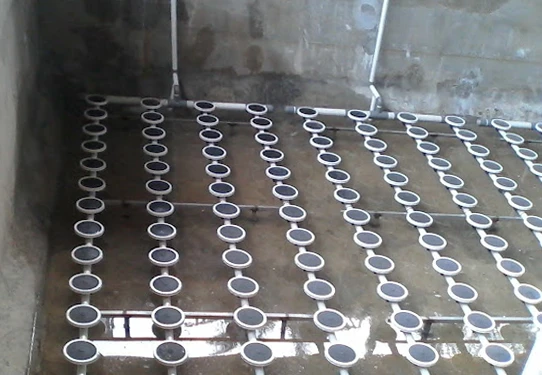
Case Study: Guangdong Lube Oil Plant
- Issue: 80% diffusers clogged monthly
- Root Cause: Oil emulsification (150 mg/L) + CaCO3 scaling
- JUNTAI Solution:
Pre-coalescence unit (oil removal to <20 mg/L)
Acid dosing (pH control at 7.2-7.5)
Nano-coated diffusers (contact angle >150°)
- Result: 9-month continuous operation
Phase 2: Anti-Clogging Material Innovations
1. Graphene-Enhanced EPDM Membranes
- Pore Structure: 0.05-0.1mm laser-drilled with staggered layout
- Performance:
Oil repellency: 98% (vs standard EPDM's 65%)
Scaling resistance: 85% CaCO3 reduction
2. Dynamic Backflush System
- Operation: 15s pulse every 2h at 3 bar
- Efficacy:
92% biofilm detachment
Energy consumption: 0.08 kWh/m³
3. IoT-Enabled Monitoring
- Sensors: Differential pressure (ΔP <0.3 bar)
- Predictive Alerts: Clogging risk 72h in advance
Phase 3: Emergency Recovery Protocol
| Step | Action | Technical Parameters |
|---|---|---|
| 1 | Chemical Soak | 5% citric acid + 0.5% surfactant (60°C, 4h) |
| 2 | Ultrasonic Cleaning | 40kHz, 120W/cm² (30min) |
| 3 | Mechanical Scraping | PTFE-coated blades (≤0.1mm residue) |
Cost Comparison:
| Method | Cost/Event ($) | Recovery Rate |
|---|---|---|
| Traditional | 2,500 | 60% |
| JUNTAI Protocol | 1,800 | 95% |