


Honeycomb Inclined Tube Settler for River Water Purification: 10-Year Case Study at Wuhan Petrochemical
When the Wuhan Petrochemical Plant first tapped the Yangtze River as its raw water source, they faced extreme seasonal turbidity swings and the daunting challenge of meeting drinking water standards without a dedicated filtration stage. A decade later, their integrated grit-flocculation-sedimentation system using polyethylene honeycomb inclined tube settlers consistently delivers effluent turbidity below 5 NTU. Here is exactly how they did it - and what their operational data means for your next water treatment project.
THE RAW WATER CHALLENGE
The Wuhan Petrochemical Plant draws raw water directly from the Yangtze River, where turbidity swings dramatically between seasons. Summer floodwaters carry extremely high suspended solids loads, while winter flows drop to relatively low turbidity. The original treatment system was designed as an integrated grit removal, flocculation, and sedimentation process, targeting an effluent turbidity of 20 NTU for industrial use. Two parallel treatment units were built, each measuring 30.0 m by 9.8 m with a design capacity of 2,000 cubic meters per hour. One unit was initially equipped with wooden slanted plates, the other with paper honeycomb tubes. Critically, the system included no downstream filtration step - the inclined tube settler alone was responsible for delivering the final effluent quality.
SYSTEM DESIGN PARAMETERS
Understanding the engineering behind this integrated tank reveals why it performs so reliably. The process follows a carefully sequenced path: Raw Water --> Coagulant Dosing --> Grit Chamber --> Flocculation --> Sedimentation --> Clear Water Tank --> Pressurization --> Distribution Network. Each stage is dimensioned to optimize a specific treatment mechanism, and the design values were selected based on extensive pilot testing with Yangtze River water.
Grit Chamber Design
The grit chamber measures 12.0 m in length and 3.0 m in width, with an effective depth of 1.5 m. At the design flow of 2,000 m3/h, this yields a flow velocity of 0.15 m/s and a retention time of approximately 2 minutes. This gentle horizontal velocity allows coarse sand and heavy grit particles to settle out while carrying lighter suspended solids forward into the flocculation stage. Early operational observations showed that flocs actually began forming here, which later proved significant when the mechanical mixers were evaluated for removal.
Two-Stage Flocculation System
The flocculation process employs two distinct mechanisms in series. First, a paddle flocculator (11.5 m x 4.0 m x 3.0 m depth) with four mechanical mixing stages provides rapid initial mixing with a 4-minute retention time. This was originally intended to create micro-flocs through high-energy mixing. The water then passes into a baffled flocculation channel - an 82-meter-long serpentine path with an inlet width of 0.6 m gradually expanding to an outlet width of 0.8 m. At 3.0 m water depth, the inlet velocity of 0.5 m/s progressively decreases to 0.3 m/s at the outlet, allowing flocs to grow through gentle hydraulic shear over approximately 13 minutes of contact time.
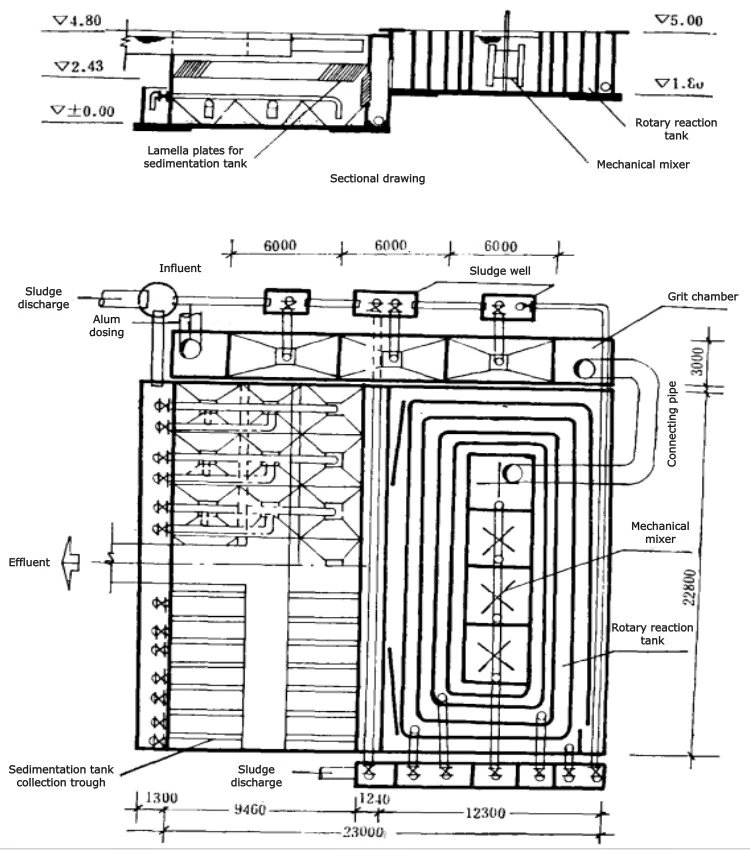
SEDIMENTATION TANK & INCLINED TUBE SETTLER SPECIFICATIONS
The sedimentation basin operates in up-flow mode with a surface area of 196 m2 (20.0 m x 9.8 m). The original wooden slanted plates measured 1,200 mm in length with a vertical height of 850 mm, set at a 60-degree inclination with 40 mm plate spacing. The paper honeycomb tubes featured a hexagonal cross-section with an inscribed circle diameter of 50 mm, tube length of 800 mm, wall thickness of 0.4 mm, and the same 60-degree inclination angle, yielding a vertical height of 700 mm. The kraft paper was impregnated with phenolic resin for structural integrity.
Under these design conditions, the upward flow velocity through the settler is 2.5 mm/s, with an overall tank retention time of 30 minutes and a residence time within the tube bundle of just 7 minutes. This extremely shallow settling depth - only 40-50 mm between inclined surfaces - is the key to the settler's efficiency. According to the shallow-depth sedimentation principle, the settling distance is reduced from the full tank depth to the inter-plate spacing, dramatically shortening the particle capture time while maintaining the same overflow rate.
MEDIA UPGRADE: FROM PAPER HONEYCOMB TO PE PLASTIC
Both the wooden slanted plates and paper honeycomb tubes delivered satisfactory treatment performance during the initial operating period (post-1980), with the paper honeycomb tubes showing a slight edge. However, field experience exposed critical material limitations that drove the decision to upgrade:
Wooden plates were difficult to manufacture to consistent tolerances and had a short service life due to persistent wet-dry cycling causing warping and biological degradation. Paper honeycomb tubes suffered from limited durability and, more critically, the phenolic resin impregnation made them unsuitable for potable water applications due to potential leaching of organic compounds into the treated water. This was a non-negotiable issue once the plant committed to meeting drinking water standards.
In 1984, all settling media were replaced with polyethylene (PE) plastic honeycomb tubes. The new modules share the same hexagonal geometry and 60-degree inclination but feature a larger inscribed circle diameter of 60 mm, tube length of 800 mm, and wall thickness of 0.5 mm. PE honeycomb tubes offer several decisive advantages:
First, the material is certified non-toxic and approved for drinking water contact, eliminating the contamination concern that plagued the phenolic resin tubes. Second, PE resists both biological degradation and chemical attack, meaning no replacement cycle and dramatically lower lifecycle costs. Third, the smooth, hydrophobic PE surface exhibits low sludge adhesion, so accumulated solids slide off under their own weight rather than building up and narrowing the flow channels. This self-cleaning behavior maintains consistent hydraulic capacity between maintenance intervals. Fourth, the hexagonal tube geometry provides a larger wetted perimeter than flat plates of equivalent spacing, producing a lower hydraulic radius and consequently lower Reynolds numbers - meaning more stable laminar flow conditions that improve settling efficiency. One operational issue that arose was the buoyancy of PE tube modules when submerged; this was resolved by installing anchoring fixtures to prevent floating.
SLUDGE DISCHARGE SYSTEM IMPROVEMENT
The original sludge discharge system relied on manual flap butterfly valves, which proved to be one of the plant's most persistent operational headaches. These valves demanded high operator labor intensity, suffered from poor sealing that resulted in water leakage of approximately 10 m3/h per valve, experienced frequent connecting rod breakage, and delivered generally poor sludge removal. In a continuous 24/7 water treatment operation, unreliable sludge discharge translates directly into deteriorating effluent quality as accumulated sludge begins to decompose, release gases, and re-suspend into the water column.

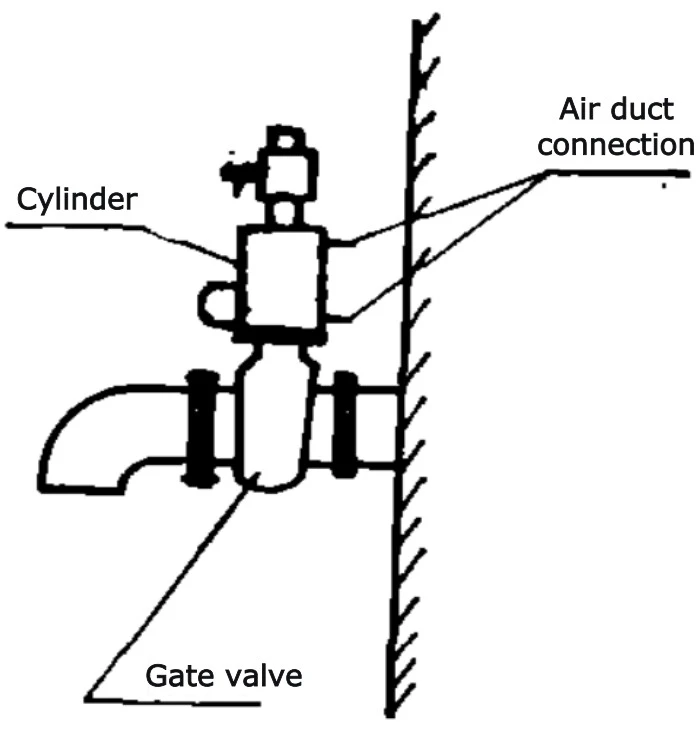
In June 1988, the manual valves were replaced with pneumatic gate valves across all discharge points. The pneumatic system eliminated water leakage entirely by providing positive sealing force, simplified operation to a single control action, and dramatically improved sludge discharge effectiveness by enabling rapid, high-volume evacuation before sludge could compact. Additional modifications included increasing the sludge hopper height from 800 mm to 1,200 mm to provide more storage volume and installing two additional discharge valves on the perforated sludge collection pipe for more uniform hopper evacuation. These changes extended the operational cycle between full tank cleanings from weeks to approximately three months.
CHEMICAL DOSING OPTIMIZATION
The coagulant dosing system underwent four interconnected improvements that collectively transformed treatment economics and reliability. First, the coagulant solution concentration was standardized to approximately 5% (down from the earlier 5-10% range). This lower, consistent concentration ensured that dosing pipes remained fully flooded at all flow rates, preventing the air locking that had intermittently interrupted coagulant feed. Second, after extensive comparative testing, the plant switched from crude aluminum sulfate to basic aluminum chloride (PAC). The original aluminum sulfate required high dosages, gave inconsistent results under varying raw water conditions, and during summer high-turbidity periods the operators resorted to ferric chloride - which, while effective, was so corrosive it damaged pipes and equipment. PAC proved superior across all seasons: lower dosage requirements, reduced consumption cost, stable effluent quality, and noticeably better treated water color.
Third, all dosing pipelines were replaced with plastic pipes, eliminating the mixed-material corrosion problems that had plagued the original installation of plastic, cast iron, and steel piping. Fourth, and perhaps most insightfully, the four-stage mechanical mixers were removed from the flocculation tank entirely. The operators observed that flocs already formed in the grit chamber were being broken apart by the high-shear mechanical stirrers, undoing the very coagulation they were meant to promote. After removing the mixers, flocs grew progressively and stably in the baffled flocculation channel through gentle hydraulic shear alone, significantly improving coagulation efficiency while simultaneously reducing power consumption.
TREATMENT RESULTS: PERFORMANCE DATA
After implementing the full suite of improvements, the treatment system achieved results that exceeded its original industrial-grade design specification. At the design flow of 2,000 m3/h, effluent turbidity has remained consistently below 5 NTU since 1984, meeting China's National Drinking Water Standard (GB 5749-85). When pushed to overload conditions of 3,000 m3/h (50% above design), the system still maintains effluent turbidity below 15 NTU. Raw water turbidity fluctuates seasonally, but the treated water turbidity stays within the drinking water range regardless.
The water quality analysis confirms the system's ability to produce potable water from surface water:
| Parameter | Value |
| Color (raw water) | Yellow, none after treatment |
| Odor | None |
| Turbidity (raw) | Variable (seasonal) |
| Turbidity (treated) | < 5 NTU |
| pH | 7.2 |
| Chlorination | Partial, for drinking water supply at refinery |
The economic benefits of the coagulant switch are equally striking. In a side-by-side comparison during June 1988, with a water production of approximately 170,000 tons per month, the PAC dosage was just 11.4 mg/L compared to 25.6 mg/L for aluminum sulfate - a 55.5% reduction in chemical consumption. Monthly coagulant consumption dropped from 4.5 tons to 2.1 tons:
| Period (June 1988) | Coagulant Type | Consumption (tons) | Unit Dosage (mg/L) | Reduction |
| 1-15 | Aluminum sulfate | 4.5 | 25.6 | - |
| 16-30 | PAC | 2.1 | 11.4 | 55.5% |
Note: Monthly water production was approximately 170,000 tons. Power consumption also decreased notably following the removal of the mechanical mixers, though exact figures were not quantified in the published case study.
REMAINING CHALLENGES & PLANNED UPGRADES
The Wuhan plant team identified three areas for further improvement that are equally relevant to anyone operating inclined tube settlers today. First, manual turbidity monitoring created a response lag between detecting water quality changes and adjusting coagulant dosing. The solution under consideration was an automatic dosing control system using online turbidity meters to provide real-time feedback for coagulant feed rate adjustment. This represents the logical next step for any plant that has already optimized its mechanical and chemical subsystems.
Second, algae growth on exposed honeycomb tube surfaces progressively reduced the effective cross-sectional area of the flow channels. Sunlight penetration into the settler basin promoted biofilm and algae colonization, which not only restricted flow but eventually clogged tubes entirely. The proposed solution was pre-chlorination of the raw water upstream of the settler to control biological growth before it could establish on the tube surfaces. Third, despite improvements in sludge discharge, hoppers still accumulated compacted sludge that could not be removed during normal discharge cycles, necessitating complete tank shutdown and manual cleaning every three months. The engineering response was to install internal spray nozzles that would use pressurized water for flushing during the sludge discharge cycle, eliminating the need for periodic shutdowns.
KEY LESSONS FOR INCLINED TUBE SETTLER DESIGN
The decade of operating data from Wuhan distills into four principles that should guide any inclined tube settler project:
1. Integrated design works. The grit-flocculation-sedimentation一体化 (integrated) tank concept, when properly dimensioned, can reliably produce drinking water quality from surface water without a downstream filtration step. The key is getting each stage's hydraulic parameters right: flow velocity in the grit chamber (0.15 m/s), retention time in flocculation (17 minutes total), and upward flow velocity in the settler (2.5 mm/s). Deviating from these values compromises the entire treatment chain.
2. Material selection has cascading consequences. PE plastic honeycomb tubes offer the best combination of treatment performance, durability, potable water safety, and maintenance simplicity compared to wooden plates or resin-impregnated paper tubes. The larger wetted perimeter, self-cleaning surface, and indefinite service life justify the initial investment many times over through reduced maintenance and consistent treatment performance.
3. Sludge discharge reliability determines effluent consistency. A reliable, easy-to-operate sludge discharge system is not optional - it is the single most important mechanical subsystem for maintaining consistent settling performance. Manual valves invite operator fatigue and inconsistent sludge removal, which directly translates to variable effluent quality. Pneumatic or automated discharge should be considered standard, not optional, for any continuous-operation settler.
4. Coagulant optimization delivers the fastest payback. The switch from aluminum sulfate to PAC produced a 55% reduction in chemical cost as just the immediate benefit. The downstream effects - less sludge production, better water color, more consistent performance across seasonal turbidity variations - multiply the economic return. Pairing PAC with properly designed dosing infrastructure (plastic piping, consistent concentration, full-flow pipes) ensures those benefits are realized continuously.
OUR HONEYCOMB INCLINED TUBE SETTLER SOLUTIONS
Drawing on decades of water treatment engineering experience, we provide a complete range of honeycomb inclined tube settler products and services tailored to your raw water quality and treatment objectives:
Our PE and PVC hexagonal honeycomb tube media are available in cell diameters of 25 mm, 35 mm, 50 mm, 60 mm, and 80 mm, allowing you to select the optimal settling surface area and hydraulic loading for your specific raw water turbidity range. For surface water treatment applications targeting drinking water quality, the 50-60 mm diameter range (matching the Wuhan specification) provides the best balance of settling efficiency and clogging resistance.
We supply integrated settler design and fabrication for surface water treatment, industrial wastewater clarification, and process water conditioning. Our complete sludge collection and discharge systems include pneumatic gate valves and automatic timed discharge controllers that eliminate the manual valve problems documented at Wuhan. For existing plants, we offer retrofit and upgrade services covering media replacement, sludge system modernization, coagulant selection support, dosing system optimization, and operational troubleshooting.
Ready to upgrade your sedimentation system? Explore our tube settler solutions or contact our engineering team for a customized proposal.
Reference: Tang T.Q. Honeycomb Inclined Tube Settler for River Water Purification [J]. Petroleum Refining, 1989(4): 1-6.