


Disc Diffusers for Commercial RAS Aquaculture: Boost Survival Rate & Cut Aeration Cost by 28%
Dissolved oxygen is the single most critical limiting factor in commercial recirculating aquaculture systems. When an 8,000-square-meter indoor shrimp farm in Thailand swapped its surface impeller aerators for 9-inch EPDM fine bubble disc diffusers, the results rewrote their production economics: aeration energy costs dropped 28%, bottom-tank dissolved oxygen stabilized above 5 mg/L, and shrimp survival rates jumped from 79% to 93%. Here is the full technical analysis of why disc diffusers outperform every legacy aeration technology in RAS applications - and how to configure them for maximum return.
THE DISSOLVED OXYGEN PROBLEM IN COMMERCIAL RAS
High-density indoor fish and shrimp farms depend entirely on mechanical aeration. There is no atmospheric re-aeration, no photosynthetic oxygen from algae, and no dilution from incoming water flow - every milligram of dissolved oxygen must be supplied by the aeration equipment. When that equipment underperforms, the consequences cascade rapidly: low DO triggers stress responses, suppresses feeding, impairs immune function, and in severe cases causes mass mortality within hours. Yet many commercial RAS facilities continue to rely on surface aerators designed decades ago for low-density outdoor ponds, accepting excessive power consumption, poor oxygen transfer at depth, and chronic sub-lethal stress on their stock as unavoidable operating costs.
The physics of oxygen transfer explains why surface aerators are fundamentally limited. An impeller splashing water at the surface creates oxygen transfer primarily through the air-water interface of droplets and surface turbulence. The bubble plume is shallow, the contact time is brief, and the energy expended on splashing - rather than on generating fine bubbles with high surface-area-to-volume ratios - represents wasted electrical power. In tanks deeper than 1.5 meters, surface aerators leave the bottom water layer essentially unoxygenated, creating a stratified environment where shrimp and fish are forced to choose between warm surface water with adequate oxygen and cooler bottom water that is effectively hypoxic.
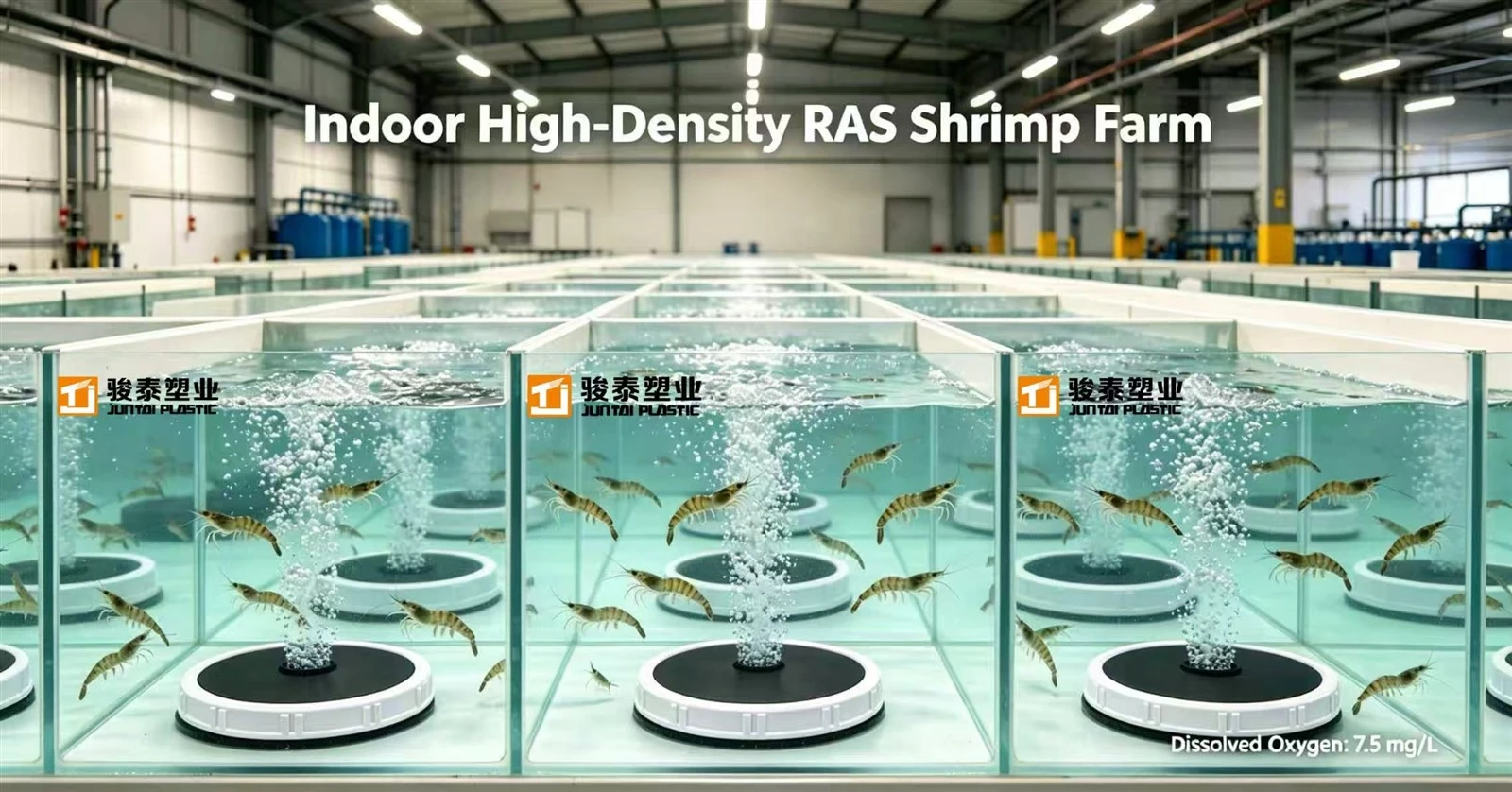
WHY DISC DIFFUSERS OUTPERFORM TRADITIONAL AERATION
Fine bubble disc diffusers solve the oxygen transfer problem at the level of fundamental physics. Mounted on the tank floor, they release a dense plume of microbubbles 1-3 mm in diameter that rise slowly through the entire water column. This accomplishes three things simultaneously that surface aerators cannot:
First, extended gas-water contact time. A 1 mm bubble rising from a 2-meter tank bottom takes approximately 30-40 seconds to reach the surface, compared to the fraction of a second for surface-splashed droplets. During that slow ascent, oxygen continuously diffuses across the bubble-water interface, achieving dramatically higher oxygen transfer efficiency. Second, vertical water circulation. The rising bubble column drives a gentle, tank-wide circulation pattern that eliminates thermal and oxygen stratification. Water from the oxygen-depleted bottom is lifted into the aerated zone, while oxygenated surface water is drawn downward, creating a homogeneously oxygenated environment throughout the entire water column. This circulation also sweeps settled solids toward central drains, improving overall tank hygiene. Third, the flexible EPDM membrane is engineered specifically for aquaculture conditions: it resists fouling from residual feed particles and fish manure, tolerates mild seawater corrosion in marine RAS applications, and maintains consistent bubble size over years of continuous operation. When air supply stops, the membrane's self-sealing perforations close, preventing water backflow into the air piping.
| Key Parameter | 9-inch Aquaculture Disc Diffuser | Surface Impeller Aerator |
| Oxygen Utilization Rate | 26-33% | 9-16% |
| Stable DO Coverage | Full water layer (0-5 m) | Surface only (0-1.5 m) |
| Energy per Ton Water | 28% lower | High power waste |
| Impact on Stock | Gentle bubble, no stress | Strong water shock, fish stress |
| Service Life | 5-7 years | 2-3 years |
| Effect on Bottom Water | Oxidizes ammonia & H2S | Dead zones at tank bottom |
The oxygen utilization rate gap is the most consequential number in this comparison. A disc diffuser system delivering 26-33% OUE means that for every unit of electrical energy consumed by the blower, two to three times more oxygen actually dissolves into the water compared to a surface aerator. That ratio translates directly into the 28% energy reduction documented in the Thailand case study - and for a facility running aeration blowers 24 hours a day, 365 days a year, the annual savings compound rapidly.
COMMERCIAL CASE STUDY: INDOOR SHRIMP RAS IN THAILAND
The most compelling evidence for disc diffuser performance comes from a large-scale commercial retrofit at an indoor white shrimp (Litopenaeus vannamei) recirculating farm in Thailand. The facility spans 8,000 square meters with 16 culture tanks and a total daily water circulation of 15,000 cubic meters. At a stocking density of 120 shrimp per cubic meter, the oxygen demand is extreme - and continuous.
Before the retrofit, the farm relied on surface impeller aerators. The operational symptoms were classic for under-aerated intensive RAS: bottom dissolved oxygen routinely fell below 3 mg/L, shrimp experienced frequent stress-induced molting events, the feed conversion ratio (FCR) was stuck at an uneconomical 1.82, and monthly electricity bills were the single largest operating expense. The farm operated in a precarious state where a single blower failure or unexpected oxygen sag during feeding could trigger a mass mortality event.

| Project Parameter | Specification |
| Total culture water volume | 4,200 m3 |
| Diffuser specification | 9-inch food-grade EPDM disc diffuser |
| Installed quantity | 2,200 pieces |
| Single disc airflow | 2-7 m3/h |
| Culture density | 120 shrimp/m3 |
The retrofit replaced all surface aerators with 2,200 units of 9-inch EPDM disc diffusers distributed uniformly across the 16 culture tanks. Each diffuser operates at 2-7 m3/h airflow, providing dense, overlapping bubble coverage that eliminates oxygen dead zones. The results after a 5-month trial period were documented across every key production metric:
Energy and Cost Performance
Total aeration energy consumption dropped by 28%, delivering annual power cost savings exceeding $52,000. This reduction came from the higher oxygen transfer efficiency allowing the blowers to operate at lower pressure and flow rates while still meeting the total oxygen demand. The savings alone provided a payback period of less than 18 months on the complete diffuser retrofit investment.
Water Quality and Dissolved Oxygen
Bottom-tank dissolved oxygen stabilized at 5.2-6.5 mg/L, eliminating the chronic hypoxia that had suppressed feeding and triggered stress responses. Critically, this DO level was maintained uniformly from the tank floor to the surface, ending the stratification that forced shrimp to choose between temperature and oxygen. Ammonia nitrogen and nitrite concentrations both decreased by approximately 40%, a direct consequence of the oxygenated bottom environment supporting robust nitrifying bacterial activity on all submerged surfaces.
Survival Rate and Production Biology
Shrimp survival rate increased from 79% to 93% - a 14-percentage-point improvement that is extraordinary in intensive aquaculture, where survival gains of 3-5% are typically considered significant. The frequency of disease outbreaks dropped sharply as chronic stress - the primary immunosuppressant in intensive RAS - was eliminated. The feed conversion ratio (FCR) improved from 1.82 to 1.57, meaning 14% less feed was required to produce each kilogram of shrimp biomass. For a facility producing at this scale, the combined savings from reduced mortality and improved FCR dwarf even the energy savings.
| Performance Metric | Before (Impeller) | After (Disc Diffuser) |
| Aeration energy consumption | Baseline | 28% reduction |
| Annual power cost savings | - | $52,000+ |
| Bottom tank DO | < 3 mg/L | 5.2-6.5 mg/L |
| Shrimp survival rate | 79% | 93% |
| Ammonia & nitrite reduction | Baseline | 40% reduction |
| Feed conversion ratio (FCR) | 1.82 | 1.57 |
PROFESSIONAL OPERATION GUIDELINES FOR DISC DIFFUSER SYSTEMS
Achieving the results documented in the Thailand case study requires more than simply installing diffusers and turning on the blowers. The following operational protocols are drawn from commercial aquaculture experience across shrimp, tilapia, and salmon RAS facilities:
Uniform tank-floor distribution is non-negotiable. Diffusers should be arranged in a grid pattern with equal spacing calculated to provide overlapping bubble coverage at the design airflow rate. The goal is zero oxygen dead zones - any floor area not swept by rising bubbles will accumulate solids and become hypoxic. For 9-inch disc diffusers operating at 2-7 m3/h, a typical spacing of 1.2-1.8 meters center-to-center provides uniform coverage in tanks up to 2.5 meters deep. Deeper tanks require closer spacing to maintain bubble plume density through the full water column.
Monthly air backwash prevents biofilm fouling. Over time, residual feed particles and bacterial biofilm accumulate on the EPDM membrane surface, progressively reducing airflow and altering bubble size distribution. A monthly backwash cycle - briefly increasing airflow to maximum rated capacity for 30-60 seconds per diffuser zone - dislodges accumulated fouling and restores design performance. For facilities with high organic loading, bi-weekly backwash may be warranted.
Membrane material must match water chemistry. Standard EPDM membranes perform well in freshwater and low-salinity brackish water applications. For full-strength seawater marine aquaculture (salmon hatcheries, marine shrimp broodstock), specify silicone membrane diffusers that resist the oxidative degradation seawater inflicts on EPDM over extended exposure. The incremental material cost is small compared to the downtime and labor cost of premature membrane replacement in a stocked production tank.
Automated DO control maximizes energy savings. The most advanced RAS facilities link their blowers to in-tank dissolved oxygen sensors via a programmable logic controller (PLC). When DO exceeds the target setpoint (typically 5.5-6.0 mg/L for shrimp, 6.0-7.0 mg/L for finfish), the blower output automatically modulates downward, saving energy during periods of low oxygen demand such as between feeding cycles or during cooler nighttime hours. This closed-loop control typically captures an additional 10-15% energy reduction beyond the baseline efficiency gain of the diffusers themselves.
APPLICATIONS ACROSS AQUACULTURE SECTORS
While the Thailand shrimp case study provides the most complete dataset, fine bubble disc diffusers have demonstrated equivalent benefits across the full spectrum of commercial aquaculture systems:
Indoor RAS finfish (tilapia, barramundi, Eurasian perch): Disc diffusers provide the homogeneous DO distribution essential for even growth rates across tank populations. In tilapia RAS operating at 60-80 kg/m3 stocking density, the vertical circulation from bottom diffusers also improves solids transport to central drains, reducing the load on downstream drum filters.
Salmon smolt hatcheries and RAS grow-out: Atlantic salmon are exceptionally sensitive to DO fluctuations, with even brief exposure to sub-5 mg/L conditions triggering gill damage and increased susceptibility to amoebic gill disease (AGD). Disc diffuser systems providing stable 7-8 mg/L DO are becoming standard in modern RAS hatcheries. The membrane material must be specified as silicone for seawater-stage applications.
Outdoor intensive pond aquaculture: While designed primarily for tanks and RAS, disc diffusers also outperform paddlewheel aerators in lined intensive ponds up to 2 meters depth. The bottom-mounted diffuser grid eliminates the "dead zone" under paddlewheels and provides far more uniform oxygen distribution across irregularly shaped ponds.
CONCLUSION: THE ECONOMICS OF DISSOLVED OXYGEN
The Thailand case study proves a principle that every intensive aquaculture operator should internalize: dissolved oxygen is not an operating cost to be minimized, but a production input whose optimization generates disproportionate returns. The 28% aeration energy savings from switching to disc diffusers is the most visible benefit, but it is not the most important one. The 14-point improvement in survival rate and the 0.25-point reduction in FCR represent far greater financial impact - and both are direct consequences of providing stable, full-water-column oxygenation rather than the marginal, surface-only aeration that shrimp and fish can merely survive on.
For indoor high-density RAS farms and outdoor intensive pond operations alike, fine bubble disc diffusers deliver a rare combination of simultaneous benefits: lower operating cost, higher production yield, better water quality, and reduced disease risk. The capital investment in a diffuser retrofit is recovered through energy savings alone within 12-18 months at commercial scale; the production gains continue compounding year after year.
Ready to upgrade your RAS aeration system? Explore our aquaculture disc diffuser solutions or contact our engineering team for a customized aeration layout.
WhatsApp: +86 137 9555 6548 | Email: [email protected]