


Cold temperatures are the enemy of biological nitrogen removal. As water temperature drops below 15°C, nitrifying bacteria slow their metabolic activity dramatically - and at high altitudes, thinner air compounds the problem by reducing oxygen transfer efficiency by up to 22%. This case study examines how an 85,000 m³/d wastewater treatment plant on the Qinghai-Tibet Plateau at 2,200 m altitude deployed MBBR technology to sustain 93–96% ammonia removal even at 9°C, meeting China's Grade 1A effluent standards year-round.
Project Background
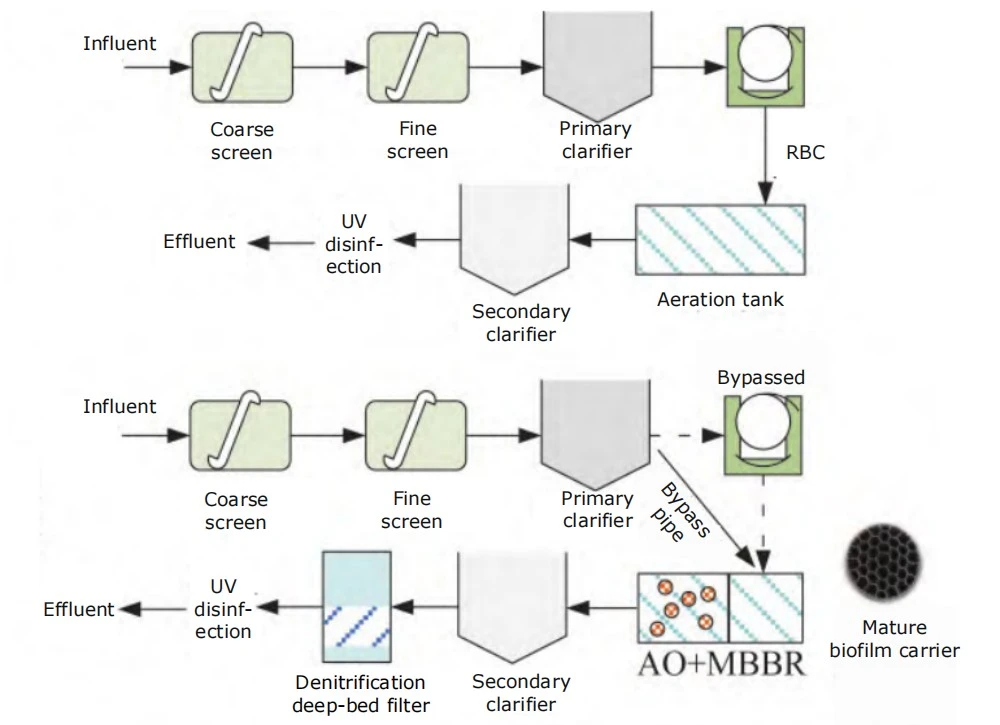
Located in a densely populated urban area of the Qinghai-Tibet Plateau, this WWTP was originally commissioned in 2010 with a conventional "biological disc + aeration tank" process designed solely for COD and ammonia removal. At that time, the effluent was required to meet only Grade 1B standards under GB 18918-2002 - a relatively lenient target. However, with rapid urbanization, increasing discharge volumes, and progressively tighter environmental regulations mandating total nitrogen removal to Grade 1A (NH₃-N ≤ 5 mg/L, TN ≤ 15 mg/L), the plant faced an urgent retrofit imperative. The challenge was not just technical but physical: the existing tank volume was fixed, and expanding the footprint was not feasible given the dense surrounding infrastructure.
The retrofit strategy maximized nitrogen removal within the constrained tank geometry. Channels 1 and the first half of Channel 2 were converted into an anoxic zone for denitrification, while the second half of Channel 2 and Channels 3 and 4 were designated as the aerobic MBBR zone for nitrification. Rather than replacing the existing aeration discs, the engineering team retained them and introduced MBBR media directly into the aerobic channels - transforming the system into a hybrid integrated fixed-film activated sludge (IFAS) process. This approach minimized retrofit costs while leveraging the existing infrastructure investment.
Key Design Parameters
| Parameter | Value |
| Design flow | 85,000 m³/d |
| Water temperature range | 9–26°C (winter minimum 9°C) |
| Influent COD | 350–500 mg/L |
| Influent NH₃-N | 35–55 mg/L |
| Influent TN | 45–70 mg/L |
| Aerobic tank HRT | 8.2 hours |
| MBBR media filling ratio | 30% (media volume / tank volume) |
| Media specification | PE cylindrical carrier, Φ15 mm × 15 mm, 800 m²/m³, density 0.96 g/cm³ |
| Effluent target (Grade 1A) | COD ≤ 50, NH₃-N ≤ 5, TN ≤ 15, SS ≤ 10, BOD₅ ≤ 10 mg/L |
Carrier and Biofilm Science
The choice of carrier media is arguably the single most important design decision in cold-climate MBBR applications. This project selected high-density polyethylene (HDPE) cylindrical carriers, and the rationale reveals why carrier engineering matters far more than most operators realize.
High specific surface area (800 m²/m³): At a 30% fill ratio, the effective biofilm surface area is approximately 240 m² per cubic meter of tank volume - roughly 8 to 10 times what conventional activated sludge can offer. This enormous surface area means the reactor can host a nitrifier population density that suspended-growth systems simply cannot match, which is the fundamental reason MBBR outperforms at low temperatures. Even with the reduced metabolic rate at 9°C, the sheer quantity of nitrifiers retained on the carriers compensates for slower per-cell kinetics.
Near-neutral buoyancy (0.96 g/cm³): At high altitude, where atmospheric oxygen partial pressure is only about 78% of sea-level values, oxygen transfer is already compromised by physics. A carrier density just below water ensures the media remain suspended and circulate freely with minimal aeration energy input - a critical operational and economic consideration when every kWh of blower power must overcome both biological demand and altitude-induced transfer inefficiency.
Protected internal surface geometry: The cylindrical shape with internal cross-bracing creates sheltered microenvironments where biofilm is shielded from hydraulic shear forces during mixing. This protection allows thicker, more resilient biofilms to develop - a crucial advantage in cold conditions where biofilm growth rates are inherently slow and the microbial community needs every advantage to establish and persist through the long winter months.
Cold-Climate Nitrification Mechanism
At low temperatures, biological nitrification faces three interrelated challenges that conventional activated sludge struggles to overcome:
1. Reduced metabolic rate: Ammonia-oxidizing bacteria (AOB) and nitrite-oxidizing bacteria (NOB) have significantly lower specific growth rates below 15°C. In a suspended-growth system, this means the nitrifier population can be literally washed out of the reactor if the solids retention time (SRT) is insufficient - a mathematical inevitability when growth rate drops below the wasting rate. MBBR solves this by immobilizing nitrifiers in biofilm, where the effective SRT far exceeds hydraulic retention time. Even at 9°C, the population remains stable and functional.
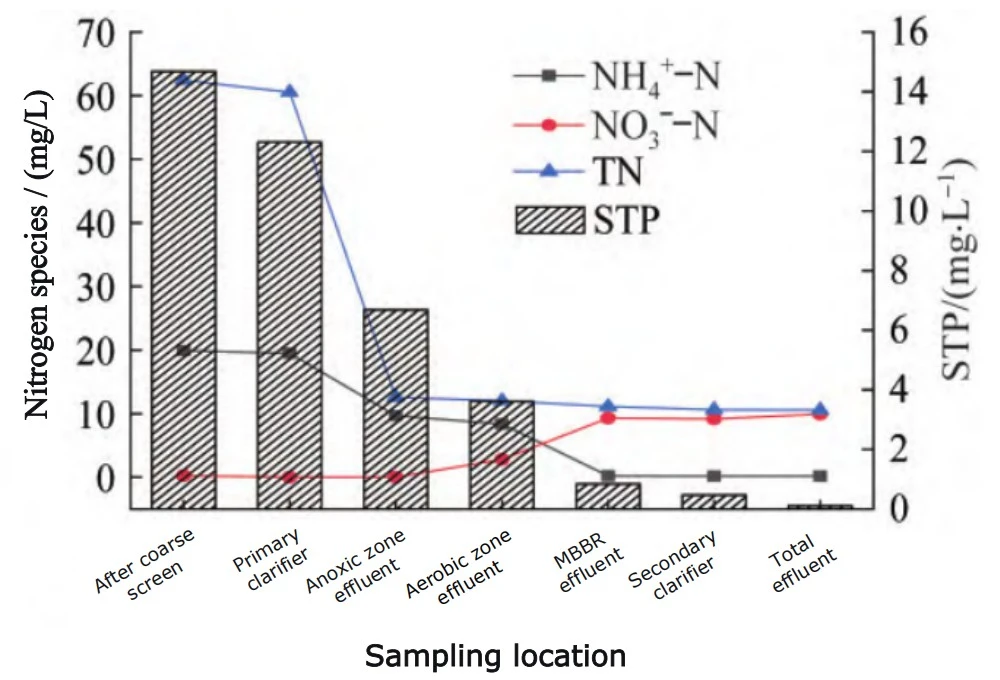
2. Oxygen transfer limitation: At 2,200 m altitude, the oxygen saturation concentration in water is approximately 22% lower than at sea level, reducing the driving force for oxygen mass transfer from gas bubbles to liquid. Biofilm architecture mitigates this: the outer aerobic layer actively consumes the available oxygen for nitrification, maintaining a steep concentration gradient that maximizes transfer efficiency, while the inner anoxic zone supports denitrification using the nitrate produced in the outer layer.
3. Substrate diffusion limitation: Colder water is more viscous, which slows the molecular diffusion of ammonia and oxygen into biofilms. The MBBR approach addresses this by maintaining a thin, metabolically active outer biofilm layer (typically 150–300 μm) that minimizes the diffusion path length, ensuring that substrate reaches nitrifiers even in cold, viscous water.
Performance Results
The retrofitted plant has been operating stably since commissioning, and the data tells a compelling story. The following table presents key performance indicators across seasonal conditions - note particularly how little degradation occurs between summer and winter operation.
Table 1: MBBR Performance Across Seasonal Temperature Ranges
| Parameter | Summer (20–26°C) | Winter (9–13°C) | Annual Average |
| Effluent COD (mg/L) | 28–35 | 32–42 | 33 |
| COD Removal (%) | 91–93 | 89–91 | 91 |
| Effluent NH₃-N (mg/L) | 0.8–1.5 | 1.8–3.2 | 1.6 |
| NH₃-N Removal (%) | 96–98 | 93–96 | 96 |
| Effluent TN (mg/L) | 9–12 | 11–14 | 10.5 |
| TN Removal (%) | 78–82 | 74–78 | 79 |
The winter performance is remarkable: even at 9°C, NH₃-N removal stayed above 93% with effluent consistently below 3.2 mg/L - comfortably within the 5 mg/L Grade 1A ceiling. TN removal held at 74–78%, meeting the 15 mg/L standard. COD removal remained stable at 89–91%, confirming that heterotrophic activity is considerably less temperature-sensitive in biofilm systems than in suspended-growth configurations.

Key Success Factors
Low-Load Biofilm Acclimation
Before winter onset, the plant implemented a deliberate, gradual reduction in organic loading rate over a 3-week period. Why does this matter? At lower organic loads, heterotrophic bacteria - which grow faster than nitrifiers - are starved of their primary substrate, giving the slower-growing nitrifying bacteria a competitive advantage. This pre-acclimation strategy allowed the nitrifier population to reach peak density before temperatures dropped, building a biological buffer that sustained performance through the coldest months. Without this step, nitrifiers entering winter at sub-peak populations would show far greater performance decline.
Carrier Retention Design
Stainless steel wedge-wire screens with a precise 3 mm slot opening were installed at the tank outlet. This opening size was carefully selected - large enough to allow mixed liquor suspended solids (MLSS) to pass through freely, but small enough to reliably retain the 15 mm diameter carriers. Screen clogging, a common headache in MBBR operations, was prevented by automated intermittent air scouring that dislodged any accumulated solids before they could form a mat.

Progressive Aeration Strategy
Aeration intensity was progressively tapered from inlet to outlet zones, matching oxygen supply to spatially varying demand. At the inlet, where ammonia concentrations are highest, higher aeration rates drive rapid nitrification. Toward the outlet, reduced aeration conserves energy while maintaining DO at 2–3 mg/L in nitrification zones. This tapered profile also creates micro-gradients within the biofilm that promote simultaneous nitrification-denitrification (SND) - the holy grail of biological nitrogen removal - where nitrate produced in the aerobic outer biofilm layer diffuses inward and is denitrified in the anoxic core, all within a single carrier.
Cross-Climate Benchmarking
How does the Qinghai plant compare to MBBR installations in warmer climates? Table 2 provides the answer - and it's more encouraging than many engineers would expect.
Table 2: MBBR Performance Comparison Across Climate Zones
| Parameter | Qinghai (Cold Plateau 9–26°C) | Northern China (Temperate 12–30°C) | Southeast Asia (Tropical 25–32°C) |
| Altitude (m) | 2,200 | 50 | 5 |
| Winter NH₃-N Removal (%) | 93–96 | 94–97 | 95–98 |
| HRT (hours) | 8.2 | 6.5 | 5.0 |
| Media Fill Ratio (%) | 30 | 25 | 20 |
| Aeration Energy (kWh/kg COD removed) | 0.38 | 0.31 | 0.28 |
The data confirms a consistent pattern: cold-climate MBBR systems require moderately higher HRT (8.2 vs. 5.0 hours) and fill ratios (30% vs. 20%) to compensate for slower biological kinetics, yet they achieve comparable treatment performance to warm-climate systems. The 2–3 percentage point difference in winter NH₃-N removal between Qinghai and tropical systems is remarkably small given the 16–23°C temperature gap. This is a powerful validation of biofilm-based nitrogen removal as a climate-resilient technology.

Operational Lessons Learned
Cold-weather start-up: Commissioning during winter is challenging but entirely feasible with seed sludge from a mature nitrifying system and a 4–6 week ramp-up period. The biofilm takes longer to establish at low temperatures, but once formed, it is self-sustaining. Attempting to shortcut this acclimation period invariably leads to poor initial performance.
Carrier mixing optimization: At a 30% fill ratio, aeration rates of 3–5 Nm³/m²·h are sufficient for complete carrier circulation. The team found that excessive aeration beyond this range wasted energy without improving mixing - a frequent mistake in MBBR operation where operators assume "more air equals better mixing."
Biofilm thickness monitoring: Periodic measurement of biofilm thickness using carrier sampling and microscopy - targeting 150–300 μm - proved essential for optimizing SRT and preventing excessive biofilm accumulation. Biofilms thicker than 300 μm risk developing anaerobic zones that can cause sloughing and unpredictable performance swings.
Winter foaming control: Start-up during cold months may trigger mild filamentous foaming due to low food-to-microorganism (F/M) ratios. The plant managed this with controlled sludge wasting and temporary anti-foam dosing - a minor operational nuisance that should not dissuade plants from winter commissioning.
Conclusion
The Qinghai project conclusively demonstrates that MBBR technology can deliver reliable, high-efficiency nitrogen removal in cold plateau environments where conventional activated sludge would struggle to meet modern discharge standards. The four key technical enablers - high-specific-surface-area HDPE carriers that retain slow-growing nitrifiers, biofilm architecture supporting simultaneous nitrification-denitrification, pre-winter acclimation strategies that build resilient microbial communities, and tapered aeration design that optimizes energy use - form a replicable framework that plants facing similar challenges can adopt with confidence.
For engineers and plant managers dealing with cold climates, high altitudes, limited footprints, or tightening nitrogen discharge limits, MBBR offers a proven, cost-effective retrofit pathway that does not require major civil works or expanded tankage.

Specify High-Performance MBBR Media for Your Cold-Climate Application
Juntai Plastic manufactures HDPE MBBR carriers with 800 m²/m³ protected surface area, engineered for cold-climate and high-altitude wastewater treatment. Our carriers feature proprietary cylindrical geometry with internal cross-bracing for maximum biofilm retention and minimal shear loss - backed by full technical support from process design through commissioning.