


In modern high-density aquaculture, water quality is not just an environmental concern - it is the single most important variable determining survival rates, feed conversion ratios, and ultimately farm profitability. Every kilogram of uneaten feed and every gram of shrimp excretion adds ammonia to the water column, and at concentrations above 1–2 mg/L, ammonia becomes toxic to shrimp, suppressing growth and increasing disease susceptibility. This case study examines how a large-scale shrimp farm deployed MBBR technology to treat 600 m³/d of nutrient-rich wastewater, achieving 90–95% ammonia removal and enabling 85% water reuse - saving an estimated 186,000 m³ of freshwater per year.
Project Overview
The client operates a large-scale shrimp farm with a pressing dual objective: maintain stable water quality to support high-density production, and comply with increasingly stringent discharge regulations. After evaluating multiple treatment technologies, the farm selected an MBBR-based biological treatment system - and the decision was driven by three factors that matter enormously in aquaculture: superior nitrification capability at the consistently warm temperatures shrimp farms operate at, a compact footprint that fits within the limited land available adjacent to production ponds, and operational simplicity that does not demand a dedicated process engineer on site.
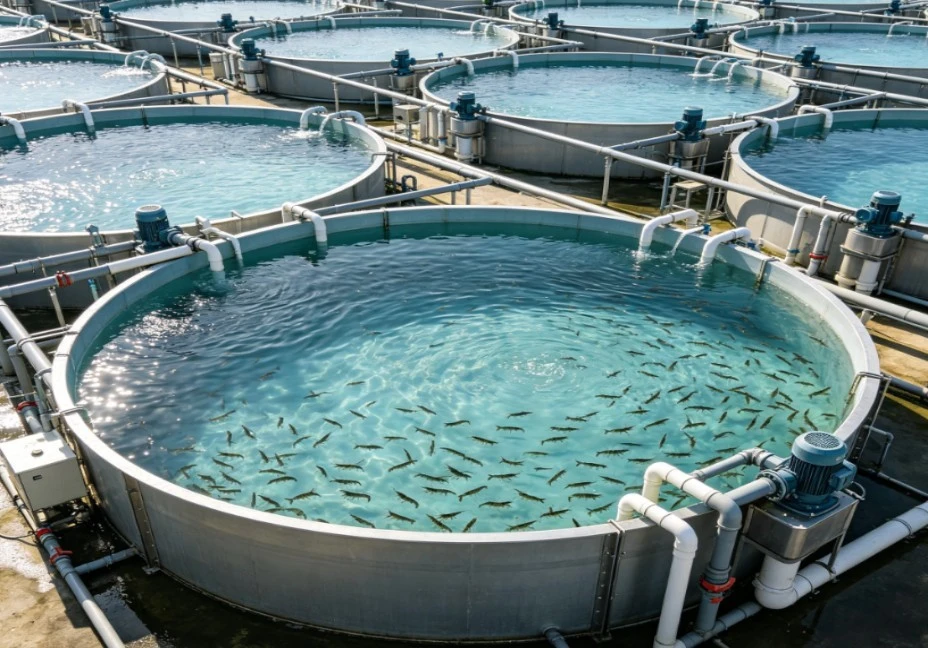
The treated water is primarily reused in the farm's recirculating aquaculture system (RAS), creating a nearly closed-loop water cycle. Any excess beyond recirculation needs is discharged to a nearby receiving water body - but at a quality that meets the Chinese discharge standard for aquaculture wastewater (SC/T 9101-2007) with comfortable margins on all parameters.
Feed Water Characteristics
Aquaculture wastewater from shrimp farms has a distinctive profile that differs significantly from municipal sewage. The organic loads are moderate, but ammonia concentrations are disproportionately high relative to COD - a result of protein-rich feed residues and concentrated shrimp excretion. Suspended solids come predominantly from uneaten feed particles and fecal matter, both of which settle relatively well. Understanding this profile is critical because it directly shapes the treatment process design.
| Parameter | Raw Aquaculture Wastewater | After Primary Sedimentation |
| Flow Rate (m³/d) | 600 | 600 |
| COD (mg/L) | 180–250 | 120–180 |
| BOD₅ (mg/L) | 80–120 | 60–90 |
| NH₃-N (mg/L) | 8–15 | 6–12 |
| TN (mg/L) | 25–40 | 20–35 |
| TSS (mg/L) | 120–200 | 40–80 |
| pH | 7.2–7.8 | 7.2–7.8 |
| Temperature (°C) | 26–30 | 26–30 |
Primary sedimentation is the essential first step: it removes approximately 50–60% of TSS and 30–35% of COD through simple gravity settling in a conical-bottom tank with a 2-hour retention time. This pre-treatment is deceptively important - by stripping out the bulk of settleable solids before biological treatment, it prevents inert solids from accumulating on MBBR carrier surfaces and competing with biofilm for surface area, while also reducing the organic load that would otherwise consume aeration energy oxidizing particulate BOD.
Treatment Process Design
The treatment system follows a four-stage configuration that balances treatment performance with operational simplicity - a critical consideration for aquaculture facilities where operators are fish farmers, not wastewater engineers.
Stage 1 - Primary Sedimentation Tank: A conical-bottom tank designed for 2-hour retention removes settleable solids, uneaten feed, and fecal matter through gravity. Periodic desludging from the cone bottom prevents anaerobic decomposition and associated odor issues. This straightforward mechanical step reduces downstream biological treatment load by roughly one-third.
Stage 2 - MBBR Biological Reactor (Two Zones): The core treatment unit is a 100 m³ rectangular concrete tank split into two functional zones. The anoxic zone occupies the first 30% of tank volume (30 m³), equipped with submersible mixers and maintained at DO below 0.5 mg/L. Here, nitrate recycled from the aerobic zone is denitrified to nitrogen gas - this is where total nitrogen is actually removed from the water, not just converted from one form to another. The aerobic zone fills the remaining 70 m³ with MBBR media at a 35% fill ratio. Fine bubble disc diffusers deliver oxygen for both nitrification and carrier circulation, targeting 3–4 mg/L DO.
Stage 3 - Secondary Clarifier: A gravity sedimentation tank operating at a surface loading rate of 0.8 m³/m²·h separates detached biofilm and suspended biomass from treated effluent. A fraction of settled sludge is returned to the MBBR inlet to maintain biomass inventory (100% recycle ratio), while the remainder is wasted to control SRT at 12–15 days.
Stage 4 - UV Disinfection: A UV channel delivering 30 mJ/cm² ensures pathogen inactivation before reuse in the RAS or discharge. This dose is the standard benchmark for aquaculture applications and provides a 3–4 log reduction of common aquatic pathogens including Vibrio species.

Key Design Parameters
| Parameter | Value |
| Design flow | 600 m³/d |
| MBBR tank volume | Anoxic: 30 m³ + Aerobic: 70 m³ (total: 100 m³) |
| Total HRT | 4 hours (anoxic: 1.2 h, aerobic: 2.8 h) |
| MBBR media type | HDPE cylindrical carrier, Φ25 mm × 12 mm |
| Protected surface area | 620 m²/m³ |
| Media fill ratio (aerobic zone) | 35% |
| Design organic load | 1.5 kg COD/m³·d |
| Internal recirculation ratio | 300% (nitrate recycle from aerobic to anoxic) |
| Sludge recycle ratio | 100% (from clarifier to MBBR inlet) |
| Design SRT | 12–15 days |
| MLSS in aerobic zone | 4,000–5,000 mg/L (including attached biomass equivalent) |
Performance Results
After an 8-week commissioning and biofilm stabilization period, the system reached steady-state performance. The results demonstrate why MBBR is particularly well-matched to aquaculture wastewater - high ammonia removal at consistently warm temperatures, with a compact footprint and minimal operator intervention.
Table 1: MBBR Treatment Performance
| Parameter | Influent (After Primary Sed.) | Effluent | Removal (%) |
| COD (mg/L) | 120–180 | ≤ 30 | 80–85 |
| BOD₅ (mg/L) | 60–90 | ≤ 10 | 88–92 |
| NH₃-N (mg/L) | 6–12 | ≤ 1.0 | 90–95 |
| TN (mg/L) | 20–35 | ≤ 8 | 70–78 |
| TSS (mg/L) | 40–80 | ≤ 10 | 85–90 |
The effluent quality consistently met the Chinese discharge standard for aquaculture wastewater (SC/T 9101-2007) and - critically for the farm's economics - was suitable for direct reuse in the RAS without additional polishing. At effluent NH₃-N below 1.0 mg/L, the treated water was actually cleaner than the farm's source water for some parameters.
Key Benefits for Aquaculture
Stable Nitrification at High Water Temperatures
In tropical shrimp farming regions, water temperatures stay consistently at 26–30°C year-round - which happens to be the optimal temperature range for nitrifying bacteria. The MBBR biofilm maintains a dense, metabolically active nitrifying population that achieves ammonia removal above 90% with no seasonal dips. Unlike suspended-growth activated sludge systems, where a temperature spike can accelerate nitrifier washout if SRT is not carefully managed, the attached-growth biofilm is inherently resistant to biomass loss - the nitrifiers stay on the carriers, period.
Compact Footprint
With a total HRT of only 4 hours - compared to the 8–12 hours typical for conventional activated sludge treating equivalent loads - the MBBR requires significantly less tank volume. The entire 100 m³ biological reactor fits within approximately 40 m² of floor space. For shrimp farms, where every square meter of land adjacent to production ponds is valuable and often scarce, this compact footprint is a decisive economic advantage.
No Sludge Bulking Issues
RAS aquaculture wastewater typically has a relatively low C/N ratio - a condition known to promote filamentous bulking in conventional activated sludge, where filamentous bacteria outcompete floc-formers and produce sludge that refuses to settle. The attached-growth nature of MBBR eliminates this problem entirely: the biofilm remains fixed on carriers regardless of C/N ratio, and only naturally detached biomass enters the clarifier, maintaining consistently good settling characteristics without chemical additives or operator adjustments.
Operational Simplicity
Activated sludge systems demand continuous monitoring of SRT, return sludge rate adjustments, and F/M ratio control - tasks that require trained operators who are rarely available at aquaculture facilities. The MBBR system self-regulates through a elegant feedback mechanism: as organic loading increases, biofilm thickness naturally increases to match, and vice versa. Daily operator attention is minimal - primarily monitoring DO, pH, and effluent ammonia with simple test kits. This is not a system that needs a process engineer on speed dial.
Resilience to Harvest-Cycle Load Fluctuations
Aquaculture operations experience dramatic load swings during periodic harvesting cycles, when feeding rates and water exchange volumes change abruptly. During peak harvest periods when organic loads spike by 40–50%, the MBBR biofilm system tolerated these fluctuations without effluent quality excursions - the attached biomass provides a stable treatment buffer that suspended-growth systems simply cannot replicate. For a farm operator, this means one less thing to worry about during the most critical production periods.
Water Reuse Economics
The economic case for MBBR in aquaculture goes beyond treatment performance - it is fundamentally a water economics argument. The 600 m³/d treatment system enables approximately 85% water reuse in the RAS, translating to roughly 186,000 m³ of freshwater saved annually. At typical freshwater abstraction and treatment costs in major aquaculture regions, this represents direct water savings of approximately USD 15,000–25,000 per year, depending on local water pricing structures. The reduced discharge volume also lowers environmental compliance costs and mitigates regulatory risk - increasingly important as discharge permits tighten globally.
| Economic Factor | Value |
| Daily treated water reused | ~510 m³/d (85% of 600 m³/d) |
| Annual freshwater savings | ~186,000 m³/year |
| Estimated annual water cost savings | USD 15,000–25,000 |
| System footprint | ~40 m² (MBBR reactor only) |
| Payback period (est.) | 2–4 years (water savings + reduced compliance costs) |
Conclusion
This case study demonstrates that MBBR technology is not merely suitable for aquaculture wastewater treatment - it is arguably the optimal biological treatment choice for recirculating aquaculture systems. The combination of high nitrification efficiency (90–95% NH₃-N removal), an ultra-compact footprint (4-hour HRT in 40 m²), inherent operational simplicity, and proven resilience to harvest-cycle load fluctuations addresses exactly the pain points that shrimp and fish farm operators face daily.
For aquaculture operations evaluating treatment upgrades - whether driven by expansion plans, tightening discharge permits, or the desire to reduce freshwater costs through recirculation - MBBR with properly specified HDPE carriers offers a proven pathway that pays for itself through water savings within a few years of operation.
Upgrade Your Aquaculture Wastewater Treatment with MBBR Technology
Juntai Plastic manufactures HDPE MBBR carriers engineered for aquaculture applications - featuring 620 m²/m³ protected surface area, optimized for warm-water nitrification and RAS water reuse. Our carriers are backed by technical support covering process design, commissioning, and operational troubleshooting for aquaculture facilities worldwide.