


Ammonia Nitrogen Removal from Micro-polluted River Water and Combined Sewage Using MBBR Packings of Different Materials
The Moving Bed Biofilm Reactor (MBBR) combines the advantages of the activated sludge process and traditional biofilm process, making it an innovative and revolutionary technology in modern biological sewage treatment. Numerous previous studies have shown that the MBBR process can effectively alleviate the nitrogen removal pressure of urban sewage. The bio-carrier packings in the MBBR process can transport the biofilm to the entire reactor, promote the contact between the biofilm, oxygen and reaction substrates, and improve the efficiency of degradation reactions. Due to their unique stability and density characteristics, they have broad application prospects.
At present, most MBBR bio-carrier packings are mainly made of materials such as polyethylene (PE), polypropylene (PP), polyurethane (PU) and porous polyurethane (PPC). Among them, PE-based MBBR packings have a good removal effect on chroma, CODCr, ammonia nitrogen, total nitrogen, total organic carbon and volatile phenols in wastewater; PP packings are mostly used in combined MBBR processes, such as MBBR-AO combined process and MBBR-MBR combined process; PU and PPC packings have high porosity, which can provide a larger attachment area for microorganisms, enabling microorganisms to grow rapidly and stably, thereby effectively removing organic pollutants and various nutrients in wastewater. PE and PPC packings are two widely used types currently. PE packings are more widely applied with better performance, while PPC packings have stronger hydrophilicity and larger specific surface area, which are more conducive to the attachment of microorganisms. Both types of packings have their own advantages and disadvantages, and both possess good mechanical strength and low cost. However, there are few reports on their ammonia nitrogen removal effects from micro-polluted river water and combined stormwater-sewage in the MBBR-AO coupled process. This paper explores the impact of adding different types of MBBR bio-carrier packings (PE and PPC materials) in the MBBR-AO coupled process on the ammonia nitrogen removal efficiency from micro-polluted river water and combined stormwater-sewage. Simultaneously, it analyzes the biofilm formation rate and service life of different MBBR bio-carrier packings, aiming to improve the specific selection methods of different MBBR bio-carrier packings in the MBBR process for sewage treatment.
1. Sewage Treatment Process
1. 1 Process Flow and Bio-carrier Packing Details
The sewage treatment device used in this study is a self-designed biological fluidized bed reactor, adopting the MBBR-AO coupled process. The main process flow is shown in Figure 1(a), and the specific equipment includes a grille, a lift pump, MBBR bio-carrier packings, an integrated high-efficiency biological nitrogen removal tank, a high-efficiency sedimentation tank, an aeration system, etc. The influent flow rate of the reactor is 50 m³/d (approximately 2 m³/h), the effective hydraulic retention time is 5 hours, and the effective volume of the reactor is about 10 m³.
The MBBR bio-carrier packings in the sewage treatment device are PE-based packings and PPC gel carrier packings. The PE-based packings are in the shape of annular radiations with a size of Φ25 mm×10 mm, 19 holes, and pentagonal channels, with a specific surface area of approximately 500 m²/m³ [Figure 1(b)]; the PPC gel carrier packings are cubic with a size of Φ10 mm×10 mm×10 mm and a specific surface area of about 5,000 m²/m³ [Figure 1(c)].

1.2 Sewage Quality
In this study, the sewage treatment device was used to treat two types of water bodies: micro-polluted river water and combined stormwater-sewage. The micro-polluted river water was from an urban river in a region of Zhejiang with low pollution levels, and its ammonia nitrogen concentration was relatively low, with an average mass concentration of 5 mg/L. The combined stormwater-sewage was the influent source of two sewage pumping stations (Pumping Station 1 and Pumping Station 2) of a sewage treatment plant in Zhejiang, with a relatively high ammonia nitrogen concentration ranging from 3 to 20 mg/L. This is because some nitrogen oxides in the air react with rainwater to form nitric acid or nitrates during the rainfall period, which is more conducive to the reproduction of ammonia-oxidizing bacteria, resulting in a relatively high ammonia nitrogen content in the sewage. Meanwhile, the pH value of both water bodies was maintained between 7 and 9.
1.3 Operating Parameters of the Sewage Treatment Device
1.2.1 Initial Biofilm Formation Process
The sewage treatment system was started by adding packings in batches for biofilm formation. According to the actual fluidization effect of the packings in the reactor, the final volume fraction of the added packings was determined to be 20%. During the start-up process, the suspended sludge in the system was not returned, and the sludge return ratio during sewage treatment was 1:8.
1.2.2 Control of Device Operating Parameters
The sewage treatment device operated at room temperature (20 °C). The aeration equipment at the bottom of the device was used to control the aeration rate during sewage treatment. Meanwhile, the influent flow rate of the device was controlled at 2 m³/h, and other parameters during sewage treatment remained basically consistent. The combined stormwater-sewage from Pumping Station 1 and Pumping Station 2, as well as the micro-polluted river water, were selected as the influent water samples.
2. Results and Discussion
2.1 Biofilm Formation Rate of MBBR Packings with Different Materials
During the start-up phase of the sewage treatment device, the influent water quality was stable. After adding the packings in batches, the packings underwent normal biofilm formation and maturation.
Under the same operating conditions, the biofilm formation rate of bio-carrier packings with different materials varied significantly due to their inherent characteristics. The biofilm formation rate of PE-based packings was relatively slow, requiring the addition of chemicals such as glucose for closed aeration culture. By observing the operation of PE and PPC packings in the MBBR-AO coupled process, it was found that about 5 days after the addition of PE packings, a thin yellowish-brown biofilm appeared on the surface of the carriers. After continuous operation for about 1 week, a large number of paramecia, epistylis, rotifers and a small amount of vorticella appeared on the carrier surface, indicating that the biofilm was basically mature and the system start-up was completed at this time. In contrast, the biofilm formation rate of PPC packings was faster, and the biofilm was basically mature in about 3 days, while sludge could be adsorbed into the interior of the packings. The formation of biofilm helps to improve the activity of ammonia-oxidizing bacteria. Compared with PE packings, the large specific surface area of PPC packings is more conducive to biofilm formation and microbial immobilization. For PE packings of the same material treating different types of sewage, the biofilm formation effect of the packings also showed significant differences. It can be seen from Figure 2(a) that there was a thin light brown biofilm on the surface of PE packings in the micro-polluted river water. However, Figure 2(b) shows that the biofilm layer on the surface of PE packings in the combined stormwater-sewage was fragmented, indicating that the biofilm formation effect of PE packings in the micro-polluted river water was significantly better than that in the combined stormwater-sewage. It can be seen from Figure 2(c) and Figure 2(d) that the difference in the biofilm formation effect of PPC packings in the micro-polluted river water and the combined stormwater-sewage was not significant.

2. 2 Ammonia Nitrogen Removal Capacity of Bio-carrier Packings with Different Materials
Ammonia nitrogen content is a key indicator for evaluating the actual treatment effect of sewage from pumping stations. Therefore, the ammonia nitrogen removal capacity has important practical guiding significance for the selection of bio-carrier packing types in the MBBR-AO coupled process.
2. 3 Ammonia Nitrogen Removal Effect of PE and PPC Packings on Micro-polluted River Water During Short-term Operation of the Process
As shown in Figure 3, the average influent ammonia nitrogen mass concentrations of the MBBR-AO coupled process with PE and PPC packings were 3.69 mg/L and 3.39 mg/L, respectively. Meanwhile, the actual influent ammonia nitrogen concentration fluctuated significantly, which was caused by rainfall. In the process with PE packings, the average ammonia nitrogen removal amount and average removal rate of the micro-polluted river water were 3.12 mg/L and 84.55%, respectively, which were higher than those of the process with PPC packings (2.56 mg/L and 75.52%). This indicates that adding PE packings in the MBBR-AO coupled process is more conducive to the removal of ammonia nitrogen from micro-polluted river water in the short term (within 12 days).
2.4 Ammonia Nitrogen Removal Effect of PE and PPC Packings on Combined Stormwater-sewage During Short-term Operation of the Process
As shown in Figure 4, during the short-term (18-day) operation of the MBBR-AO coupled process with PE packings, the average influent ammonia nitrogen mass concentrations of the combined stormwater-sewage from Pumping Station 1 [Figure 4(a)] and Pumping Station 2 [Figure 4(b)] were 7.24 mg/L and 9.35 mg/L, respectively. When PE packings were added in the short-term (18-day) treatment of combined stormwater-sewage from Pumping Station 1 and Pumping Station 2 using the MBBR-AO coupled process, the ammonia nitrogen concentration in the effluent decreased significantly. The average ammonia nitrogen removal amounts were 6.93 mg/L and 7.9 mg/L, with average removal rates of 95.71% and 84.49%, respectively. During the short-term (18-day) treatment of combined stormwater-sewage from Pumping Station 1, the ammonia nitrogen removal rate remained above 90%, and reached nearly 100% on the 9th day. The treated sewage may be more conducive to the growth of attached microorganisms, thereby promoting the removal of ammonia nitrogen. Meanwhile, during the short-term (18-day) treatment of combined stormwater-sewage from Pumping Station 2, the ammonia nitrogen removal rate mostly remained around 90%, indicating that adding PE packings in the MBBR-AO coupled process has a strong removal effect on ammonia nitrogen in combined stormwater-sewage in the short term (18days).


As shown in Figure 5, in the MBBR-AO coupled process with PPC packings, the influent ammonia nitrogen mass concentrations of the combined stormwater-sewage from Pumping Station 1 [Figure 5(a)] and Pumping Station 2 [Figure 5(b)] ranged from 3 to 20 mg/L and 3 to 22 mg/L, respectively, with large fluctuations. This may be due to rainfall causing nitrogen oxides in the air to enter the sewage system, resulting in significant fluctuations in the influent ammonia nitrogen concentration. The average influent ammonia nitrogen mass concentrations of the combined stormwater-sewage from Pumping Station 1 and Pumping Station 2 were 14.76 mg/L and 13.26 mg/L, respectively. After short-term treatment (24 days) by the MBBR-AO coupled process with PPC packings, the ammonia nitrogen concentration in the effluent decreased significantly, with average mass concentrations of only 5.32 mg/L and 6.42 mg/L. The average ammonia nitrogen removal amounts were 9.44 mg/L and 6.84 mg/L, and the average removal rates were 63.96% and 51.58%, respectively. This indicates that PPC packings have a certain effect on removing ammonia nitrogen from combined stormwater-sewage. The high ammonia nitrogen concentration in the combined stormwater-sewage may be due to the introduction of other complex components into the sewage, thereby inhibiting the degradation of ammonia nitrogen by PPC packings. Compared with PE packings, PPC packings have smaller pores and higher porosity. Impurities and suspended particles in the combined stormwater-sewage may block the pores of PPC packings, leading to agglomeration inside the packings and thus reducing the ammonia nitrogen removal efficiency. Meanwhile, previous studies have found that biofilms smaller than 1 mm can cause pore blockage inside the packings. Although biofilms can accelerate internal blockage of the packings, they are not the main factor.

During the short-term operation of the MBBR-AO coupled process, the average ammonia nitrogen removal rates of PE packings for combined stormwater-sewage (95.71% for Pumping Station 1 and 84.49% for Pumping Station 2) were slightly higher than those for micro-polluted river water (84.55%). In contrast, the average ammonia nitrogen removal rates of PPC packings for combined stormwater-sewage (63.96% for Pumping Station 1 and 51.58% for Pumping Station 2) were slightly lower than those for micro-polluted river water (75.52%). For PE packings, compared with micro-polluted river water, the low dissolved oxygen concentration in combined stormwater-sewage is more conducive to the simultaneous nitrification and denitrification of microorganisms on PE packings for nitrogen removal. During the biofilm formation of PPC packings, sludge is adsorbed into the interior of the packings, leading to an increase in dissolved oxygen concentration, which is not conducive to the simultaneous nitrification and denitrification of internal microorganisms, resulting in a decrease in ammonia nitrogen removal rates in both combined stormwater-sewage and micro-polluted river water.
In summary, adding PE packings is more conducive to the degradation of ammonia nitrogen in combined stormwater-sewage by the MBBR-AO coupled process in the short term.
Ammonia Nitrogen Removal Effect of PE and PPC Packings on Combined Stormwater-sewage During Long-term Operation of the Process
As shown in Figure 6, during the long-term (96-day) operation of the MBBR-AO coupled process with PE packings, the influent ammonia nitrogen mass concentrations of the combined stormwater-sewage from Pumping Station 1 [Figure 6(a)] and Pumping Station 2 [Figure 6(b)] ranged from 2 to 25 mg/L and 3 to 35 mg/L, respectively, with large fluctuations. The average influent ammonia nitrogen mass concentrations were 10.20 mg/L and 8.93 mg/L, respectively. After treatment by the MBBR-AO coupled process, the average ammonia nitrogen mass concentrations in the effluent decreased to 2.93 mg/L and 2.67 mg/L, with average removal amounts of 7.27 mg/L and 6.26 mg/L, and average removal rates of 71.27% and 70.10%, respectively. There was no significant difference in the degradation of ammonia nitrogen in the combined stormwater-sewage from Pumping Station 1 and Pumping Station 2 by adding PE packings during the long-term (96-day) operation of the MBBR-AO coupled process, and the ammonia nitrogen removal rates were maintained at around 74%. This indicates that adding PE packings in the MBBR-AO coupled process has a good removal effect on ammonia nitrogen in combined stormwater-sewage during long-term (96-day) operation. When the MBBR-AO coupled process with PE packings operated in the later stage (84-96 days), regardless of whether the influent was combined stormwater-sewage from Pumping Station 1 or Pumping Station 2, the effluent ammonia nitrogen concentration increased significantly, and the ammonia nitrogen removal rate was significantly lower than the nearly 90% removal rate in the early stage of the process operation. This is because after long-term use, the PE packings themselves are damaged and aged, and the surface roughness of the packings changes, leading to a decrease in service strength and ammonia nitrogen removal capacity.
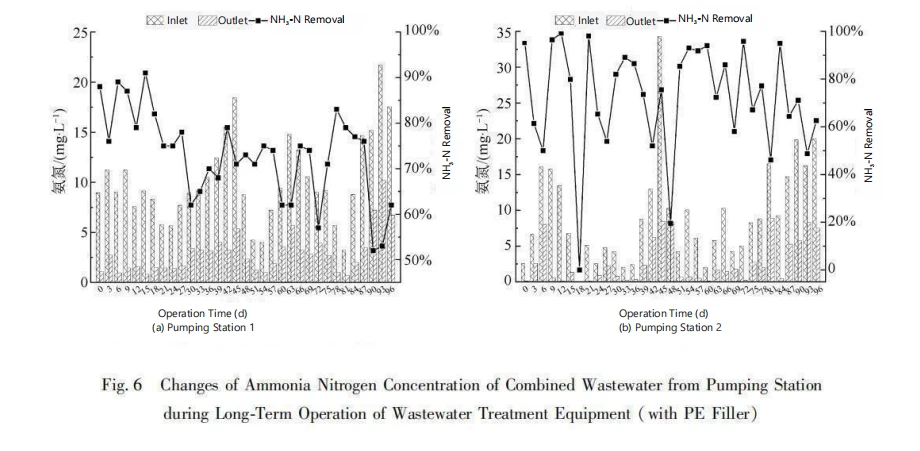
Figure 7 shows the changes in influent ammonia nitrogen concentration, effluent ammonia nitrogen concentration, ammonia nitrogen removal amount, and ammonia nitrogen removal rate during the long-term operation of the MBBR-AO coupled process with PPC packings. The influent ammonia nitrogen mass concentrations of the combined stormwater-sewage from Pumping Station 1 [Figure 7(a)] and Pumping Station 2 [Figure 7(b)] ranged from 3 to 35 mg/L, with average influent ammonia nitrogen mass concentrations of 10.96 mg/L and 8.10 mg/L, respectively. After treatment by the MBBR-AO coupled process, the average ammonia nitrogen mass concentrations in the effluent decreased to 3.96 mg/L and 3.39 mg/L, with average removal amounts of 7.00 mg/L and 4.71 mg/L, and average removal rates of 63.87% and 58.15%, respectively. During the long-term operation of the MBBR-AO coupled process, adding PPC packings had a slightly better degradation effect on ammonia nitrogen in the combined stormwater-sewage from Pumping Station 1 than that from Pumping Station 2, but the difference was not significant. This indicates that adding PPC packings in the MBBR-AO coupled process has a certain removal effect on ammonia nitrogen in combined stormwater-sewage during long-term operation. The ammonia nitrogen removal rate of the MBBR-AO coupled process with PPC packings during long-term operation was higher than that during short-term operation. This is because during long-term operation, sludge accumulates inside the PPC packings, forming a local anaerobic or anoxic environment, which provides a suitable living environment for the life activities of nitrifying bacteria. The nitrifying bacteria reproduce rapidly, and the local reaction rate accelerates

In summary, adding PE packings is more conducive to the degradation of ammonia nitrogen in combined stormwater-sewage by the MBBR-AO coupled process during long-term operation. Meanwhile, the PE packings should be replaced or cleaned in a timely manner after long-term use to ensure that the ammonia nitrogen in the sewage can still be effectively removed during the long-term operation of the MBBR-AO coupled process.
Service Life of Bio-carrier Packings with Different Materials
Compared with PPC packings, PE packings have a longer service life during the long-term treatment of micro-polluted river water and combined stormwater-sewage by the MBBR-AO coupled process. As shown in Figure 8(a), the PPC packings experience slagging and damage during the sewage treatment process by the MBBR-AO coupled process. Meanwhile, aging and agglomeration occur inside the packings after long-term operation [Figures 8(b) and 8(c)]. The PPC packings have poor sludge permeability. Although the sponge-like PPC packings have a large specific surface area, their internal pores are easily adsorbed by sludge and difficult to flow out. Long-term accumulation of sludge inside the packings tends to form an anaerobic or anoxic environment, causing the color of the packings to gradually change from brown to black. This leads to problems such as slagging, breakage, aging, and agglomeration of the PPC packings during long-term operation, thereby shortening their service life. This is also the main factor for the poor effect of PPC packings in removing ammonia nitrogen from combined stormwater-sewage [Figures 5(a) and 5(b)]. In contrast, the PE packings basically did not have the above problems during the long-term sewage treatment by the MBBR-AO coupled process, with better durability and longer service life. A reasonable carrier configuration can effectively buffer the impact of water flow on the biofilm, allowing the biofilm to grow stably without being damaged.

Conclusions
In this study, PE bio-carrier packings and PPC packings were added during the sewage treatment process of the MBBR-AO coupled process. The effects of packing materials on the degradation of ammonia nitrogen in micro-polluted river water and combined stormwater-sewage, as well as the microbial biofilm formation rate and service life of packings with different materials, were investigated. Compared with PPC packings, PE packings have a slower biofilm formation rate but a longer service life. Meanwhile, whether used in the long-term or short-term treatment of micro-polluted river water and combined stormwater-sewage by the MBBR-AO coupled process, PE packings exhibit better degradation effects on ammonia nitrogen. The research results provide technical support for the selection of packing materials in sewage treatment processes.