


A hydropower station on a sediment-heavy river has a problem most water treatment engineers never see: the cooling water for the turbine-generator units carries so much sand and grass that it clogs the coolers solid. Stator coil temperatures rise. Bearings overheat. The unit trips offline - not because of a mechanical fault, but because the water that is supposed to cool it has turned into abrasive slurry. At Bapanxia Hydropower Station, three 36,000 kW Swedish-built units faced this exact threat every flood season. In 1975, the station installed a honeycomb inclined tube settler. Over the next 13 flood seasons - seven months a year, April through October - not a single unit was lost to cooling system failure.
THE COOLING WATER PROBLEM NO PUMP CAN SOLVE
Hydropower stations on rivers with heavy sediment loads face a seasonal crisis. During flood seasons, reservoir water carries sand concentrations that would be unthinkable in a municipal water treatment plant. If this water is taken directly from in front of the dam for unit cooling, sand and plant debris pack the cooler tubes tightly. The blockage is mechanical and total - cleaning and dredging the coolers is extremely difficult, time-consuming, and often damages equipment. Some stations resort to alternating forward and reverse operation of the cooling system to flush the tubes, but this only partially helps: it cannot fully clear the blockage, and the constant reversals accelerate wear on the cooler pipes themselves.
The Swiss-made coolers at Bapanxia had strict water quality requirements. A sedimentation solution was needed - one that could handle 20 kg/m³ influent sediment concentration during flood peaks and still deliver enough clean water to cool three 36 MW units.
HOW HONEYCOMB TUBES DO WHAT AN OPEN TANK CANNOT
The honeycomb inclined tube settler was designed on three principles derived from shallow-layer sedimentation theory:
Principle 1 - Area multiplication. Sedimentation is a function of water surface area. Adding honeycomb inclined tubes increases the effective settling area by dozens of times compared to an open tank of the same footprint. More area means faster separation.
Principle 2 - Laminar flow stabilisation. Water flowing through the honeycomb cells has an exceptionally large wetted perimeter, which dramatically reduces the hydraulic radius. This drops the Reynolds number, stabilising the flow into a laminar regime. Sediment and water separate cleanly - no turbulence to keep particles in suspension.
Principle 3 - Sludge-layer settling. Inside the inclined tubes, sediment settles in a sludge-layer mode. This not only shortens the settling distance and time but also increases the effective settling surface, boosting overall efficiency. Model tests at 1:1 scale showed that at a design influent sediment concentration of 20 kg/m³ and a surface loading of 3–5 m³/m²·h, the sediment removal rate reached 92–98%, with only 3% of effluent particles exceeding 0.025 mm - the critical size at which cooler clogging begins.
THE SYSTEM: FROM DAM INTAKE TO COOLING WATER HEADER
A dedicated water intake was built in front of the dam, with upper and lower ports serving as mutual backups. Each port has a fixed trash rack; a common movable trash rack at the intake front intercepts larger aquatic weeds and debris. Water is drawn through a header pipe on the upstream side of the pump house and split into four lines, fed by four 12Sh-19 centrifugal pumps (all four backing each other up). An automatic strainer before each pump provides a final filter for fine debris before the water enters the sedimentation tank.
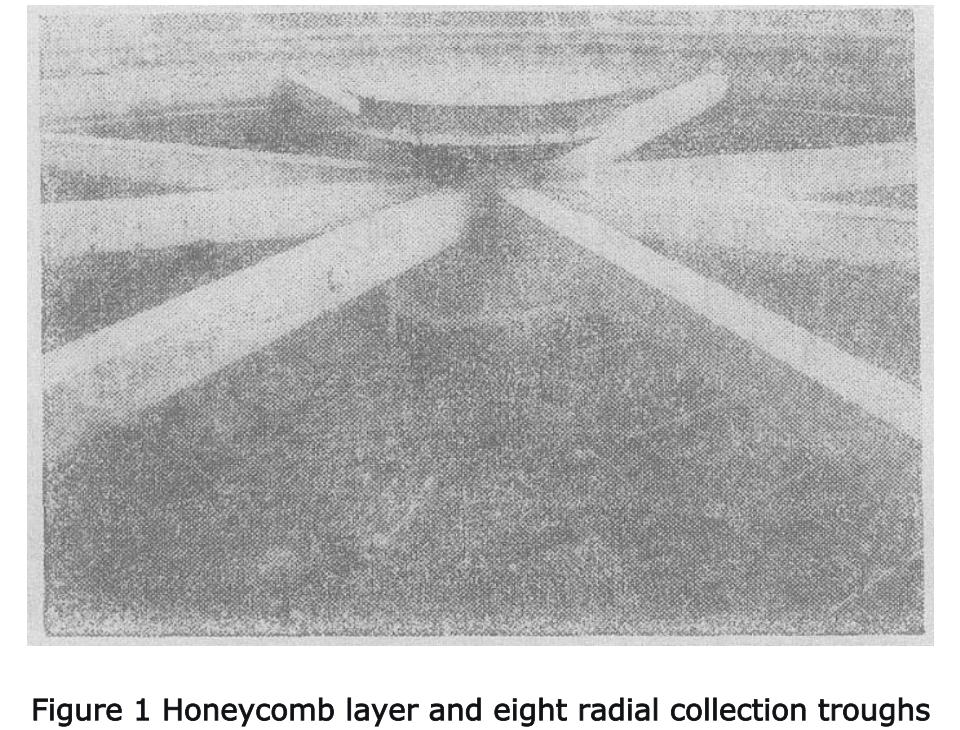
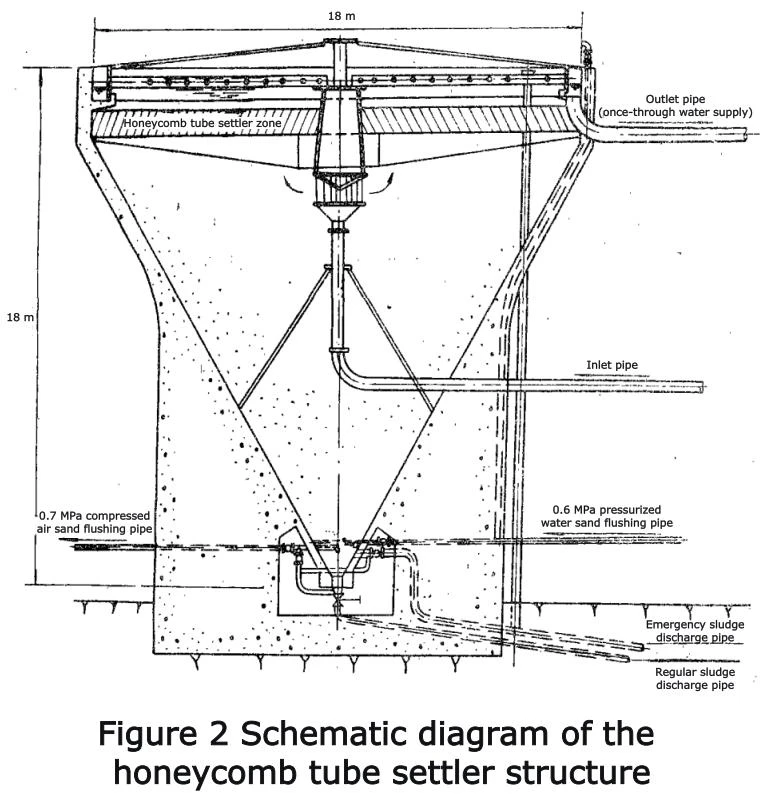
Inside the tank - 18 m diameter, 18 m height, 0.3 m freeboard - the water rises through a distribution trough at an outlet velocity of 50 mm/s. The upward velocity at the water surface is a gentle 0.2–0.8 mm/s. After passing through the honeycomb tubes, clarified water rises and is collected through side openings on eight radial short collection troughs (see Figure 1), which feed into an annular collection trough around the tank perimeter. From there, a φ500 mm outlet pipe delivers the treated water to the cooling water header serving all units. The used cooling water discharges entirely into the tailrace.
Settled sediment drops into a 60° conical hopper at the tank bottom and is discharged to the tailrace through a sludge pipe. The tank structure is shown in Figure 2.
THE HONEYCOMB SPECIFICATION - AND THE MATERIAL UPGRADE
The honeycomb cells are regular hexagons with a 50 mm inscribed circle diameter. Each tube module is 1 m long, inclined at 60°, giving a vertical height of 0.866 m. The tubes are assembled into 1 × 0.5 × 0.5 m rectangular honeycomb units.
The original 1975 installation used paper honeycomb - 80 g Jiamusi kraft paper dipped in phenolic resin and heat-cured. The paper honeycomb cost 40,000 yuan. It worked, but the material had clear limitations: poor strength and toughness, and it aged. After four years of operation, in 1979, the paper honeycomb was replaced with aluminum honeycomb at a cost of 120,000 yuan - three times the price, but far more durable. After nine years of subsequent operation, the aluminum showed only minor surface corrosion and remained structurally intact.
The concrete tank itself required 1,400 m³ of concrete, 50 tonnes of steel reinforcement, and cost 160,000 yuan. Altogether - tank, paper honeycomb, and later aluminum upgrade - the total investment was 320,000 yuan. For a system that would protect three 36 MW turbine-generators for over a decade, this was modest.
| Design Parameter | Design Value | Actual Operating Condition |
| Tank diameter × height | 18 m × 18 m | Single tank (two planned) |
| Settling area per tank | 254.5 m² | 508 m² needed (2 tanks) |
| Surface loading | 3–5 m³/m²·h | ~5 m³/m²·h (single tank) |
| Tube cell diameter | 50 mm (inscribed circle) | Hexagonal honeycomb |
| Tube length / inclination | 1 m / 60° | Vertical height 0.866 m |
| Material (original → upgrade) | Paper (phenolic resin) | Aluminum (from 1979) |
FIELD PERFORMANCE: 83 SAMPLES OVER 4 YEARS
Between 1977 and 1980, the plant and the reservoir area monitoring station collected 83 paired water samples at the tank inlet and outlet, analysing both sediment concentration and particle size distribution. The results tell a consistent story:
1. Coarse sediment (d > 0.025 mm) settled well. The effluent contained only 10–15% of the coarse particles present in the influent - a high removal rate for the fraction that actually causes clogging.
2. The median particle size in the effluent was consistently smaller than in the influent. The tank was doing exactly what it was designed to do: selectively removing the larger, clogging-size particles.
3. The percentage of sediment with d < 0.025 mm increased in the effluent, while the percentage with d > 0.025 mm decreased - confirming selective removal of the problematic coarse fraction.
4. Sediment removal efficiency improved with influent concentration. At the design influent of 20 kg/m³, overall removal exceeded 65%.
Table 1: Removal efficiency by particle size (d > 0.025 mm boundary)
| Particle size greater than d > 0.025 mm (as % of total measurements) | Percentage of measurements meeting this condition | Sediment removal efficiency |
| 15% | 100% | 78% |
| 25% | 71% | 65% |
| 50% | 43% | 33% |
The table confirms that removal efficiency for the coarse fraction (d > 0.025 mm) is strong, while the fine fraction (d < 0.025 mm) passes through more readily - which is acceptable, since it is the coarse particles that cause cooler clogging.
Table 2: Sediment transport rate and removal efficiency (1980 measured data)
| Measurement period | Inlet transport rate (kg/h) | Inlet avg. conc. (kg/m³) | Outlet transport rate (kg/h) | Outlet avg. conc. (kg/m³) | Removal rate |
| Jul 4 00:00 – Jul 6 08:00 | 7,500 | 3.72 | 2,497 | 1.96 | 67% |
| Jul 13 00:00 – Jul 13 12:00 | 7,338 | 3.64 | 3,069 | 2.41 | 58% |
| Aug 2 17:00 – Aug 3 00:00 | 20,906 | 9.52 | 6,318 | 6.70 | 70% |
All three measurement periods show removal rates above 50%, with the highest rate - 70% - coinciding with the highest influent concentration (9.52 kg/m³ average). This confirms the trend: the dirtier the incoming water, the more efficiently the settler removes sediment - exactly the behaviour needed during flood-season peaks.
WHY THE FIELD DATA FELL SHORT OF THE MODEL - AND WHY IT DIDN'T MATTER
The model tests had predicted 92–98% removal at design loading. The field data showed 58–70%. Three factors explain the gap:
1. Single-tank operation against a two-tank design. The station needed 1,280 m³/h of cooling water. The design calculation - based on the required sedimentation area of 427 m² - called for two tanks (each 254.5 m²). Due to site constraints, only one was built. The single tank ran continuously above its design surface loading. Retention time inside the honeycomb tubes was shorter than the model assumed, and sedimentation efficiency suffered accordingly.
2. Lower-than-design influent concentrations. Over 13 years of operation, a daily average sediment concentration of 20 kg/m³ occurred only two to three days per year - and in some years, not at all. The tank spent most of its life operating well below the design influent loading. Sludge was also not discharged at the design volume, which further affected efficiency.
3. Sampling limitations. The testing methodology - including the number of samples, sampling locations, and representativeness of the data - was acknowledged as insufficient for a definitive performance evaluation. The measured 58–70% is likely a conservative estimate.
And yet, despite running a single tank where two were specified, the system delivered what mattered: zero forced shutdowns due to cooling system failure in 13 flood seasons. When combined with alternating forward-reverse cooling system operation, no severe wear or clogging was found in cooler end covers or pipes during inspections. The honeycomb settler did not need to achieve 98% removal to succeed - it only needed to remove enough of the >0.025 mm fraction to keep the coolers clear. It did.
WHAT THIS MEANS FOR OTHER HYDROPOWER STATIONS
1. Inclined tube settlers work for industrial cooling water - not just for drinking water treatment. The performance target is different (remove coarse particles, not achieve sub-NTU clarity), but the hydraulic principles are identical.
2. Material choice depends on the application. Paper honeycomb worked for four years at 40,000 yuan. Aluminum lasted nine years (and counting) at 120,000 yuan. For today's installations, PVC and PP offer a cost-durability middle ground that neither paper nor aluminum could match in 1975.
3. A single undersized tank can still deliver operational reliability if the design target is correctly defined. The Bapanxia tank was half the required area - but because the goal was cooler protection, not perfect clarity, it succeeded.
4. For hydropower stations on sediment-laden rivers, honeycomb inclined tube settlers offer low technical complexity, low cost, rapid sedimentation, and a small footprint - advantages that are especially valuable when the station site is spatially constrained.
Need Tube Settler Media for Industrial or Municipal Applications?
Juntai supplies PVC and PP honeycomb inclined tube settler media in a full range of cell sizes and sheet thicknesses - for water treatment plants, industrial cooling water systems, and hydropower applications. We provide hydraulic sizing calculations, material selection guidance, and installation support. Whether you are designing a new settler or replacing aged media, we can help you specify the right product for your water quality target.
| Tube Settler Product Specs | Request Engineering Support | Full Product Range |