


Every two months, the Phase III water treatment plant at CNOOC Fudao shuts down a tube settler for cleaning. The operation takes 4 hours. It discharges 1,500 m³ of sludge-water mixture into the sludge collection tank. The tank was never designed for that kind of surge. By the time the cleaning cycle is finished, the tank level is dangerously high, the online settler can't discharge sludge normally, and the sludge treatment system is burning chemicals and electricity just to keep up. The fix was not a bigger tank or a larger pump - it was a pipe, a 4.3-metre elevation difference, and gravity.
1. THE PROBLEM: A CAPACITY CRUNCH EVERY TWO MONTHS
The Phase III water treatment plant operates two independent treatment trains, each using a counter-current tube settler for sedimentation. A shared sludge treatment system handles sludge discharge from all three phases of the plant. The system is built around two sludge collection tanks, each with an effective volume of 1,500 m³, for a combined total of 3,000 m³.
The original design assumed a manageable daily inflow: 1,200 m³/d of normal sludge discharge from three tube settlers, plus 300 m³/d of filtrate from the filter press. But during a cleaning event, the reality looks very different. As Table 1 shows, the total inflow to the sludge collection tank surges to 3,329.3 m³/d - exceeding the design effective capacity of 3,029.3 m³/d by 300 m³/d.

The consequences cascade quickly: the collection tank liquid level rises to near-overflow, the online tube settler loses its normal sludge discharge capacity because there is no empty tank capacity to receive it, and the sludge treatment system - designed for steady-state operation - must run extended hours. More chemicals. More electricity. More labour. All because clear water that didn't need treatment was being sent to the sludge system.
2. UNDERSTANDING THE TUBE SETTLER'S ZONES - AND WHERE THE CLEAR WATER SITS
The tube settler is built on the shallow-tank principle: by stacking inclined tube modules in the sedimentation zone, it multiplies the effective settling area, reduces the hydraulic radius, and promotes laminar flow - all of which dramatically improve solids separation in a compact footprint.
Functionally, the tank is divided into four vertical zones. For each Phase III treatment train (internal dimensions: 8.8 m wide × 22.0 m long × 7.9 m effective depth), the zone heights and volumes are:
| Zone | Height (m) | Volume (m³) | % of Total |
| Water Distribution | 3.3 | 638.88 | 41.77% |
| Tube Settling | 1.2 | 232.32 | 15.19% |
| Clear Water | 2.1 | 406.56 | 26.58% |
| Sludge Accumulation | 1.3 | 251.68 | 16.45% |
Here is the critical observation: the clear water zone holds 406.56 m³ - over 26% of the total tank volume - and that water is already treated. Its turbidity is below 10 mg/L. The design turbidity of the plant's raw water is 30 mg/L. Yet during the emptying and cleaning procedure, this entire volume of clean water was being mixed with sludge and sent to the collection tank for re-treatment. It was clean water paying the price of dirty water.
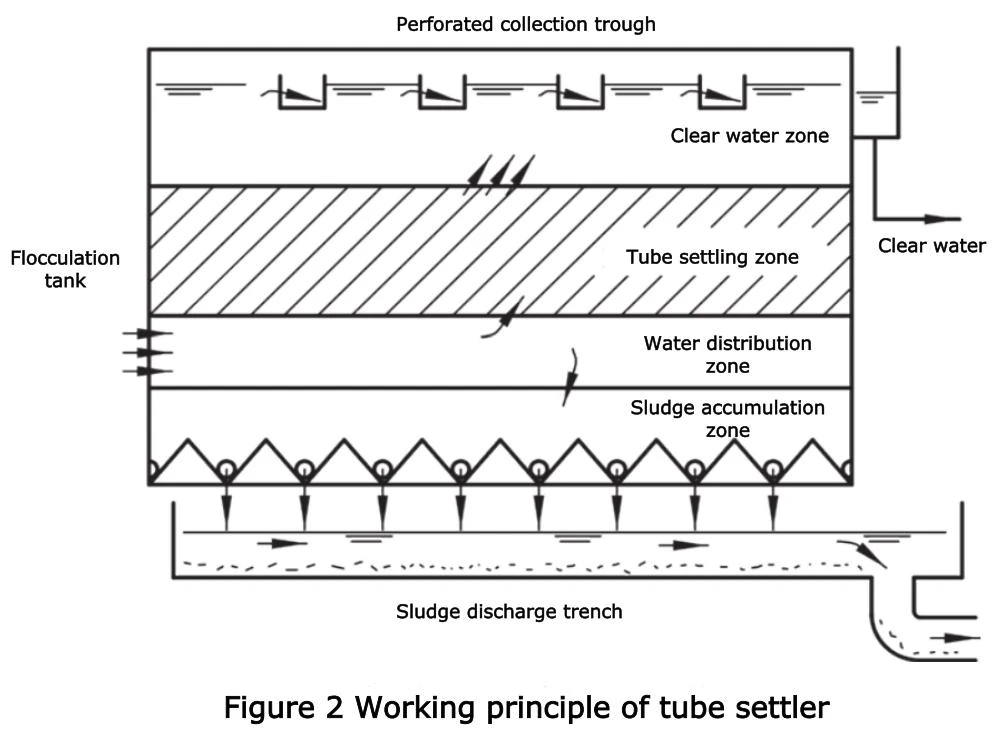
3. THE STANDARD CLEANING PROCEDURE - AND WHY IT OVERLOADS THE SYSTEM
Tube settlers accumulate sludge inside and on top of the tube modules during operation. Left unchecked, this accumulation obstructs flow through the tubes, degrades settled water quality, and can even cause excessive pressure leading to tube module collapse. Periodic emptying and cleaning is non-negotiable.
The standard procedure follows four steps: open the bottom drain valves, lower the water level below the tube zone, then use pressurised fire-fighting water to flush the tube modules from the top until accumulated sludge is dislodged. Stop flushing, keep the drain valves fully open to discharge the water and sludge from the distribution and accumulation zones, and close the valves.
The problem is that every zone drains into the sludge collection tank. The clear water zone - 406 m³ of treated water - mixes with the sludge-laden water from the tube and accumulation zones. All of it heads to the collection tank. Most of it eventually gets separated and returned to the raw water tank anyway - but only after passing through the thickener, the filter press, and two sets of lift pumps. The clear water takes a long, expensive detour through the sludge treatment system for no reason.
4. THE FEASIBILITY CHECK: THREE REASONS GRAVITY DIVERSION WORKS
The retrofit concept is straightforward: instead of sending the clear water zone's 406 m³ into the sludge system, divert it directly back to the raw water tank. Three conditions must be satisfied for this to work:
Condition 1 - Water quality compatibility. The turbidity of the clear water zone is below 10 mg/L. The design turbidity of the plant's raw water is below 30 mg/L. The clear water is actually cleaner than the river water entering the plant. Recycling it as raw water is perfectly acceptable.
Condition 2 - Gravity head. The bottom elevation of the clear water zone is +5.8 m. The design maximum water level of the raw water tank is +1.5 m. That is a 4.3-metre height difference. No pump needed. Gravity does the work.
Condition 3 - Cost avoidance. Under the existing arrangement, the clear water is pumped twice (collection tank pump + return tank pump), dosed with PAM, and settled in a radial-flow tank - all before returning to the raw water tank. A gravity pipe bypasses every one of these steps. Electricity, chemicals, and equipment runtime all drop.
5. THE PIPING SCHEME: DN200, TWO BASINS, ONE PIPE EACH
The tube settler consists of an east basin and a west basin sharing a common partition wall. A separate gravity diversion line was designed for each.
After calculating gravity flow resistance based on pipeline length, fittings, material, elevation difference, and required flow rate, DN200 mm carbon steel pipe was selected for both basins. The pipe diameter is critical: too small, and the diversion flow is too slow to be practical; too large, and the tank wall opening creates unnecessary structural risk.
The intake position is equally important. Too close to the tube zone, and the intake velocity could draw sludge out of the tubes. The design places the intake vertically 0.2 m above the bottom of the clear water zone (0.2 m above the top of the tube settling zone) - close enough to drain effectively, far enough to avoid disturbing the tubes.
Each pipeline runs from its intake point through the settler wall to the raw water intake bar screen channel of the Phase III plant. Pipe supports secure the routing, and a flow control valve plus a gate valve are installed near the bar screen channel. The gate valve provides positive shutoff during normal operation, preventing unintended backflow. The flow control valve regulates the diversion rate to avoid drawing sludge from the tubes or overwhelming the raw water tank.
| Design Element | East Basin | West Basin |
| Pipe specification | DN200 carbon steel | DN200 carbon steel |
| Intake - vertical position | 0.2 m above clear water zone bottom | 0.2 m above clear water zone bottom |
| Intake - horizontal position | 0.8 m from east side wall | 0.8 m from west side wall |
| Valves | Flow control valve + gate valve | Flow control valve + gate valve |
| Destination | Raw water intake bar screen channel | Raw water intake bar screen channel |
6. MEASURED RESULTS
After the retrofit, the numbers told a clean story. During cleaning events, the sludge-water discharge from the tube settler dropped from 1,529.3 m³/d to 1,122.8 m³/d. The total inflow to the sludge collection tank decreased from 3,329.3 m³/d to 2,922.8 m³/d - now comfortably below the design limit of 3,029.3 m³/d.
The overflow risk was eliminated. The online tube settler regained normal sludge discharge capacity. And the sludge treatment system no longer had to process 406 m³ of already-clean water every cleaning cycle.
The economics, while modest, are worth noting. The tube settler is cleaned six times per year, with each cycle returning 406.5 m³ of clear water directly to the raw water tank - an annual total of 2,439 m³ of wastewater load avoided. Based on the sludge treatment system's consumption of PAM powder (~10 g/m³ at 25 RMB/kg) and the electricity drawn by the collection tank lift pump (15 kW, 50 m³/h) and return tank pump (22 kW, 150 m³/h) at an industrial rate of 0.9 RMB/kWh:
| Savings Category | Annual Savings (RMB) | Basis |
| PAM powder | 610 | 10 g/m³ × 2,439 m³ × 25 RMB/kg |
| Pump electricity | 981 | (15 kW + 22 kW) × flow-based runtime × 0.9 RMB/kWh |
| Total annual savings | 1,591 | PAM + electricity |
The direct savings of 1,591 RMB/year are secondary to the operational benefit: a sludge collection tank that no longer risks overflow, a sludge treatment system that runs within its design envelope, and a cleaning procedure that no longer disrupts the rest of the plant.
KEY TAKEAWAYS
1. If your tube settler's clear water zone holds treated water, it should not be routed through the sludge treatment system. A direct return to the raw water tank eliminates double-handling.
2. A 4.3 m elevation difference is more than enough for gravity flow. Before adding pumps, check whether the tank elevations already give you what you need.
3. Intake position matters. Placing the intake 0.2 m above the tube zone top prevents the diversion flow from pulling sludge out of the tubes - close enough to drain, far enough to avoid disturbance.
4. Pipe sizing requires a gravity flow resistance calculation - not a rule of thumb. DN200 was right for this plant; your plant's pipe diameter depends on your specific elevation difference, pipe length, and required flow rate.
5. A gate valve for positive shutoff plus a flow control valve for rate regulation is the minimum valve configuration. Without both, you risk either backflow during normal operation or suction effects during diversion.
Need Design Support for Your Tube Settler Retrofit?
Juntai supplies PVC and PP inclined tube settler media with full engineering support - from hydraulic analysis and zone sizing to sludge management layout and retrofit piping design. If your plant is facing similar capacity or discharge problems, we can help you design a solution that works with your existing infrastructure.
| Tube Settler Product Specs | Request Retrofit Engineering Support | Full Product Range |