


Upgrading a wastewater treatment plant usually comes down to one uncomfortable question: which biofilm process actually earns its keep on your site? Brochures promise higher biomass and better nitrogen removal for both Moving Bed Biofilm Reactor (MBBR) and fixed-bed biofilm contact oxidation. But the real answer only shows up in months of operating data. This case follows a municipal plant in northern Jiangsu Province, China that ran A²/O+MBBR and A²/O+Fixed-Bed in parallel under identical influent for six months - a rare apples-to-apples comparison that challenges several assumptions about which technology is genuinely cheaper to own.
Why The Comparison Matters
When a treatment plant needs upgrading, the choice between biofilm-based technologies can feel overwhelming. Both MBBR and fixed-bed biofilm contact oxidation grow concentrated biofilms on engineered media, boosting total biomass and improving nitrogen removal compared with conventional activated sludge alone. The shared principle is simple: attach slow-growing nitrifying bacteria to a protected surface so they are not washed out of the system, regardless of hydraulic or organic swings.
The real difference lies in how the media is held. In an MBBR, carriers are kept in constant suspension by aeration and submerged mixers - this maximizes contact but puts mechanical energy and moving parts directly against hard plastic. In a fixed-bed system, the media is static; biofilm grows on a stationary structure and the mixed liquor simply flows through it. That one design difference cascades into everything else: wear, energy use, maintenance, media loss, and life-cycle cost. Yet most procurement decisions are made on initial performance tables, not on the five-year ownership picture.
The Plant And Its Challenge
A Two-Phase Municipal Plant Facing Stricter Standards
The plant treats municipal wastewater in northern Jiangsu Province. Phase I and Phase II each have a design capacity of 25,000 m³/d, originally running a conventional A²/O process that discharged to Class 1B standard (GB 18918-2002). In 2017, both phases were upgraded to meet the tighter Class 1A standard, with MBBR carriers added directly into the existing A²/O basins - the classic retrofit approach that avoids new tank construction.
Over several years of operation, however, the MBBR system exposed a series of practical problems that steadily eroded maintenance budgets and operational confidence:
Media abrasion of tank walls. The constant movement of suspended carriers ground down the concrete surface of the biological tanks, risking long-term structural damage. The only practical mitigation was installing stainless steel liners - an expensive, one-time corrective measure that MBBR design guides rarely mention.
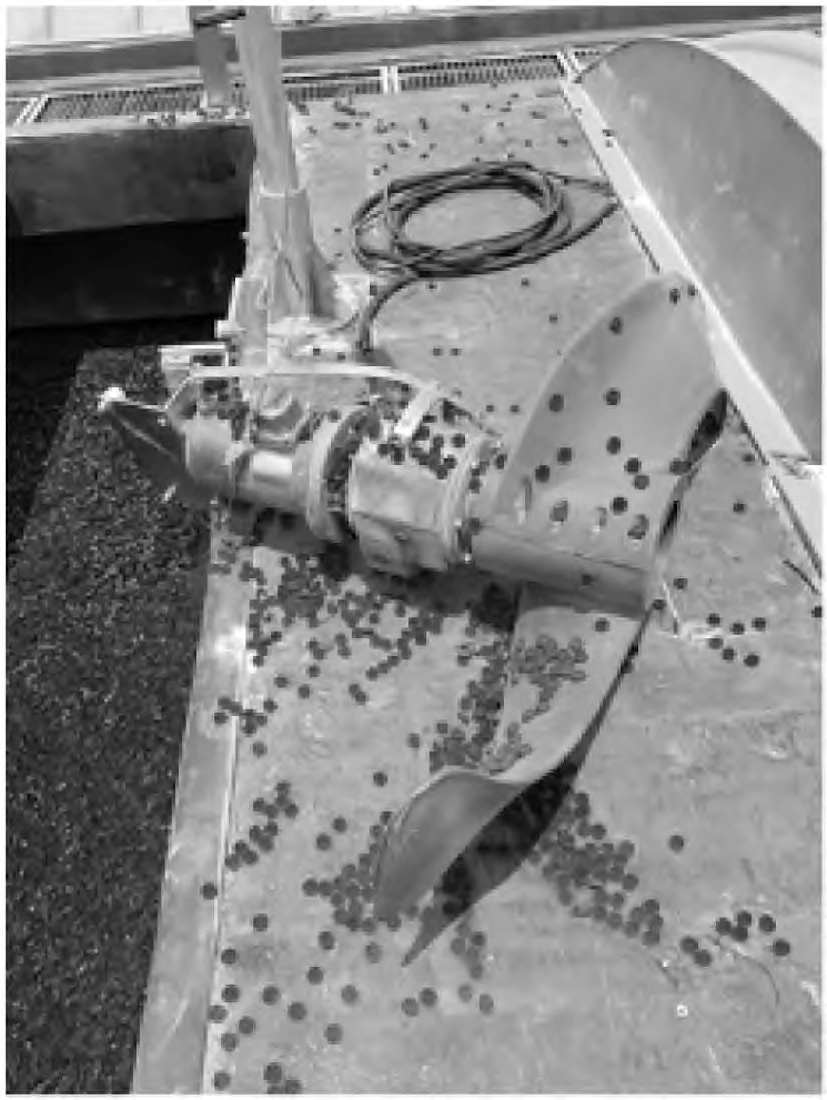
High equipment failure. Submerged mixers suffered severe wear on impellers, cables, and housings from continuous contact with carriers, leading to frequent rebuilds and replacements. Every moving part in the tank became a consumable.
Media loss and replacement. Annual carrier attrition reached roughly 5%, requiring continuous replenishment simply to hold the design surface area constant. This is not a one-time capital cost - it is a permanent recurring expense.
Screen clogging and overflow risk. Carriers accumulated against retention screens at the tank outlets, potentially blocking flow and causing tank overflow during aeration failures - a genuine safety and compliance hazard.
Difficult tank maintenance. Draining a tank required special carrier recovery equipment. Sludge mixed with carriers was extremely difficult to clean, turning routine maintenance into a major operation.
Downstream impact. Carrier fragments entered the sludge stream, clogging filter cloths and reducing dewatering efficiency - an indirect cost that appeared far away from the biological tank itself.
The two photographs below show the physical toll of suspended media in practice: tank wall protection bolted on as a reactive fix, and a mixer impeller that has been progressively destroyed by carrier impact.

Faced with these accumulating burdens, the plant converted Phase I from A²/O+MBBR to A²/O+Fixed-Bed biofilm contact oxidation in December 2022. Critically, the fixed-bed was specified with equivalent effective biofilm surface area to the MBBR phase, creating a fair, controlled comparison. Both phases shared the same inlet pump station, fine screens, and grit chamber, so influent conditions were identical - the closest thing to a controlled experiment available at full scale.
Treatment Performance Comparison
Both Meet Class 1A - But With Very Different Margins
Over six months of continuous monitoring, both systems met Class 1A effluent standards. The fixed-bed system, however, showed a clear and consistent advantage in stability. Table 1 tracks the monthly data: air volume delivered, dissolved oxygen (DO), mixed liquor suspended solids (MLSS), and effluent ammonia-nitrogen (NH₃-N) for each phase.
| Month | Air FBBR | Air MBBR | DO FBBR | DO MBBR | MLSS FBBR | MLSS MBBR | NH₃-N FBBR | NH₃-N MBBR |
| Month 1 | 269.2 | 159.0 | 4.24 | 5.40 | 7,812 | 5,776 | 0.49 | 0.65 |
| Month 2 | 246.7 | 164.5 | 4.68 | 5.40 | 7,030 | 5,599 | 0.26 | 2.09 |
| Month 3 | 353.0 | 263.1 | 3.06 | 3.11 | 6,555 | 5,298 | 0.28 | 1.36 |
| Month 4 | 291.4 | 222.8 | 2.74 | 4.17 | 7,979 | 6,751 | 0.25 | 0.32 |
| Month 5 | 270.8 | 172.4 | 2.52 | 2.92 | 6,672 | 6,296 | 0.17 | 0.21 |
| Month 6 | 275.0 | 183.3 | 2.57 | 4.29 | 6,539 | 6,010 | 0.19 | 0.18 |
| Average | 284.4 | 194.2 | 3.0 | 4.0 | 7,098 | 5,955 | 0.27 | 0.80 |
Air volume unit is ×10⁴ m³ (monthly total); DO, MLSS, and NH₃-N are in mg/L. Influent averages during the monitoring period were COD 468 mg/L, NH₃-N 22.3 mg/L, TN 42.1 mg/L. Three observations stand out:
Effluent NH₃-N. The fixed-bed system averaged 0.27 mg/L versus 0.80 mg/L for MBBR - a roughly threefold difference - and its month-to-month values were far more stable. In Month 2, MBBR spiked to 2.09 mg/L while fixed-bed held at 0.26 mg/L, a gap that matters enormously when the compliance limit is tight and the operating margin is thin.
MLSS. The fixed-bed system sustained a higher active biomass concentration, averaging 7,098 mg/L versus 5,955 mg/L for MBBR - about 19% higher. More biomass in the same tank volume means more treatment capacity and more resilience to shock loads.
Dissolved oxygen. Despite delivering 46% more air volume (284.4 vs 194.2 ×10⁴ m³), the fixed-bed phase maintained a lower average DO (3.0 vs 4.0 mg/L). This is the signature of more efficient oxygen transfer and utilization: oxygen is being consumed for nitrification and COD oxidation rather than being wasted. The higher MLSS means a thicker, more active biofilm that scavenges oxygen far more effectively than sparse suspended carriers.
Operational Reliability And Maintenance
Where the Two Technologies Diverge Most
The performance numbers were impressive, but the day-to-day operating differences were even more striking. Reliability is the cost that never appears in a design table yet dominates a plant's lifetime budget.
MBBR system challenges. Moving carriers cause continuous wear on every piece of equipment in contact - mixers, cables, tank walls, and retention screens. Annual media replacement of ~5% adds both material cost and labor. There is a permanent risk of screen clogging and tank overflow during aeration failures. Tank draining requires media recovery equipment and special handling, and carrier fragments damage downstream sludge dewatering equipment. A dedicated aeration system is even needed to keep retention screens from clogging.
Fixed-bed system advantages. The media is fixed in place - no wear, no abrasion, no clogging. No submerged mixers are required, so there are fewer moving parts and a fundamentally lower failure risk. There is no media loss, which means no annual replenishment cost. Without retention screens, the inherent clogging and overflow risk disappears. Tank maintenance is straightforward because there is no media to recover when draining. And operation is similar to conventional activated sludge, lowering the skill requirement for operators.
The two photographs below show the reality of MBBR maintenance: carriers packed into a drained tank that must be laboriously recovered before any cleaning can begin, and the debris collected from a single tank cleaning operation.


The Financial Story
68% Lower Annual Operating Cost
The annual operating cost comparison (Table 2) delivers the most compelling argument of all. Over the monitoring period, the total annual cost for the MBBR system was 432,000 RMB versus just 138,000 RMB for the fixed-bed system - a saving of 68%.
| No. | Cost Item | MBBR (10,000 RMB) | Fixed-Bed (10,000 RMB) |
| 1 | System depreciation | 15.48 | 5.80 |
| 2 | System operation & energy | 9.75 | 8.00 |
| 3 | Equipment maintenance & repair | 7.20 | 0 |
| 4 | Media replenishment | 10.77 | 0 |
| Total annual cost | 43.20 | 13.80 |
The breakdown explains exactly where the savings come from:
Depreciation (15.48 vs 5.80). MBBR requires more specialized equipment - mixers, retention screens, dedicated blowers, and control systems - driving up both capital cost and depreciation. The fixed-bed system eliminates most of this hardware entirely.
Maintenance (7.20 vs 0). The fixed-bed system incurred essentially zero equipment repair costs during the monitoring period, while MBBR consumed 72,000 RMB annually from mixer rebuilds and tank clean-outs. This is the wear-and-tear cost of suspended media made visible in the budget.
Media (10.77 vs 0). Roughly 25% of MBBR's annual cost went to replacing worn carriers - a recurring expense the fixed-bed system completely eliminated because its media does not abrade or wash out.
Choosing The Right Technology
This case study demonstrates that both MBBR and fixed-bed biofilm processes can achieve Class 1A standards. The choice is therefore not about compliance - it is about what kind of ownership burden you are willing to accept over the life of the asset.
When does MBBR make sense? MBBR remains the right answer when land is extremely limited and maximum volumetric loading is the top priority; when existing tank volume cannot be expanded and the highest possible biomass concentration is required; when the operating team has strong technical support and a budget for ongoing maintenance and media replacement; and when a retrofit must minimize structural modification to existing tanks. In these constrained scenarios, the higher operating cost is the price of density.
When is fixed-bed the better choice? The fixed-bed approach wins when long-term reliability and simplicity are valued over absolute maximum loading; when the plant has a limited maintenance budget or limited technical staff; when minimizing life-cycle cost is a priority; and when the consequences of equipment failure must be minimized. For the majority of municipal upgrade projects, these conditions describe the operating reality far more accurately than the extreme-land-constraint scenario.
Conclusion
The data from this plant is unusually clear. For the majority of municipal wastewater treatment upgrading projects where reliability, simplicity, and life-cycle cost are primary considerations, a fixed-bed biofilm approach can deliver equal or better treatment performance with a fraction of the operational burden - better nitrogen stability, higher active biomass, more efficient oxygen use, and a 68% reduction in annual operating cost.
For the specific scenarios where land constraints demand maximum loading in minimum footprint, MBBR remains a viable and proven solution - but the higher operating costs and maintenance complexity must be factored into the decision from the start, not discovered after commissioning. Whether you are retrofitting an existing basin or designing a new plant, let the six-month operating record - not the sales brochure - guide your technology selection.
This article is based on a real parallel-operation case study at a municipal wastewater treatment plant in northern Jiangsu Province, China. If you are evaluating biofilm media or fixed-bed biofilm systems for an upgrade project, reach out to discuss which configuration best matches your treatment targets, site constraints, and ownership budget.
Compare MBBR and Fixed-Bed Head to Head
Six months of parallel operation showed both processes meet Class 1A, but fixed-bed cut operating cost by 68%. Get Juntai biofilm media and evaluate real performance data for your project.