


Project Overview
Fuyang People's Hospital is a comprehensive medical institution integrating healthcare, teaching, research, prevention, rehabilitation, and emergency services. It has 21 clinical departments, 16 medical technology departments, 650 authorized beds, and 827 staff members, with an annual outpatient volume of 300,000 visits and 18,000 inpatient admissions. As the hospital expands, wastewater discharge has increased significantly. To prevent environmental pollution, protect public health, and improve living conditions, the hospital pioneered a wastewater treatment project in the local healthcare system to ensure compliant effluent discharge.
1. Water Quantity
Hospital wastewater discharge depends on factors such as scale, medical services, equipment, patient numbers, region, season, and management practices. As a fully equipped general hospital with a canteen,bathroom, and pharmacy, its daily wastewater output is approximately 700 m³/d (peaking factor K=2.0–2.2). Accounting for future expansion, the design capacity was set at 800 m³/d.
2. Water Quality
Hospital wastewater is highly complex, with COD and BOD levels similar to domestic sewage but containing additional pathogens (bacteria, viruses, parasite eggs) and hazardous substances. Design influent parameters:
- COD: 300 mg/L
- BOD: 150 mg/L
- SS: 160 mg/L
- pH: 7–9
- Fecal Coliform: >2.4×10⁷ CFU/L
3. Discharge Standards
- The project complies with China's Integrated Wastewater Discharge Standard (GB 8978-1996) Level I:
- COD <100 mg/L
- BOD <30 mg/L
- SS <70 mg/L
- pH: 6–9
- Fecal Coliform ≤500 CFU/L
- Total Residual Chlorine ≤0.5 mg/L (post-dechlorination).
Process Flow
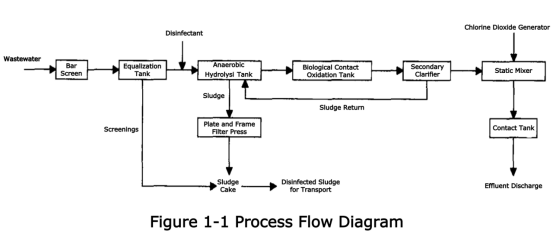
Wastewater from wards (pre-treated in septic tanks), domestic sources, and other medical streams flows through a rotary mechanical bar screen to remove coarse solids, then enters an equalization tank for homogenization. Submersible pumps lift the water to an anaerobic hydrolysis tank, where microbes partially degrade organics and enhance biodegradability while digesting sludge recycled from the secondary clarifier.
The effluent flows into a biological contact oxidation tank with aeration provided by blowers, where aerobic microbes remove most organics. The mixed liquor separates in a secondary clarifier, and the clarified effluent is disinfected with chlorine dioxide in a pipeline mixer before discharge.
- Sludge Management: Clarifier sludge returns to the anaerobic tank for digestion. Excess sludge is dewatered via a plate-and-frame filter press, and the filter cake (with screened grit) is lime-disinfected before off-site disposal.
- Process Diagram: See Figure 1-1.
Key Metrics & Performance
1. Economic Indicators
- Capacity: 800 m³/d
- Total investment: ¥530,000 (¥663/m³)
- Footprint: 0.34 m²/m³
- Operating cost: ¥0.47/m³
2. Environmental Benefits
Annual reductions:
- COD: 27.7 tons
- BOD: 11.87 tons
- SS: 12.56 tons
3. Monitoring Results (Feb 2002)
After 3 months of trial operation, all parameters met GB 8978-1996 Level I:
| Parameter | Effluent (mg/L) | Removal Rate (%) |
| SS | 40 | 51.2 |
| COD | 27.2 | 77.7 |
| NH3-N | 5.51 | 23.8 |
| BOD5 | 9.95 | 80.3 |
| Fecal Coliform | 20-70 CFU/L | 99.9 |
Project Highlights
1. Anaerobic Hydrolysis Tank:
- Breaks down macromolecules, converts non-soluble organics, and enhances biodegradability.
- Sludge digestion minimizes waste (no sludge discharge since 2001).
2. Electrolytic Chlorine Dioxide Generator:
- Locally sourced salt/water/electricity replace hazardous sodium chlorate transport.
- Superior disinfection (vs. chlorine/hypochlorite) without forming harmful byproducts.
- Byproduct alkali reused for laundry, reducing detergent use.
3. TB/TA Swing Fillers:
- Easy installation, Free-hanging design, high surface area, and rapid biofilm formation.
4. Process Advantages:
- Stable operation, high efficiency, low cost (capex/opex), and scalability for similar hospitals.