


MOVING BED BIOFILM REACTOR (MBBR) BIOFILM MEDIA
Document Version: 1.0
Date: Aug.29,2025
Subject: Simplified Comparison: MBBR vs. Conventional Activated Sludge (CAS) Process

MBBR (Moving Bed Biofilm Reactor) is an efficient biological wastewater treatment technology. Its core principle relies on using special biological carriers suspended in the reactor as a medium for microorganisms to attach and grow, forming a highly active biofilm system. This process innovatively combines the technical advantages of the traditional activated sludge process and the biofilm process. By means of aeration or mechanical agitation, the carriers keep flowing in the reactor, enabling full contact between the biofilm and wastewater. This significantly improves the pollutant degradation efficiency and the operational stability of the system.
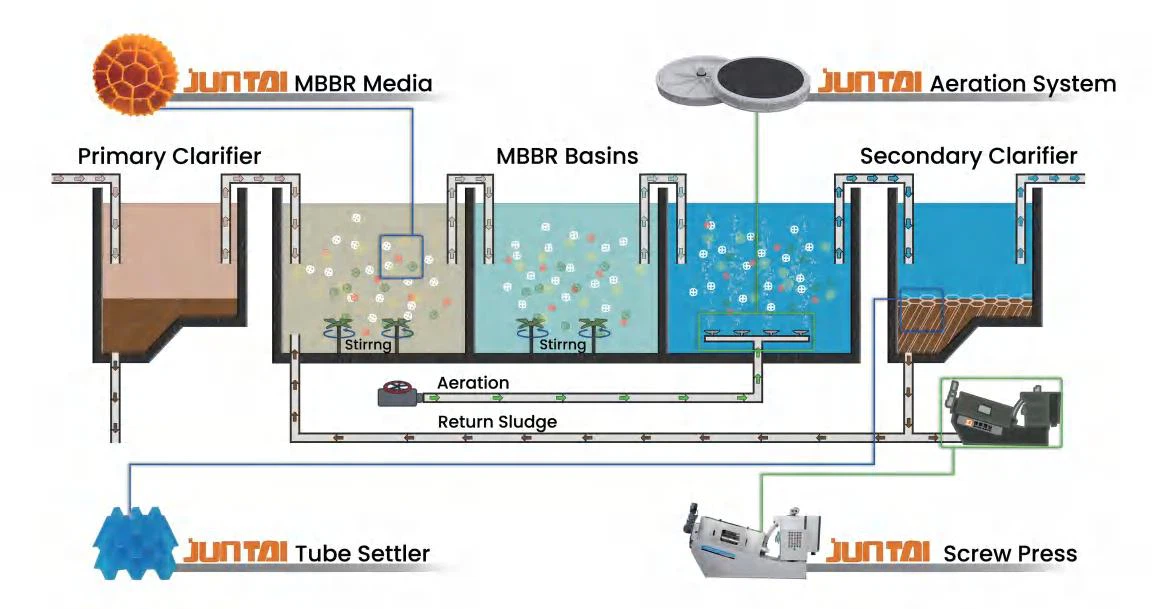
The MBBR process features small footprint, strong shock load resistance, low sludge yield, simple operation and management, and no need for sludge recirculation. Currently, it has been widely applied in the advanced treatment of municipal sewage and industrial wastewater, such as organic matter removal and nitrification/denitrification.
The following section provides a comparative analysis of MBBR and the conventional activated sludge process:
I.What is the range of organic loading rate (OLR) that the MBBR system can support, expressed in g BOD/m² (Effective surface area)?
The Organic Loading Rate (OLR) range is 5-20 kg COD/(m³·day).
This range is highly dependent on the treatment objective (carbon oxidation only, or including nitrification).
For Carbon Oxidation (BOD removal): A higher load can be applied, typically within the range of 10 - 20 g BOD/m²·d.
For Nitrification (Ammonia removal): A lower load is mandatory, usually requiring < 5 g BOD/m²·d.
This is because nitrifying bacteria grow slowly. A high BOD load would cause heterotrophic bacteria to proliferate excessively, competing for biofilm space and oxygen, thus inhibiting nitrifying bacteria.
II. What is the minimum oxygen utilization rate (%) that the MBBR media must achieve for transferring oxygen from air into the wastewater treatment process?
Additionally, what is the minimum energy savings required, expressed in kWh/m³?
Minimum OTE & Energy Savings
OTE is closely linked to the aeration system. In an MBBR system utilizing new, high-quality diffusers, the Oxygen Transfer Efficiency (OTE) in actual wastewater should be no less than 15-20%.
Impurities in wastewater will reduce the actual efficiency.
Regarding the "kWh/m³" metric:
"kWh/m³" is not widely adopted as a primary efficiency standard because it does not account for the influent pollutant concentration
(the energy required to treat one cubic meter of clean water versus one cubic meter of high-strength wastewater is vastly different).
The most scientific and universal unit for energy efficiency is kWh/kg O₂ (energy consumed per kg of oxygen delivered).
For a rough estimate: Assuming treatment of typical municipal wastewater (influent BOD = 500 mg/L, ~1 kg O₂ is required to remove 1 kg BOD, and an energy efficiency of 2.5 kWh/kg O₂),
the energy consumption per cubic meter would be approximately:
0.5 kg BOD/m³ * 1 kg O₂/kg BOD * 2.5 kWh/kg O₂ = **1.25 kWh/m³**
Please note this is a theoretical estimate; actual values fluctuate based on water quality, treatment level, and other factors.
Ⅲ.The MBBR biofilm carrier should produce less excess sludge than a conventional activated sludge system.
What is the minimum reduction percentage (%), and what is the typical sludge yield, expressed in kg dried sludge/kg BOD removed?
As mentioned before, low sludge production is a significant advantage of the MBBR process.
Sludge Reduction Percentage: Compared to the conventional activated sludge (CAS) process, MBBR systems typically achieve a 20% - 40% reduction in excess sludge production.
Sludge Yield:
Typical MBBR Sludge Yield: 0.3 - 0.6 kg Dry Sludge / kg BOD removed.
CAS Yield (for comparison): 0.8 - 1.2 kg Dry Sludge / kg BOD removed.
Reason: Microorganisms within the MBBR biofilm have a longer Sludge Retention Time (SRT) and a longer food chain, leading to more endogenous respiration
(microorganisms consuming their own cellular material for maintenance). This converts more organic matter ultimately into CO₂ and water, rather than into new cell mass (sludge).
The MBBR biofilm media must have an oxygen transfer efficiency of not less than how many grams of O₂/day (g O₂/d)?
Clarification: "Oxygen transfer efficiency" is inherently a ratio or percentage (%), not an absolute amount (g O₂/d). The total oxygen transfer capacity (g O₂/d) of any aeration system depends on its scale
(e.g., number of diffusers, tank volume, blower capacity), while "efficiency" refers to how well it transfers oxygen (OTE %). Please refer to the answer for Question 2 (OTE > 15-20%).
If your question pertains to the oxygen transfer capacity of an MBBR system, this is primarily determined by the design and scale of the aeration system (blowers + diffusers), not by the biofilm carriers themselves.
The core function of the media is to provide a surface for microbial attachment; it does not itself produce or transfer oxygen, though its presence influences bubble paths and mass transfer effects.
Disclaimer: The technical parameters provided in this document are based on typical conditions and industry experience, for reference only. Specific design parameters in practical applications must be thoroughly calculated and validated according to the actual project conditions (influent water quality, effluent standards, ambient temperature, etc.).