



How It Works
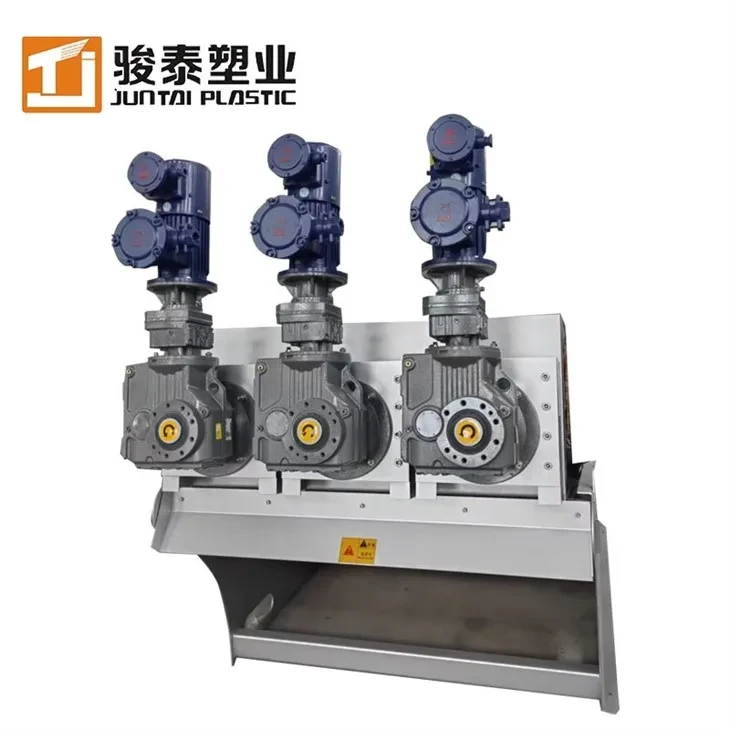
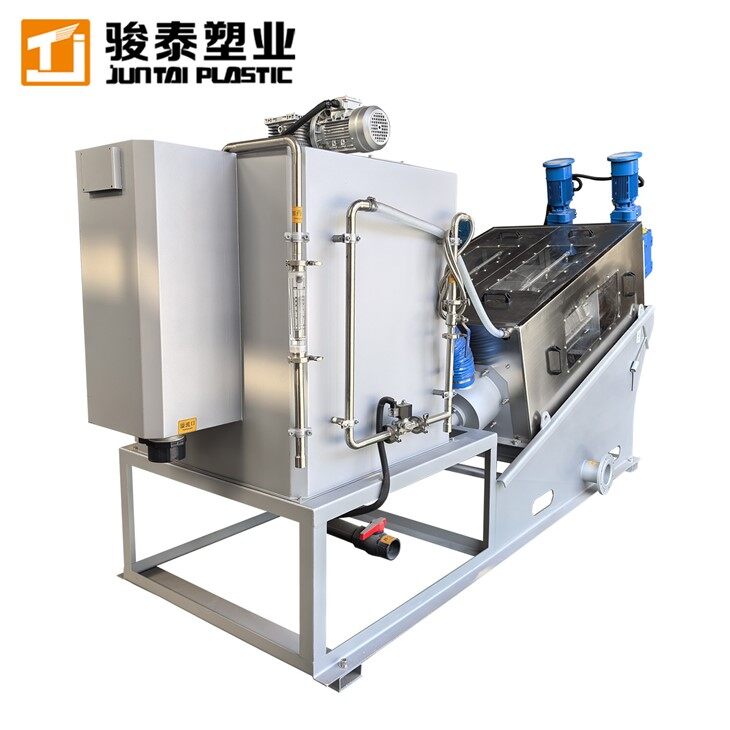
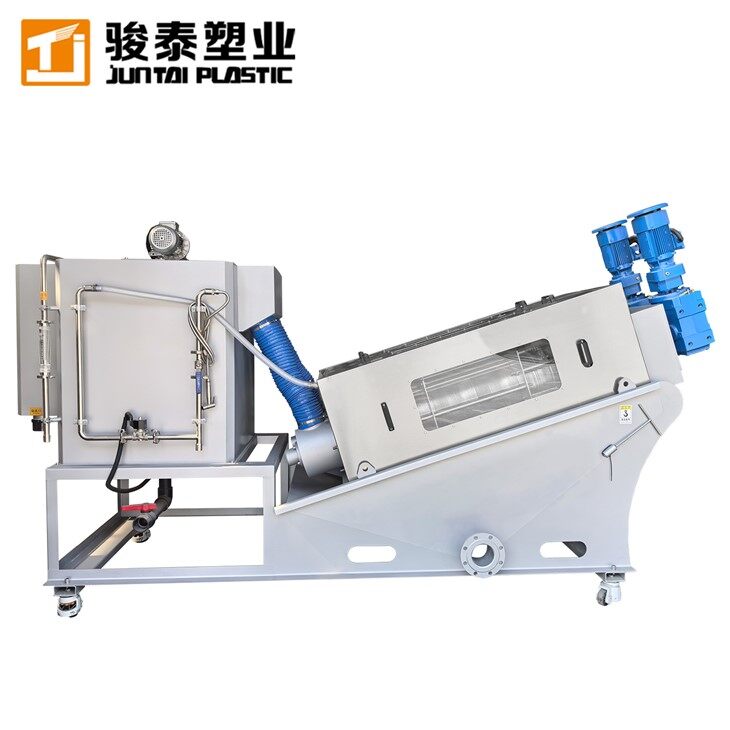
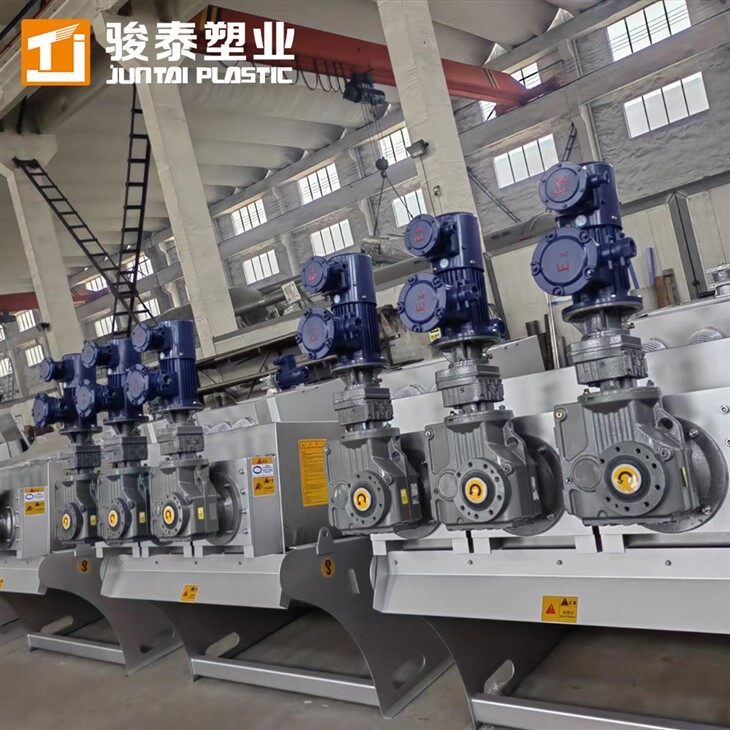
The multi-disc screw press operates on a fundamentally different principle from filter presses, belt presses, or centrifuges. There are no filter cloths, no high-speed rotating parts, and no hydraulic systems. Instead, solid-liquid separation happens through three sequential zones inside a single cylindrical body - all driven by one low-speed screw shaft rotating at just 2–5 RPM.
Zone 1 - Flocculation & Conditioning
Incoming sludge is dosed with polymer flocculant in the conditioning tank. Gentle mixing causes fine suspended solids to aggregate into larger, drainable flocs. The conditioned sludge enters the press at its original concentration - no pre-thickening needed, even for sludge as dilute as 2,000–3,000 mg/L MLSS.
Zone 2 - Gravity Concentration
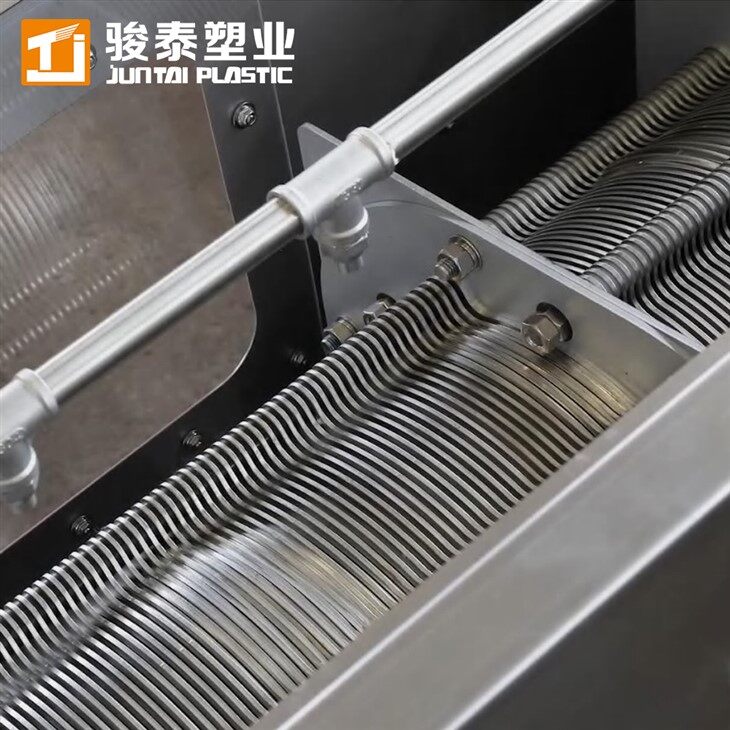
In the front section of the press body, free water drains by gravity through the narrow gaps between fixed and moving rings. Sludge concentration increases progressively as it advances along the screw shaft, without any applied mechanical pressure. This gravity thickening stage replaces the separate thickening tank that filter presses and belt presses require.
Zone 3 - Screw Extrusion Dewatering
As the screw pitch progressively decreases and the back-pressure cone restricts discharge, sludge is subjected to steadily increasing mechanical pressure. Filtrate is squeezed through the ring gaps and collected below. The self-cleaning mechanism is key: moving rings oscillate continuously against fixed rings with each screw rotation, preventing gap clogging. No washdown cycles. No operator intervention. No interruptions. Dewatered cake exits at 15–25% dry solids, ready for disposal or further treatment.

Why Juntai Screw Press
|
♦
Self-Cleaning Ring System
 Moving rings oscillate against fixed rings with every screw rotation, continuously clearing filter gaps. No filter cloth to blind. No high-pressure wash cycles. Handles oily and fibrous sludge that would foul belt presses within hours.
|
♦
Ultra-Low Operating Cost
 ~0.01–0.1 kWh per kg-DS - roughly 1/20 of a centrifuge and 1/8 of a belt press. Slow-speed operation (2–5 RPM) means minimal wear, low noise, and negligible vibration. Most plants recover the purchase cost through energy savings alone within 18–24 months.
|
♦
Thickening + Dewatering in One
 Accepts low-concentration sludge directly (2,000 mg/L and above). Eliminates the need for a separate gravity thickener, reducing footprint by 40–60% compared to conventional dewatering trains.
|
♦
PLC Automatic - 24/7 Unattended
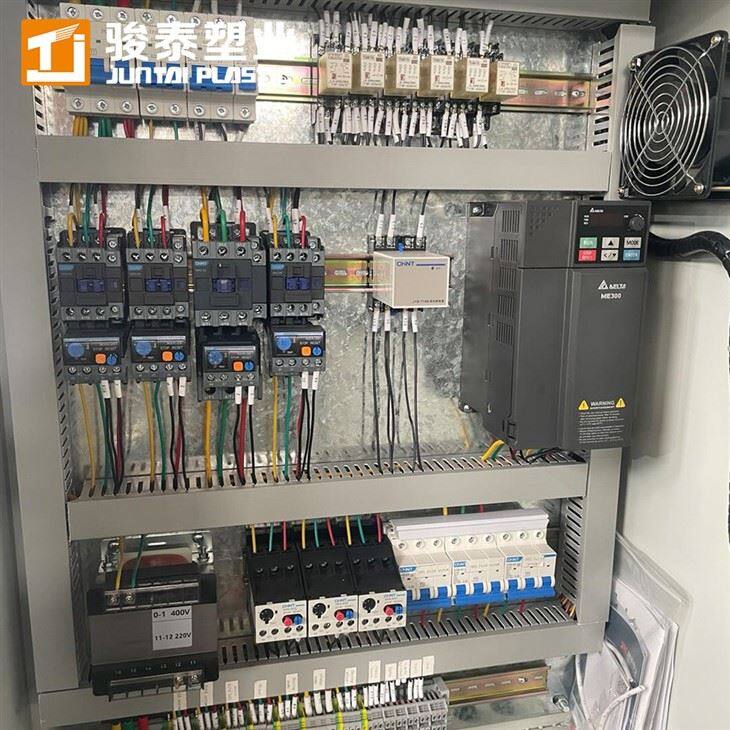
 Fully automated PLC control with variable speed drive. Auto-adjusts to fluctuating sludge loads without operator input. Remote monitoring capable. Runs around the clock with only periodic polymer replenishment.
|
Technical Specifications
Models available from 6 kg-DS/h (pilot/small plant) to 600 kg-DS/h (large municipal). All models share the same multi-disc screw press principle with SS304/316L construction. Capacity varies with sludge concentration - contact us with your sludge type and flow rate for a model-specific sizing.
| Model | DS Capacity (kg/h) |
Sludge Flow (m³/h @ 10,000 mg/L) |
Motor Power (kW) |
Dimensions L×W×H (mm) |
Weight (kg) |
| JT-131 | 6–14 | 0.6–1.2 | 0.36 | 2,400 × 800 × 1,500 | 315 |
| JT-132 | 12–28 | 1.2–2.4 | 0.62 | 3,000 × 950 × 1,600 | 450 |
| JT-201 | 8–20 | 0.9–1.8 | 0.74 | 3,200 × 1,050 × 1,750 | 350 |
| JT-202 | 18–40 | 1.8–3.6 | 1.11 | 3,600 × 1,150 × 1,850 | 730 |
| JT-301 | 30–60 | 3–6 | 1.30 | 4,200 × 1,350 × 2,050 | 1,320 |
| JT-302 | 60–120 | 6–12 | 2.05 | 4,900 × 1,550 × 2,200 | 2,230 |
| JT-303 | 90–180 | 9–18 | 3.00 | 5,600 × 1,800 × 2,400 | 3,080 |
| JT-352 | 120–240 | 12–24 | 3.75 | 6,000 × 2,100 × 2,600 | 3,400 |
| JT-353 | 180–360 | 18–36 | 6.00 | 6,800 × 2,400 × 2,800 | 4,850 |
| JT-403 | 360–600 | 24–39 | 7.50 | 7,400 × 2,700 × 3,100 | 4,950 |
Note: Capacity varies with sludge type and concentration. Above data based on 10,000 mg/L MLSS. For sludge as low as 2,000 mg/L, flow rates are 4–5× higher. Contact Juntai for sizing based on your specific sludge characteristics.
Screw Press vs. Conventional Dewatering Equipment
| Parameter | Screw Press (Juntai) |
Belt Filter Press | Centrifuge | Frame Filter Press |
| Handles low-concentration sludge directly | ✔ Yes | ✘ No | ✘ No | ✘ No |
| No separate thickener required | ✔ Yes | ✘ No | ✘ No | ✘ No |
| 24-hour fully automatic operation | ✔ Yes | ✘ No | ✔ Yes | ✘ No |
| Occupied space | ▲ Smallest | ▲▲ Medium | ▲▲ Medium | ▲▲▲ Large |
| Energy consumption | ▲ Lowest | ▲▲▲ High | ▲▲▲▲ Highest | ▲▲ Medium |
| Noise level | ▲ < 63 dB | ▲▲ 70–75 dB | ▲▲▲ > 85 dB | ▲▲ 70–80 dB |
| Wash water consumption | ▲ Minimal | ▲▲▲▲ Very High | ▲ Low | ▲▲▲ High |
| Clogging / blinding risk | ▲ Self-cleaning | ▲▲▲▲ Belt blinding common | ▲ Low | ▲▲▲ Cloth blinding common |
| Maintenance intensity | ▲ Lowest | ▲▲▲ High | ▲▲▲▲ Specialist required | ▲▲▲ High |
▲ = low/small (better); ▲▲▲▲ = high/large (worse). Assessment based on typical operating conditions for municipal sludge at 10,000–20,000 mg/L MLSS.
Built to Last - Materials & Construction
|
SS304/316L Body & Rings
All wetted parts in SS304 as standard, with SS316L available for corrosive or high-chloride sludge. Fixed and moving rings precision laser-cut for consistent gap spacing.
|
Cobalt Alloy Screw Wear Layer
All screw shafts are welded with a cobalt alloy wear-resistant layer - significantly harder than SS304 base material. Extends service life by years compared to unprotected screws, especially with abrasive sludge.
|
SS304 Sprinkler System
The spray cleaning system - pipes, injectors, and nozzles - is fully SS304. Unlike plastic nozzles that crack and need replacing, Juntai's metal sprinkler system is built for the life of the machine.
|
Safety Enclosure with PMMA Windows
Stainless steel cover with transparent PMMA (acrylic) viewing windows on both sides. Protects operators from rotating parts while allowing visual inspection. Keeps dust and debris out of the ring stack.
|

Application Scenarios
| Industry | Sludge Type | Why Screw Press Is the Right Choice |
| Municipal WWTP | Primary + secondary sludge, WAS, digested sludge | Handles low-concentration waste activated sludge (2,000–8,000 mg/L) without pre-thickening. Enclosed design controls odor - critical for plants near residential areas. Low noise allows installation without soundproof rooms. |
| Food & Beverage | DAF float, grease-trap waste, high-fat/oil sludge | Self-cleaning ring mechanism handles oily, greasy sludge that would blind belt press fabrics within hours. No filter cloth means no replacement costs from grease fouling. |
| Textile & Dyeing | Chemical sludge, dye-laden sludge, fiber-rich slurry | SS316L construction option resists chemical corrosion. Self-cleaning design handles fibrous material without wrapping around shafts or rollers. Consistent cake dryness regardless of color/dye content. |
| Paper & Pulp | Fiber-laden sludge, lime mud, de-inking sludge | Cobalt alloy wear layer on screw shaft withstands abrasive fiber particles. Low-speed operation avoids fiber shear and secondary fines generation that degrade cake quality. |
| Pharmaceutical | Biological treatment sludge, fermentation residue | Fully enclosed SS304 construction prevents cross-contamination. Small footprint suits space-constrained pharma facilities. PLC automation with data logging supports GMP documentation requirements. |
| Livestock & Agriculture | Manure slurry, biogas digestate, abattoir waste | Handles high-fiber manure solids and abrasive digestate without clogging. Dewatered cake suitable for composting or direct land application. Low energy cost critical for thin-margin agricultural operations. |
Frequently Asked Questions
Q: What sludge concentration can the screw press handle directly?
The Juntai screw press accepts sludge as dilute as 2,000 mg/L directly - no pre-thickening required. This is one of its biggest advantages over belt presses and centrifuges, which typically need 20,000–50,000 mg/L feed concentration. It can also handle highly concentrated sludge up to 50,000 mg/L.
Q: What is the typical cake dryness after dewatering?
Typical output moisture content is 75–85% (15–25% dry solids), depending on sludge type. Primary sludge generally dewaters to 20–25% DS. Waste activated sludge (WAS) typically reaches 15–20% DS. Mixed sludge falls in between. Adding polymer flocculant improves cake dryness across all sludge types.
Q: How does the self-cleaning mechanism work?
The filter element consists of alternating fixed rings and moving rings held together by tie rods. As the screw rotates at low speed (2–5 RPM), the moving rings oscillate up and down with each rotation, continuously wiping the gap between rings. This prevents solids from lodging in the filter gaps - no external cleaning mechanism needed. A small intermittent spray bar provides supplementary cleaning during extended operation.
Q: What are the maintenance requirements?
Regular maintenance is minimal: (1) periodic inspection of ring gaps and screw wear layer (typically every 3–6 months), (2) polymer dosing pump calibration, (3) gearbox oil change per manufacturer schedule (annually). There are no filter cloths to replace, no belts to tension, and no high-speed bearings to lubricate. The low-speed design means wear parts last years, not months.
Q: Can the screw press run unattended?
Yes. The PLC control system manages the entire process automatically - from sludge feed rate to polymer dosing to discharge cake consistency. It auto-adjusts screw speed and back-pressure in response to changing sludge characteristics. The only routine operator task is replenishing the polymer supply. Remote monitoring is available for off-site supervision.
Q: How do I select the right model for my plant?
Model selection depends on three factors: (1) daily sludge volume (m³/day), (2) sludge concentration (mg/L), and (3) required operating hours per day. For example, a plant producing 50 m³/day of WAS at 8,000 mg/L needs a JT-202 or larger. Contact Juntai with these three numbers and we will provide a sizing recommendation within 24 hours - including polymer consumption estimate and expected cake dryness for your specific sludge.
Tell us your daily sludge volume, concentration, and operating hours. We'll recommend the right model with estimated cake dryness, polymer consumption, and payback analysis vs. your current dewatering equipment.
| Email Your Sludge Data | WhatsApp: +86 13600513715 | Online Inquiry Form |


