




How the MBBR Process Works
In a conventional activated sludge plant, microorganisms float freely in the mixed liquor - they're suspended. This creates three chronic problems: biomass gets washed out during flow surges (requiring a return sludge pumping system), filamentous bacteria can dominate and cause sludge bulking, and the biomass concentration is limited by the settling capacity of the secondary clarifier.
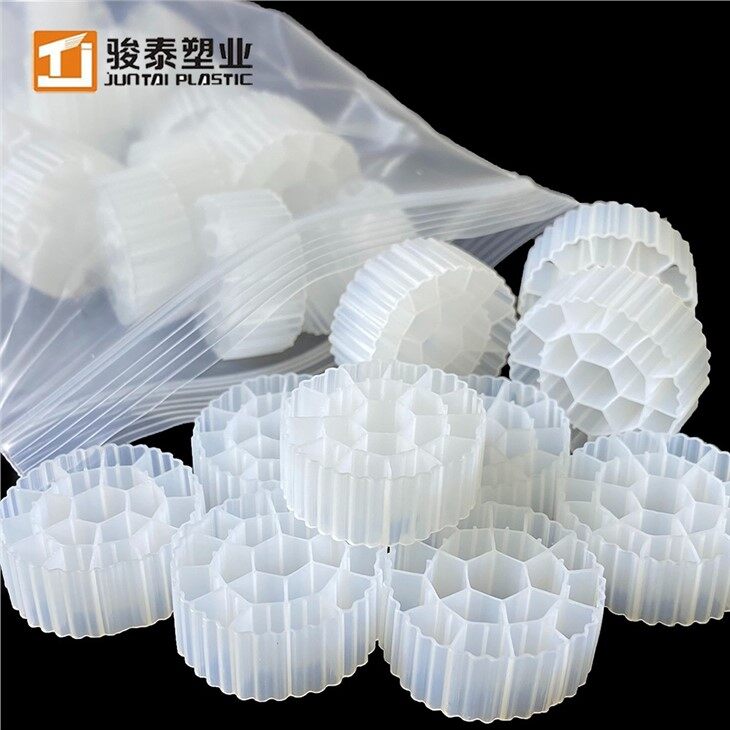
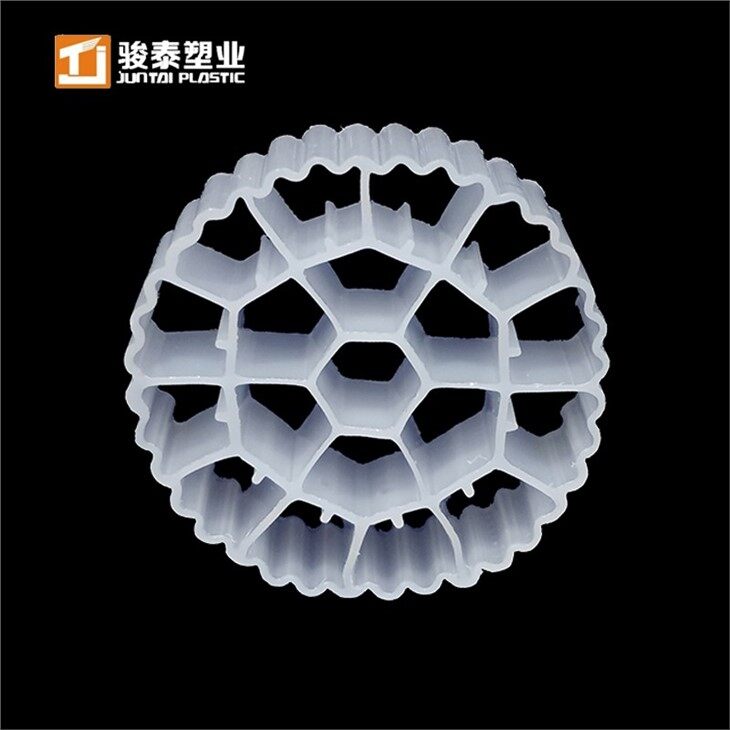
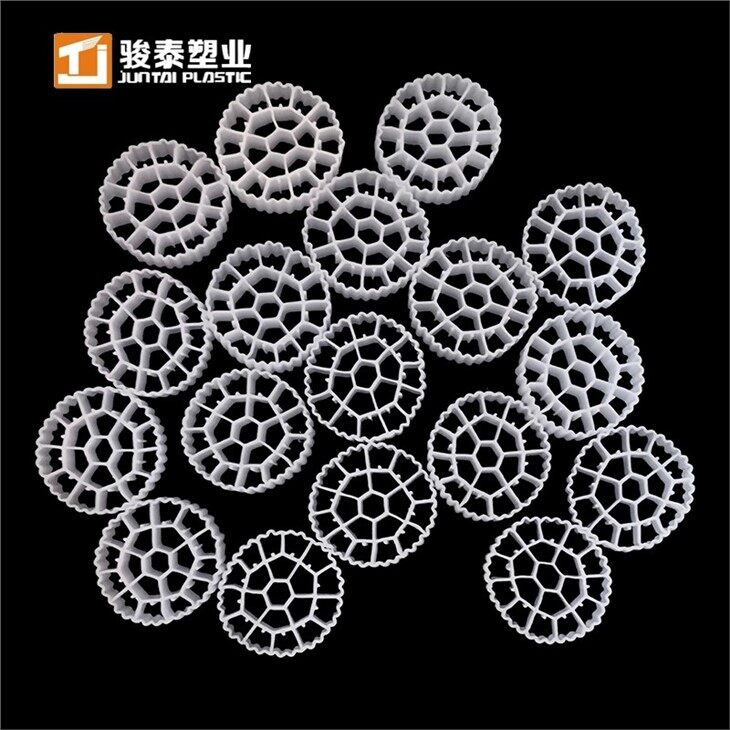
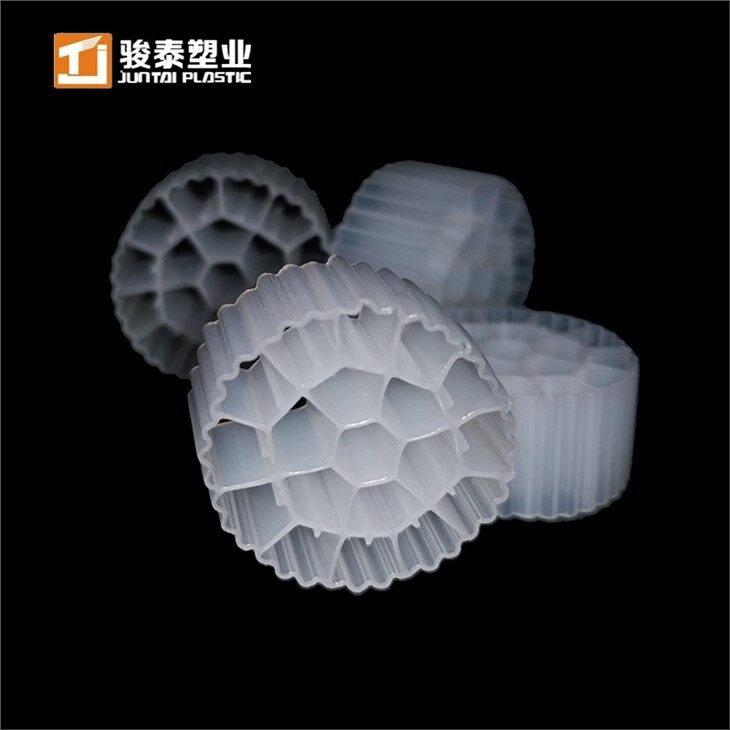
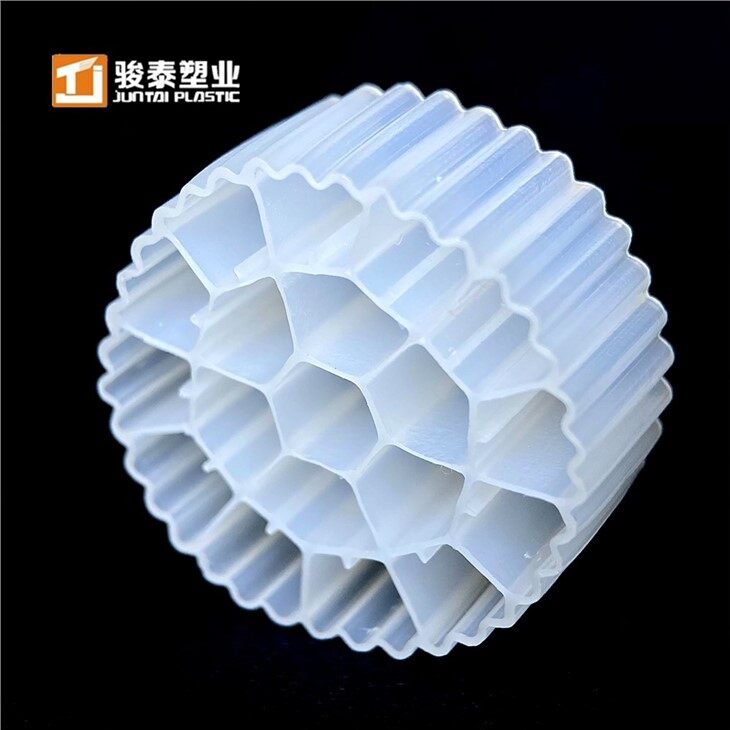
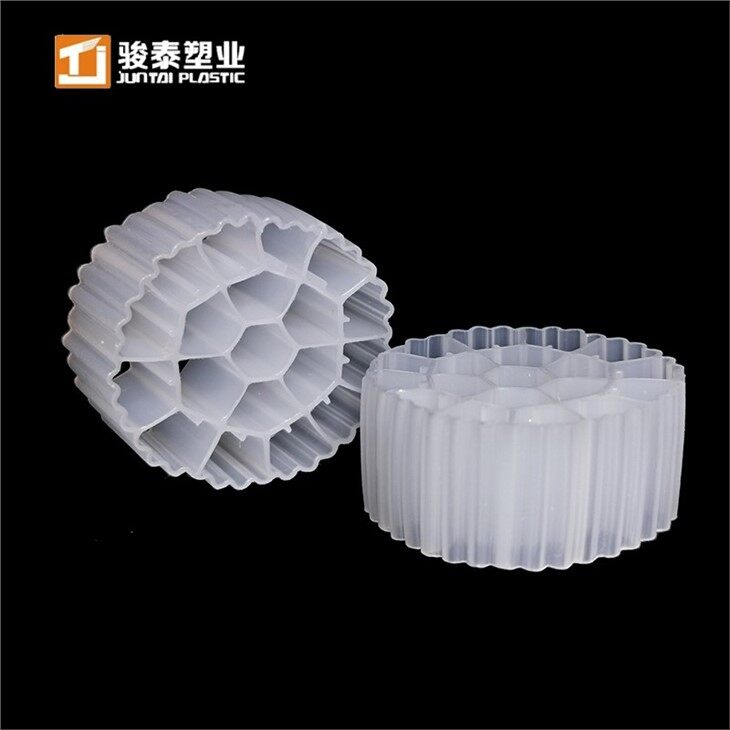
MBBR solves all three by giving microorganisms a fixed home. The MBBR19 carriers - small, wheel-shaped plastic structures with 19 internal chambers - provide >650 m² of protected surface area per cubic metre. Biofilm grows inside these chambers, sheltered from turbulence. Aeration keeps the carriers in continuous motion (hence "moving bed"), ensuring every carrier surface contacts wastewater, dissolved oxygen, and substrate. The microorganisms stay attached to the carriers. The treated water flows past. No return sludge pumping. No sludge bulking. A system that is biologically more stable and mechanically simpler.
The process can operate in two configurations. Pure MBBR uses only carrier-attached biofilm - no suspended biomass. This achieves the highest volumetric loading rates and the simplest operation. IFAS (Integrated Fixed-Film Activated Sludge) combines carriers with suspended activated sludge in the same tank - typically for retrofits where you want to boost capacity without changing the existing process. Both configurations use the same MBBR19 carriers.
MBBR19 Carrier - Technical Specifications
| Parameter | Specification |
| Model | MBBR19 (K3-type moving bed biofilm carrier) |
| Diameter × Height | 25 mm × 12 mm |
| Protected Surface Area | > 650 m²/m³ |
| Internal Chambers | 19 chambers - high protected area for biofilm colonisation |
| Material | 100% virgin HDPE - no recycled content, no fillers, no plasticisers |
| Density | 0.94–0.97 g/cm³ (near-neutral buoyancy with biofilm) |
| Recommended Filling Ratio (Aerobic) | 35–40% of tank volume |
| Recommended Filling Ratio (Anoxic) | 40–60% of tank volume |
| Ideal Influent TSS | ≤ 150 mg/L (lower is better - protects internal chambers from clogging) |
| Biofilm Formation Time | 2–4 weeks to stable treatment (municipal wastewater at 20–30°C) |
| Service Life | 15+ years - UV-stabilised virgin HDPE, no embrittlement |
| Colour | White (standard); custom colours available for OEM orders |
| Packaging | Woven bags or bulk pallets per customer specification |
Key Advantages of the Juntai MBBR Process
|
♦
Up to 70% Smaller Footprint
Biofilm concentrates 3–5× more biomass per unit volume than suspended-growth systems. The same treatment capacity fits in roughly one-third the tank volume of an equivalent activated sludge plant - freeing space for other equipment or future expansion.
|
♦
No Return Sludge, No Bulking
Biomass stays attached to carriers - eliminating the RAS pumping system entirely. No RAS pipes, pumps, or control logic. The attached-growth mode naturally suppresses filamentous bulking because filaments compete poorly for attachment sites on the carrier surface.
|
♦
Shock-Load Resistant
The biofilm matrix provides a protective barrier. Outer-layer microorganisms may be affected by a toxicity spike, but the inner biofilm survives and recolonises. Activated sludge offers no such protection - a single toxicity event can wipe out the entire suspended biomass in hours.
|
♦
Retrofit Without New Concrete
Add MBBR19 carriers to an existing aeration tank (35–40% fill), install retention screens at the outlet - and you've converted it to an IFAS system. No new tanks. No civil works. Typically increases treatment capacity by 30–50% within the same footprint.
|
MBBR vs Activated Sludge vs Trickling Filter
| Parameter | MBBR (Juntai MBBR19) | Conventional Activated Sludge | Trickling Filter |
| Footprint | Smallest - 1/3 of AS tank volume | Largest - requires large aeration basins | Medium - tall structures, limited by hydraulics |
| Return Sludge Required | No - biomass stays on carriers | Yes - RAS pumping system required | Yes - sludge recirculation needed |
| Sludge Bulking Risk | Very Low - attached growth suppresses filaments | Moderate to High - common operational issue | Low - but ponding and fly issues possible |
| Shock Load Resistance | High - biofilm protects inner microorganisms | Low - entire biomass vulnerable to toxicity | Moderate - biofilm offers some protection |
| Cold Weather Performance | Good - biofilm retains activity longer; design for <10°C with pilot testing | Poor - nitrification collapses below 10°C | Poor - icing and reduced biological activity |
| Retrofit Capability | Excellent - add carriers to existing tank, install screens | N/A - is the baseline process | Difficult - requires tall structure, civil works |
| Operator Skill Required | Moderate - focus on DO, screen condition, carrier distribution | High - SVI, RAS rate, wasting rate, F/M ratio | Moderate - media condition, hydraulic loading |
| Start-Up Time | 2–4 weeks - biofilm formation | 4–8 weeks - sludge acclimation | 4–8 weeks - biofilm establishment |
Application Scenarios
| Industry | Typical Configuration | Key Design Consideration |
| Municipal Sewage | Pure MBBR or IFAS, MBBR19, 35–40% fill | High BOD/COD ratio - ideal for biofilm formation. Most common application. Sizing based on organic loading rate: 5–15 g BOD/m²/d on carrier surface area. Include nitrification design if ammonia limits apply. |
| Industrial Wastewater | IFAS or MBBR + A²O/AO, MBBR19, 35–40% fill | Verify BOD/COD ratio > 0.3 before design. Food processing, beverage, pulp & paper, chemical, pharmaceutical - may require pretreatment (equalisation, pH adjustment, primary clarification) to maintain influent TSS ≤ 150 mg/L. Landfill leachate: effective for high ammonia loads with appropriate carrier filling ratio. |
| Aquaculture (RAS) | Pure MBBR, MBBR64 (K5-type, 800 m²/m³), 40–50% fill | Requires intense nitrification in compact volume. Higher surface area carriers (MBBR64, 64 chambers, ~800 m²/m³) recommended over MBBR19 for RAS applications. Virgin HDPE only - recycled material fragments cause fish mortality. |
| Retrofit / Capacity Expansion | IFAS, MBBR19, add carriers + screens to existing tank | Fastest path to 30–50% capacity increase. Verify existing aeration system can handle additional mixing energy for carrier fluidization. Install retention screens with adequate open area. Typical payback: 12–24 months through avoided civil construction costs. |
| Decentralised / Rural | Containerised MBBR, MBBR19, 35–40% fill | No large concrete tanks needed. Prefabricated container or small in-ground tank. Simple operation - minimal operator skill required. 2–4 week start-up for seasonal or emergency deployment. Mobile units available for flexible deployment. |
Design & Sizing Quick Reference
Proper MBBR design requires balancing five interdependent parameters. Use this table as a starting point for feasibility assessment - Juntai provides detailed engineering sizing as a free service.
| Design Parameter | Recommended Range | Notes |
| Carrier filling ratio (aerobic) | 35–40% | Below 35%: insufficient biomass. Above 60%: carriers cannot fluidize properly in aerobic zones. |
| Carrier filling ratio (anoxic) | 40–60% | Higher fill acceptable in anoxic zones (mechanical mixing, no aeration limitations). |
| Dissolved oxygen (nitrification) | 2–4 mg/L | Below 2 mg/L: nitrification rate drops sharply. Above 4 mg/L: excess energy consumption. Use online DO monitoring with automated blower control. |
| Influent TSS | ≤ 150 mg/L | Higher TSS clogs carrier internal chambers. If primary treatment cannot achieve this, evaluate larger-channel carriers or upgrade pretreatment. |
| BOD/COD ratio | > 0.3 (preferred) | Below 0.3: biofilm formation slow and unreliable. Consider combined process (A²O + MBBR) or supplementary carbon source dosing. |
| Minimum operating temperature | Pilot test if < 10°C | Nitrification rate drops significantly below 10°C. Run pilot tests at actual winter temperature before full-scale design. Size conservatively for cold-weather operation. |
| Organic loading rate (municipal) | 5–15 g BOD/m²/d | Per square metre of carrier surface area. Lower end for nitrification, higher end for BOD removal only. |
Frequently Asked Questions
Q: What is the MBBR wastewater treatment process?
MBBR (Moving Bed Biofilm Reactor) is a biological treatment process where microorganisms grow as biofilm on suspended plastic carrier media inside an aeration tank. The carriers - Juntai MBBR19, 25 mm × 12 mm, 19 internal chambers - provide >650 m² of protected surface area per cubic metre. Aeration keeps carriers in continuous motion, ensuring contact between wastewater, biofilm, and oxygen. Unlike activated sludge, MBBR does not require return sludge pumping and eliminates sludge bulking risk.
Q: What are the advantages of MBBR over conventional activated sludge?
Four key advantages: (1) 3–5× higher biomass per unit volume, enabling a footprint roughly one-third the size; (2) no return activated sludge (RAS) pumping system - biomass stays attached to carriers; (3) high resistance to shock loads and toxic substances - the biofilm matrix protects inner-layer microorganisms; (4) easy retrofit - add carriers and retention screens to an existing aeration tank to convert it to an IFAS system with 30–50% more capacity, no concrete needed.
Q: What maintenance does an MBBR system require?
MBBR requires less daily maintenance than activated sludge because there is no return sludge management, no SVI monitoring, and no sludge wasting rate calculation. Key maintenance: daily visual check of carrier distribution and retention screen condition; weekly DO profile measurement; monthly biofilm inspection (thickness, colour, uniformity); quarterly influent TSS verification (maintain ≤150 mg/L); annual screen structural inspection. MBBR19 carriers have a 15+ year service life - they typically outlast the tank infrastructure.
Q: Can MBBR be used to upgrade an existing activated sludge plant?
Yes - this is one of MBBR's strongest applications. To retrofit: (1) add MBBR19 carriers at 35–40% filling ratio to the existing aeration tank; (2) install retention screens at the outlet to prevent carrier loss; (3) verify the existing aeration system provides adequate and uniform air distribution for carrier fluidization; (4) adjust DO setpoints. The tank shell requires no modification. This IFAS configuration typically increases treatment capacity by 30–50% at a fraction of the cost of building new tanks.
Q: How long does it take for MBBR carriers to establish biofilm?
Biofilm formation typically takes 2–4 weeks to achieve stable treatment performance, compared to 4–8 weeks for activated sludge acclimation. The exact time depends on wastewater temperature (faster at 20–30°C), BOD/COD ratio (>0.3 preferred), and nutrient availability. Municipal wastewater with a high BOD/COD ratio colonises fastest. Industrial wastewater with low biodegradability may require longer acclimation or supplemental seeding. Juntai provides start-up guidance as part of every carrier order.
Q: Why specify 100% virgin HDPE carriers instead of recycled material?
Recycled-material carriers are cheaper upfront but fail in service - they crack, break apart, and release plastic fragments that are extremely difficult to remove from an operating tank. In aquaculture, ingested fragments cause fish mortality. Our analysis shows that treating recycled HDPE to match virgin HDPE performance costs more than using virgin material. Virgin HDPE carriers (Juntai MBBR19) have a proven 15+ year service life. The upfront savings from recycled carriers disappear the first time one cracks.
Send us your flow rate, wastewater characteristics (BOD, COD, TSS, ammonia, temperature range), and tank dimensions. Our engineers return a complete MBBR sizing - carrier quantity, filling ratio, aeration requirements, and retention screen specification - within 24 hours. Free of charge. No obligation. 500+ installations across 40+ countries.
| Email Your Project Data | WhatsApp: +86 13600513715 | Online Inquiry Form |


